
The object people reach for every December to squeeze butter dough into wreaths and stars was not invented to make cookies. It was invented to solve a mixing problem. In 1837, a London confectioner wrote up a cylinder press he had built for forcing sixty to eighty pounds of almond gum paste a week through a pierced metal tube — a tool meant to spare his own arms, not to decorate anyone’s dessert table.
Getting from that mixing device to the trigger-grip aluminum press sold in supermarkets today took the better part of a century and a half, four different cookbook authors, two rival metalworking shops on opposite banks of the same Wisconsin river, a world war, and a word that almost everyone who says it out loud is getting the meaning of wrong. None of that fits into a six-minute video. Here is the rest of it.
A confectioner built it to save his own arms, not to bake
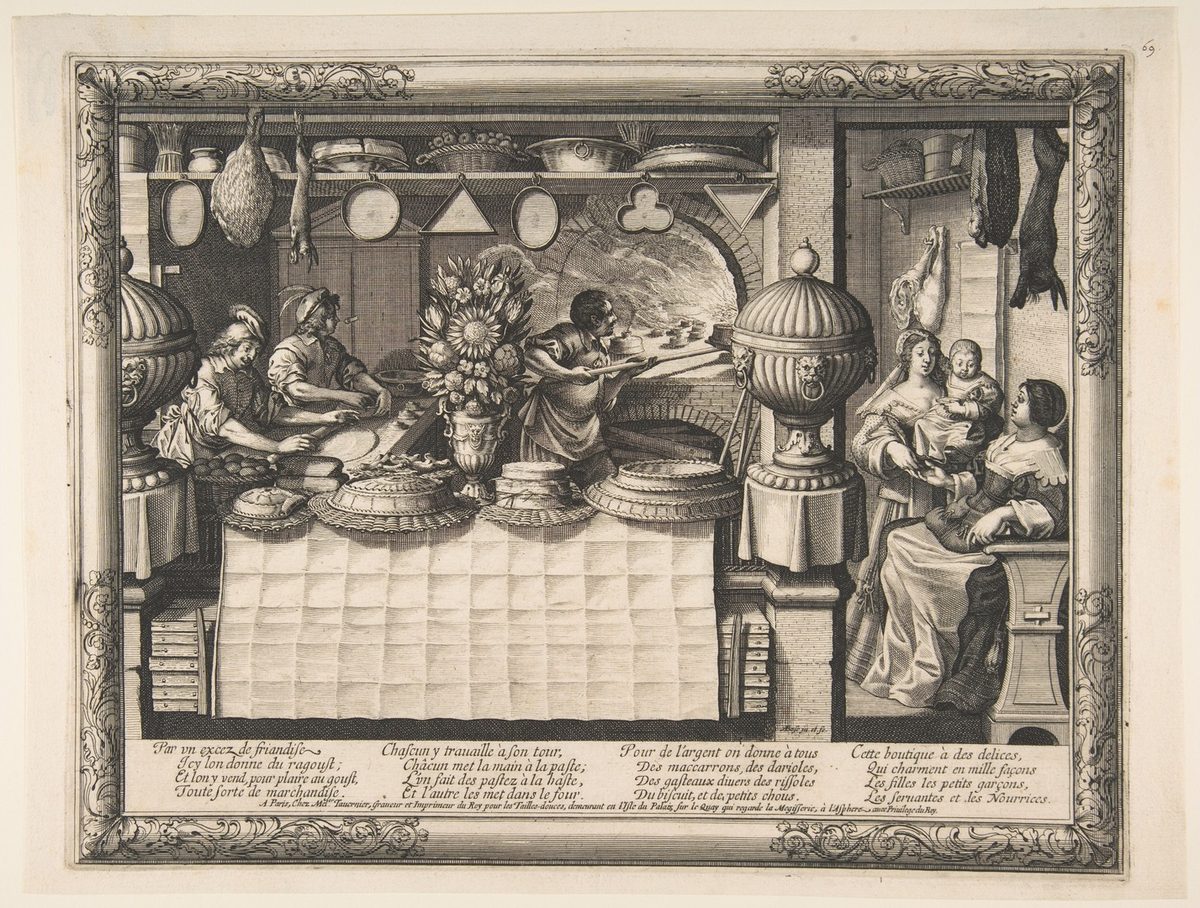
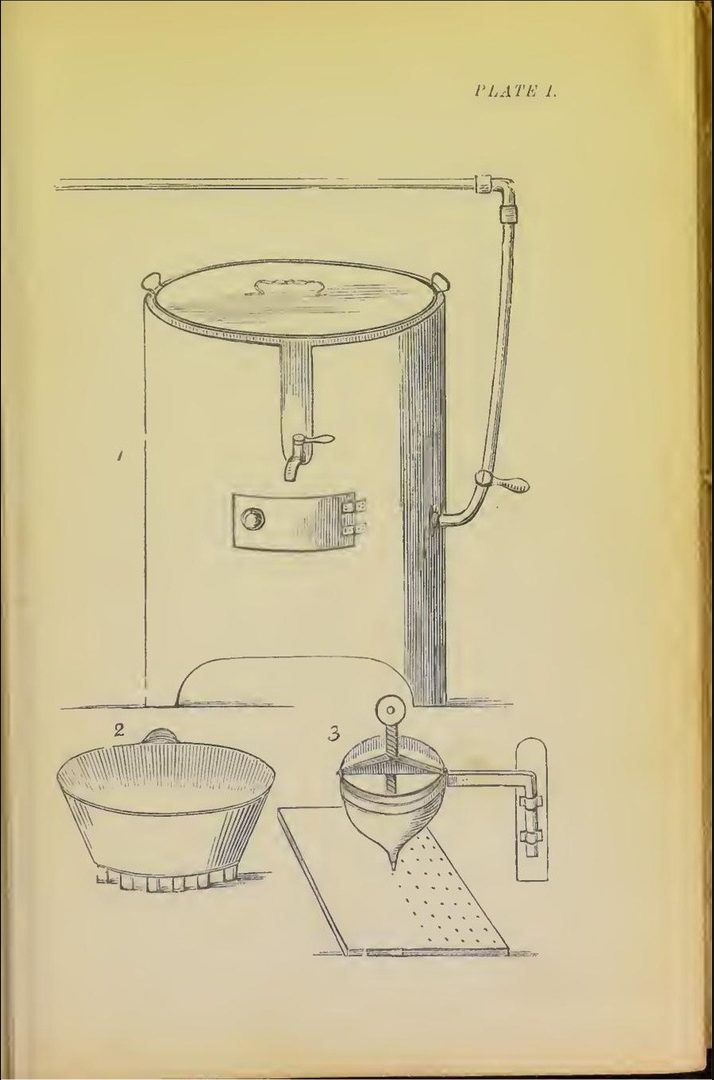
William Alexis Jarrin ran a London confectionery business in the early nineteenth century, and by the third edition of his trade manual, The Italian Confectioner, in 1837, he was describing a device of his own invention: a press for gum paste, the almond-and-sugar modeling compound used for ornamental sugarwork, not for biscuits. Jarrin says plainly that he built it because he was personally mixing sixty to eighty pounds of the stuff every week, and doing it by hand was no longer practical.
The mechanism was simple and entirely about throughput. Paste went into a bag of thick linen, which was then tightened and fixed inside a metal cylinder that had been pierced with holes. Pressure on the bag forced the paste out through the perforations in a controlled, repeatable way — which is the one idea that every cookie press since has kept. Jarrin was not trying to shape anything. He was trying to get a sore-armed afternoon’s work done faster.
Within a generation, confectioners realized the cylinder could shape dough, not just mix it
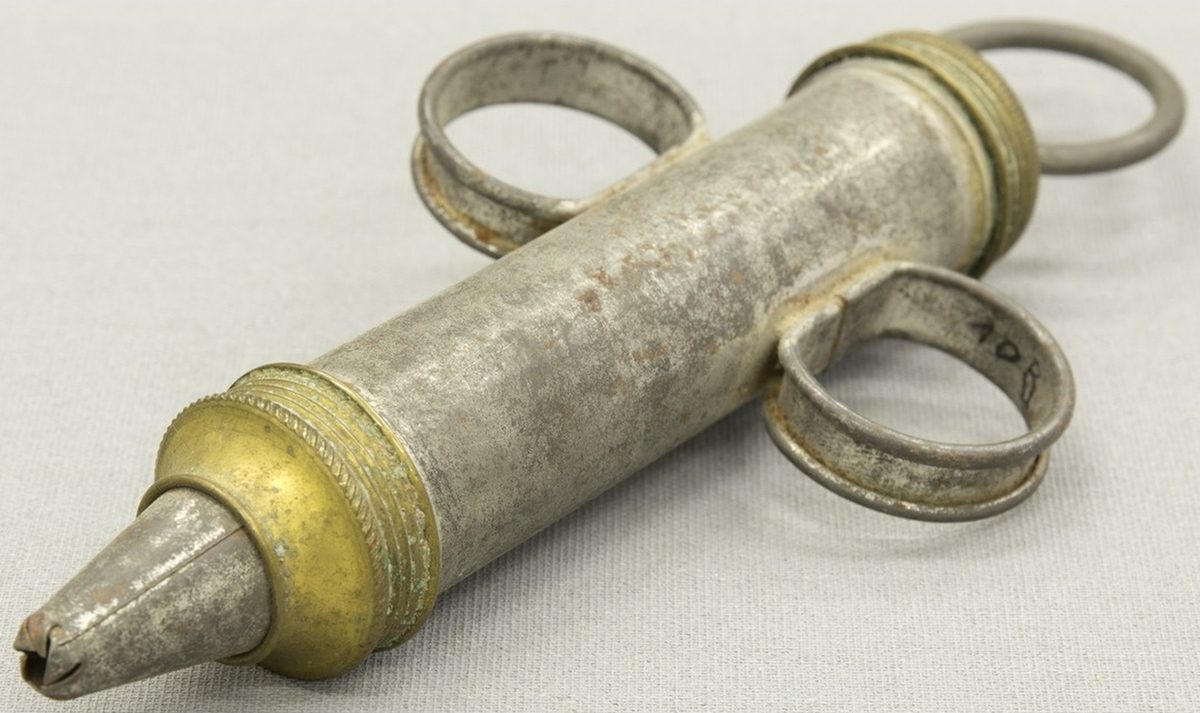
By the 1860s, English pastry manuals had noticed the obvious second use. William Jeanes’s Gunter’s Modern Confectioner, published around 1861, describes what it calls a “pewter syringe”: a barrel-and-handle tool that, when turned, forces almond paste through an ornament-shaped opening at the end. The extruded rope of paste was cut off once enough had come through, and the result was labeled, with the directness of a Victorian recipe book, a “syringe biscuit.” The name borrowed straight from the medical instrument, because the mechanism really was the same one: barrel, plunger, narrow outlet.
This is the point where the tool stops being exclusively about gum paste and starts being, unambiguously, about cookies. It is also still an expensive, specialist piece of equipment — pewter, custom-fitted, built for a working confectioner’s kitchen, not a family’s.
By 1866 the tool already looked like the one in your kitchen drawer
Massey and Son’s Biscuit, Ice, and Compote Book, from 1866, describes something close enough to a modern cookie press that the family resemblance is hard to miss: a tin tube about a foot long and two or three inches across, with a loose, star-stamped metal disc seated on a ledge near the open end, and dough forced through it with a wooden plug that fits the tube like a piston. What comes out is described as a “star corrugated rope,” cut into lengths to make individual biscuits.
The detail that matters most for the object’s later history is a throwaway line: the pattern discs, Massey notes, are removable, so that “a variety of star or other pattern biscuits may thus be obtained” from one tube. That is the interchangeable die — the single feature that turns a bespoke, one-shape tool into a kit. Everything that happened to the cookie press over the next century and a half was really an argument about how cheaply that kit could be made, and for whom.
The device reached ordinary kitchens only once a cheap, castable metal arrived
For decades after Massey’s tin tube, the press stayed a professional confectioner’s tool: pewter or tin, built to order, not something a household owned. What changed that was aluminum, and the change happened in two small Wisconsin towns that were not, at first, in the kitchenware business at all. In 1895 Joseph Koenig started the Aluminum Manufacturing Company in Two Rivers, Wisconsin, after seeing aluminum novelties on display at Chicago’s 1893 Columbian Exposition. Across the river in Manitowoc, Henry Vits set up a competing shop, the Manitowoc Aluminum Novelty Company, making the same kind of thing: stamped aluminum combs and trinkets, not pots or pans.
The two rivals didn’t stay rivals for long. In 1909 Koenig’s firm, Vits’s firm, and a third company from New Jersey merged into the Aluminum Goods Manufacturing Company — known locally, with a certain Midwestern bluntness, as simply “the Goods.” Its first cookware contract, a double boiler built for the Quaker Oats Company starting in 1913, is credited in the company’s own historical account with selling past the billion mark over its run, a figure striking enough that it is worth citing with that caveat attached: it is the company’s own number, not an independently audited one. The brand name that would end up on the cookie press came in 1917, when the merged firm launched its flagship aluminum kitchenware line and called it Mirro.
World War One interrupted the civilian product line almost immediately: the company turned out more than a million canteens and mess kits for American soldiers before returning to bakeware and cookware. By the 1920s, Mirro aluminum was being advertised nationally, in full-page spreads in the Saturday Evening Post, Ladies’ Home Journal, McCall’s, Good Housekeeping, and Better Homes and Gardens — and the Depression hit the company hard enough to be worth noting in numbers: roughly 3,400 employees in 1929, sales down more than 65 percent by 1931, employment cut to 2,500, recovering only to 2,700 by 1933. The cooky press rode out that whole arc as one line among many.

The interchangeable dies turned one bespoke tool into a drawer full of shapes
A surviving Mirro “358-AM Cooky-Pastry Press” in the collection of The Henry Ford museum, dated to the late 1960s, shows exactly how far the idea had traveled from Massey’s one star-stamped disc. Its dies are individually numbered and shaped: a butterfly, a five-point star, two different Christmas trees, a camel, a dog, a sun, a spiral, a simple jagged line. The packaging doesn’t even limit the tool to cookies — it advertises uses for cream puffs, meringue shells, eclairs, and lady fingers, and carries a “Guaranteed by Good Housekeeping” seal, the closest thing a 1960s kitchen gadget had to a warranty.
The basic mechanism Massey described kept getting refined long after Mirro itself stopped making it. A 2002 utility patent, granted in 2004 to inventor Hugh Melling and assigned to Wilton Industries, covers a press with a toothed rod and a spring-loaded advancing mechanism that clicks the plunger forward one notch at a time when a trigger is squeezed — the ratchet action familiar to anyone who has used a modern press one-handed. A patent attorney who wrote about it at the time suggested the spring in that ratchet, more than the plunger-and-disc idea itself, was probably what made the design patentable at all, which is a useful reminder that almost everything else about the object — barrel, disc, extrusion — had been public knowledge for over 130 years by then.
The cookies got a name with nothing to do with geography
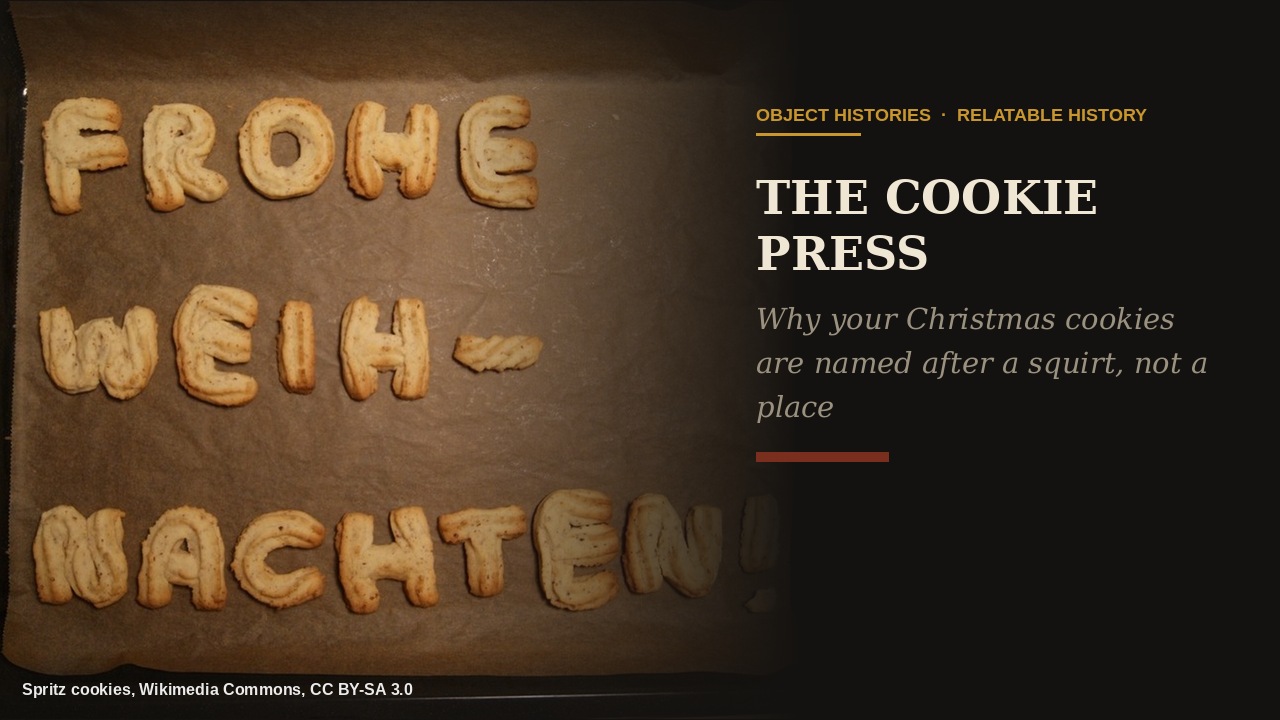
“Spritz” sounds like it ought to name a place, and it doesn’t. It is simply the German verb spritzen, “to squirt” or “to spray” — a description of what the tool does to the dough, not a region, a town, or a family name. The complication is that the squeeze-press tradition the word rode in on was not uniquely German to begin with. Trade-press write-ups from the 1920s, the same decade Mirro was becoming a household name, describe both a German tradition and a separate Swedish one, built around a nearly identical tin cylinder the Swedish sources call a spruta — the Swedish word for syringe, and no relation to the German verb at all beyond the fact that both languages were describing the same mechanical idea. Which word, and which immigrant community, gets credit for popularizing the American English name is genuinely unsettled in the record; what is clear is that German and Scandinavian home-baking traditions both arrived in the American Midwest around the same decades that two Wisconsin aluminum companies, founded by men with German surnames, were building the tool that would mass-produce the cookies. That is likely not a coincidence, even if no single document ties the three threads together with a bow.
What the etymology does settle is the common misreading: there is no village, province, or baker named Spritz. There is only a verb, applied to a dough that gets pushed, not rolled, cut, or shaped by hand.
The company didn’t survive. The object did.
Mirro’s parent company kept growing through the postwar boom, formally renaming itself the Mirro Aluminum Company in 1957. It didn’t last as an independent business much longer than that: Newell Companies bought it in 1983, after what the local historical society puts at roughly ninety years of continuous operation, and gradually moved manufacturing out of Wisconsin entirely. By the early 2000s the Manitowoc operation was gone and more than 880 jobs with it. The company that turned a professional confectioner’s pewter syringe into a mass-market kitchen fixture did not, itself, survive to see the fixture’s bicentennial.
The object outlived its maker. The press is still manufactured, under other brand names, with a mechanism that a Victorian pastry-book author would recognize on sight and a patent examiner was still finding something to refine in 2004. Somewhere between Jarrin’s sore arms in 1837 and the trigger-grip plastic version in a kitchen drawer today, a tool for mixing candy became the single most ordinary way an American household marks the start of December. How many cookies do you think one of those Wisconsin aluminum presses could shape before anyone’s wrist got tired?
Watch the full history
The video walks through the gum press, the Victorian syringe biscuit, and the Wisconsin rivalry that built the modern cookie press, in just under six minutes.

Related reading
- The Kensington Runestone Hoax: What the Evidence Actually Shows
- The History of the Pie Funnel, From Plain Clay Tube to Ceramic Bird
- What Really Happened to the Florentine Diamond
- How to Store Root Vegetables All Winter Without a Cellar
Shop the styles/items featured in this video
- OXO Good Grips 14-Piece Cookie Press Set
- Vintage Mirro Cooky and Pastry Press, with original recipe booklet
Works cited
- Jarrin, William Alexis. The Italian Confectioner; or, Complete Economy of Desserts. 3rd ed. London, 1837. Link.
- Jeanes, William. Gunter’s Modern Confectioner. London, circa 1861.
- Massey and Son. The Biscuit, Ice, and Compote Book. London, 1866.
- Reber, Patricia Bixler. “Syringes and Presses for Fancy Cookies.” Researching Food History, November 13, 2017. Link.
- “A description of a cylinder cookie-press machine for bakers.” Illustrated World, May 1917.
- “Spritz.” Dictionary.com, s.v., citing German spritzen, “to squirt, to spray.” Link.
- Rock, James M. “A Growth Industry: The Wisconsin Aluminum Cookware Industry, 1893–1920.” Wisconsin Magazine of History 55, no. 2 (Winter 1971–72): 86–99.
- “Mirro Aluminum Company.” Dictionary of Wisconsin History, Wisconsin Historical Society.
- Manitowoc County Historical Society. “Aluminum Goods Leaves Many Stories.” June 9, 2017. Link.
- “Mirro Aluminum Cooky-Pastry Press, 1965–1970.” Object ID 2021.173.1. The Henry Ford. Link.
- Brinckerhoff, Courtenay C. “A Delicious Look at a Cookie Press Patent.” PharmaPatents, Foley & Lardner LLP, republished in The National Law Review, December 22, 2015. Link.
- U.S. Patent No. 6,708,853 B1, “Manual Cookie Press” (Hugh Melling, inventor; Wilton Industries, Inc., assignee), filed 2002, issued 2004. Google Patents. Link.