
The spring-loaded mousetrap sold in hardware stores today is, mechanically, the same device an Illinois inventor patented in 1894. A hinged wire bar, a coiled spring, a baited trigger. Nobody has meaningfully improved on it in over a century, despite the United States Patent Office having granted more than four thousand separate patents for alternative rodent traps — more patents than for almost any other category of object in American history. Nearly all of them lost to the one from 1894.
That trap did not appear out of nowhere. It was the end point of roughly a hundred and fifty years in which Britain, and London especially, treated the rat as a full-blown infrastructure problem: an animal that had to be fought with a trade of professional catchers, a black-market gambling economy, a patent arms race, and eventually an Act of Parliament. The trap that finally worked was the least dramatic part of that story, which is rather the point.
London got a bigger, bolder rat in the 1730s, and never got rid of it
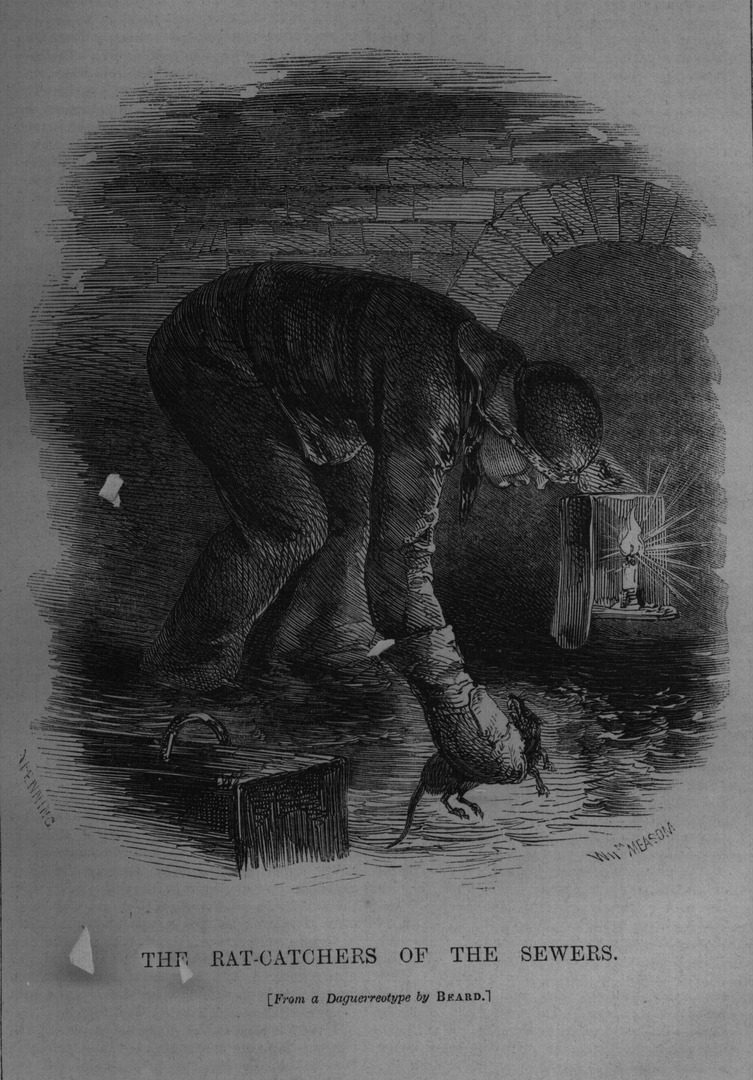
Britain’s rat problem changed species in the early eighteenth century. The rat the country had known for hundreds of years was the black rat, Rattus rattus, a nimble climber that nested in roofs and rigging. Sometime around 1728 to 1730, a second species began turning up in large numbers: the brown rat, Rattus norvegicus, bigger, better at digging, and a strong enough swimmer to colonise sewers and riverbanks the black rat had never used. Genetic work on wild and domestic brown rat populations traces their spread out of Central Asia and into Europe along exactly this kind of shipping-driven timeline, arriving in Britain within a few years either side of 1730.
The common name stuck for the wrong reason. Naturalists in the period assumed the animal had travelled on Norwegian timber ships, so it became the Norway rat, a label that survives in its scientific name even though Norway was barely involved. The English public preferred a more political explanation and nicknamed it the Hanoverian rat, blaming the new German royal house for every fresh misfortune of the 1720s and 30s, rats included. Within a century the brown rat had displaced the black rat from most of urban Britain, and it has not given up the position since.
Before the trap was a machine, it was a man with a cage and a dog
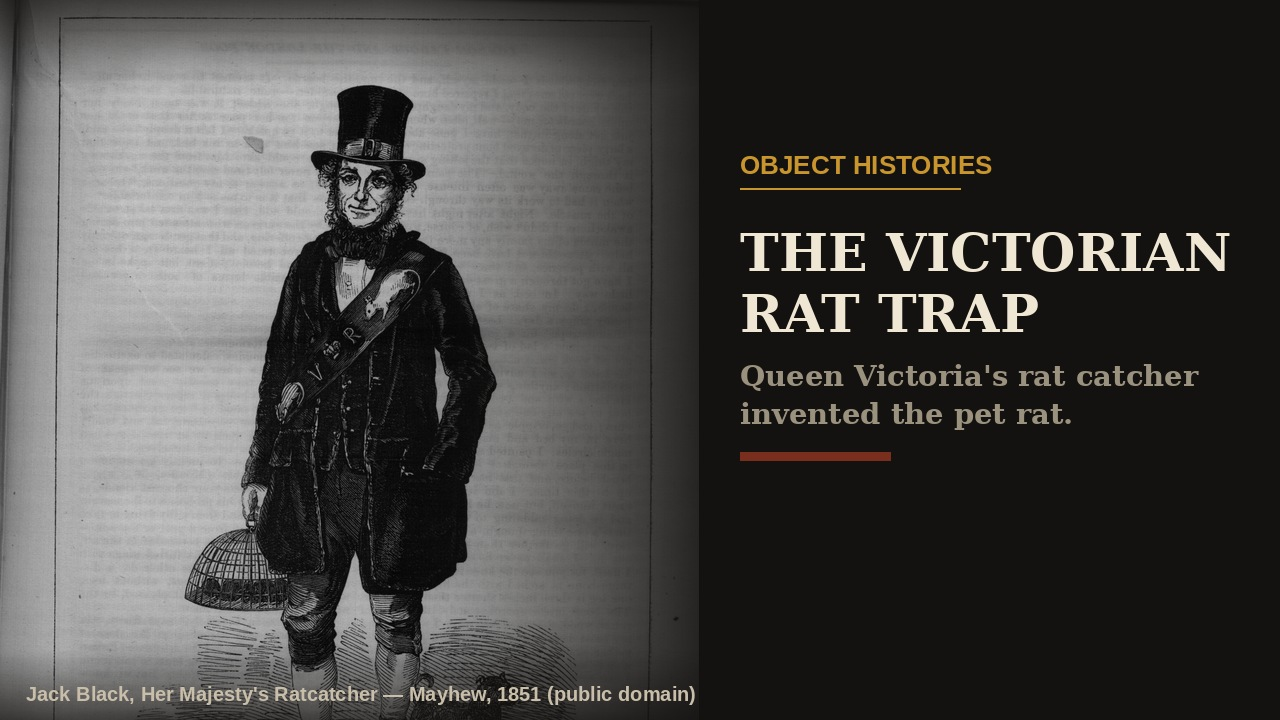
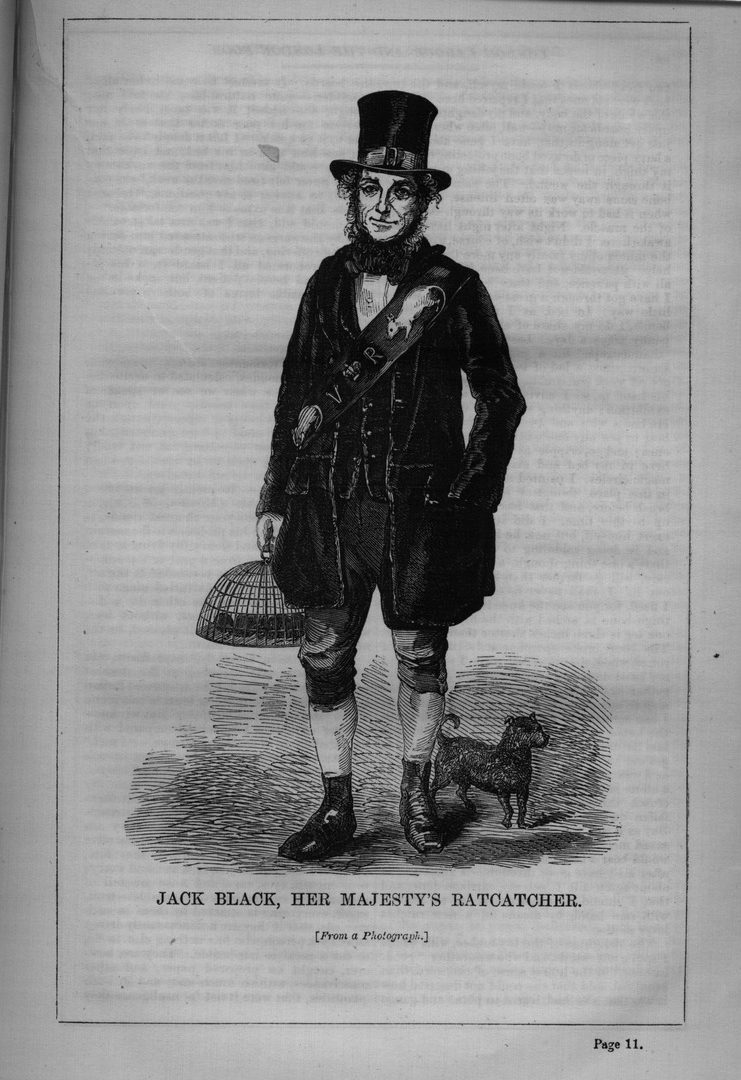
For most of the nineteenth century, London’s front line against rats was not hardware. It was a trade: men who caught rats by hand, for money, and sold the results twice over. The journalist Henry Mayhew, interviewing London’s working poor for a newspaper series later collected as London Labour and the London Poor, spent time with the best known of them in 1851. His name was Jack Black, and his business card, in effect, was his own body: a scarlet waistcoat, a green topcoat, white breeches, and a wide leather belt across his chest studded with cast-iron rats, worn while he worked the streets under the self-appointed title of Rat and Mole Destroyer to Her Majesty.
Black told Mayhew he caught rats bare-handed, reaching into drains and holes and pulling the animals out, and that he had been bitten so often it was routine — on at least one occasion badly enough that the wound turned septic and nearly killed him. He supplemented the catching with a rat poison of his own recipe and sidelines in mole catching and dog breeding. It was a full commercial operation, and the rats were the stock: some destroyed on the spot for a fee, some sold on live.
Live rats had a second market, and it was a betting shop
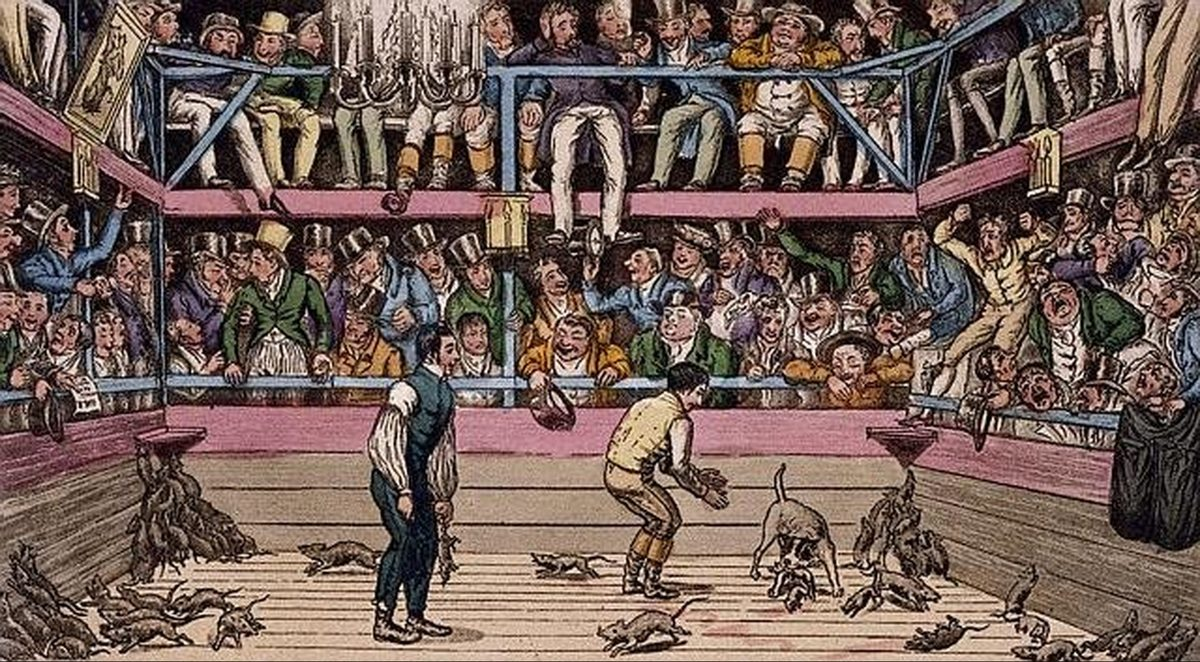
Catchers like Black supplied a specific and lucrative customer: the rat pit. A rat pit was a small boarded arena, often in the back room of a public house, with whitened boards so the rats showed up against the floor. The publican tipped in a set number of rats, dropped in a terrier, and the crowd bet on the clock. One well-known pit owner, Jimmy Shaw, told Mayhew he bought three hundred to seven hundred live rats a week from catchers at threepence a head — a volume that gives some sense of how large this secondary economy actually was.
The dogs that worked the pits became celebrities in their own right, with results reported like sporting records. In October 1822 a bull-and-terrier named Billy killed a hundred rats at the Westminster Cockpit in seven and a quarter minutes; days later he cut that to six and a quarter. By 1823 he had it down to five and a half minutes, a mark that held for nearly forty years until a dog named Jacko, owned by Jimmy Shaw, beat it by two seconds in 1862. The sport survived the 1835 Cruelty to Animals Act, which banned bull-baiting and cockfighting but said nothing about rats, and rat-baiting was not shut down in Britain until the Protection of Animals Act of 1911; the last recorded public match was prosecuted in Leicester in 1912.
Meanwhile, hundreds of inventors were racing to make the catcher obsolete
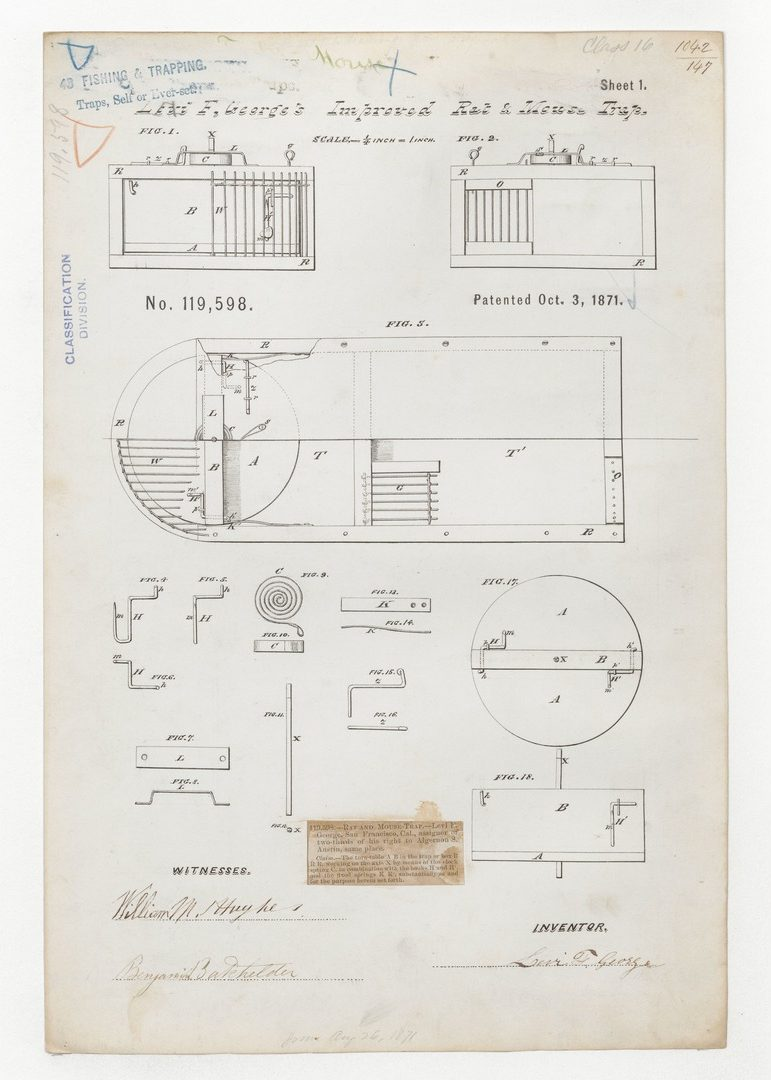
A man and a dog did not scale. What a respectable Victorian household wanted was a device it could set itself, cheaply, without hiring anyone. Through the middle of the century, ironmongers’ catalogues filled up with box traps, funnel cages, and scaled-down jaw traps borrowed from fox trapping, and inventors on both sides of the Atlantic filed patent after patent trying to improve on them. Levi F. George’s 1871 patent for a rat and mouse trap, drawn up with the meticulous cross-sections patent examiners demanded, is a reasonably typical entry from the middle of that race: a mechanically clever design that solved the problem well enough to be patented and not well enough to be remembered.
The design that actually won was filed on 6 June 1894 by William C. Hooker, an inventor from the small town of Abingdon, Illinois. Patent number 528,671 described what he called an animal trap: a flat wooden base, a stiff wire striking bar under spring tension, and a baited trigger plate that released the bar the instant an animal disturbed it. Hooker’s own Animal Trap Company sold it as the “Out O’ Sight” trap, and it worked well enough that the firm was later absorbed into what became the Victor brand, still manufacturing a close descendant of the same mechanism today.
Britain had its own near-simultaneous version. James Henry Atkinson, an ironmonger in Leeds, patented a spring-on-board trap in 1899 that he called the Little Nipper, using a lighter treadle trigger than Hooker’s design. Atkinson sold the patent outright in 1913, for a thousand pounds, to the firm that still makes the Little Nipper in Wales. Between them, the Hooker and Atkinson patents settled the mechanical question so completely that the shape has gone essentially unchanged: a coiled spring doing in a fortieth of a second what a terrier used to take five and a half minutes to do a hundred times over.
Not every competing idea was so restrained. In the 1860s a Sussex carpenter, Colin Pullinger, built and sold a self-resetting “Perpetual Mouse Trap”, a wooden box with a tipping see-saw floor that dropped each catch into a holding chamber and reset itself for the next, unattended; he claimed it could clear a house overnight and employed forty men to build them. Poison sold alongside the hardware, most famously an arsenic compound called Rough on Rats, launched by a Jersey City chemist in the 1870s under a slogan of startling directness: “Don’t die in the house.”
The rat stopped being a nuisance and became a public-health emergency
What tipped rat catching from a household chore into a legal obligation was medicine, not engineering. Research into the spread of bubonic plague in the 1890s and 1900s established that rats and the fleas they carried were the vector, and British public health officials, watching the third plague pandemic move through Asian and American port cities, took the finding seriously at home. The result, after the First World War, was the Rats and Mice (Destruction) Act 1919, which placed a legal duty on every occupier of land in Britain — a term the Act defines to include the buildings on it — to destroy rats and mice on their property and prevent it becoming infested, with the threat of a fine for anyone who ignored the notice of a local authority. The same Act put an official machinery behind an annual National Rat Week, a coordinated push each autumn asking every household and business to bait and trap at once, on the theory that scattered, individual effort could never outpace a population that breeds as fast as rats do.
That is a genuinely unusual thing for a piece of legislation to do: it does not ban an object, the way the shofar was once banned at the Western Wall, or license a trade. It conscripts an entire population into pest control as a civic duty, on public-health grounds, backed by a household object anyone could buy for a few pence. The 1919 Act stayed in force, with modifications, until it was folded into the Prevention of Damage by Pests Act in 1949.
The trade end of the story is stranger than the trap end
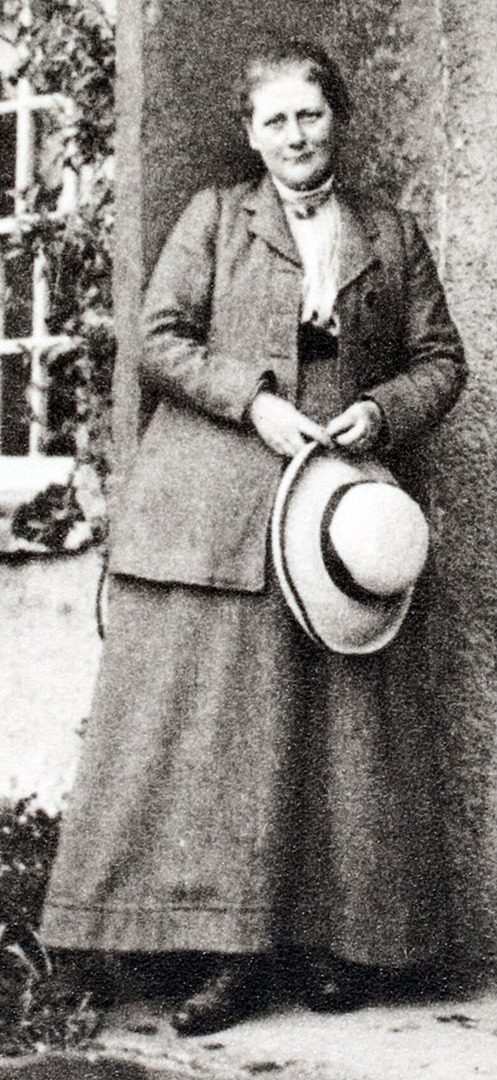
Not every rat that passed through a catcher’s hands was destined for a pit or a pail of poison. Jack Black told Mayhew that he occasionally pulled an odd-coloured rat out of a drain — white, piebald, fawn — and rather than kill it, bred from it and sold the offspring as curiosities: to gentlemen for the mantelpiece, to young ladies to keep in a cage. It is the earliest documented account of rats being deliberately bred and sold as pets, and the hobby that grew out of it eventually got a name, the fancy, and a founder: Mary Douglas, who arranged the first rat classes at a show in Aylesbury in 1901 through the National Mouse Club, and who is remembered by the society she helped found as the mother of the rat fancy. Among the trade’s customers, by her own account, was the author Beatrix Potter, whose pet rat Sammy she memorialised in the dedication to The Tale of Samuel Whiskers in 1908, describing him as “the intelligent pink-eyed representative of a persecuted but irrepressible race.”
So the object that answers “who invented the mousetrap” is really the tidy ending to two separate stories that ran side by side for a century. One is an engineering problem, solved twice, almost identically, by two men working independently a few years apart, and barely touched since. The other is a human trade — catchers, gamblers, breeders, and eventually a Parliament worried about plague — that the spring trap was built specifically to make unnecessary, and never quite managed to.
Watch the full history
The video traces the same hundred and fifty years through the men and dogs who did the catching before the trap took over.

Related reading
- Drying Fruit and Herbs: How a Farm Kept Food Without a Freezer | Old Ways
- How a Smokehouse Cured a Year’s Worth of Meat With Only Salt, Smoke, and Time
- Wax Cylinder Recordings: How an Office Machine Ended Up Saving Languages
- How Icehouses Worked Before Refrigeration: The Physics, the Industry, and the People Who Cut the Ice
Works cited
- Puckett, Emily E., et al. “The Origins of Domestic Brown Rats (Rattus norvegicus) and Their Pathways to Domestication.” Evolutionary Applications, 2020. Link.
- Mayhew, Henry. London Labour and the London Poor, Volume 3. 1861. The profile of Jack Black, “Rat and Mole Destroyer to Her Majesty,” is in the section on street-folk who work with animals. Link.
- Zieger, Susan. “Rat-Catcher’s Prank: Interspecies Cunningness and Scavenging in Henry Mayhew’s London.” Journal of Victorian Culture 19, no. 4 (2014): 520-533.
- “The Rat Pits of London.” Shooting Times, 26 May 2013. Link.
- Burt, Jonathan. Rat. Reaktion Books, 2006.
- National Fancy Rat Society. “The Foundation of the National Fancy Rat Society.” Link.
- Potter, Beatrix. The Tale of Samuel Whiskers, or, The Roly-Poly Pudding. Frederick Warne & Co., 1908. Dedicated “in remembrance of ‘Sammy.’” Link.
- Hooker, William C. “Animal Trap.” US Patent 528,671, filed 6 June 1894. Link.
- “The ‘Little Nipper’ Mousetrap — James Henry Atkinson.” MyLearning, Leeds Museums & Galleries. Link.
- Rats and Mice (Destruction) Act 1919, 9 & 10 Geo. 5, c. 72. Link.