
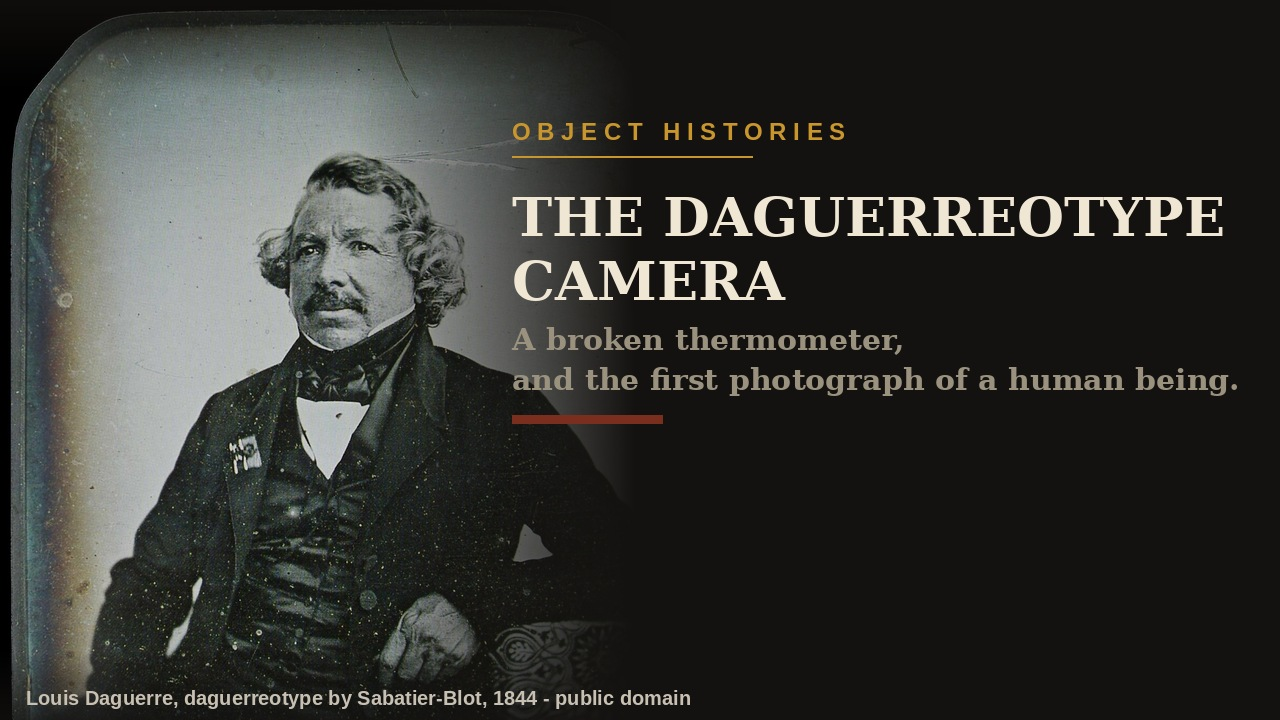
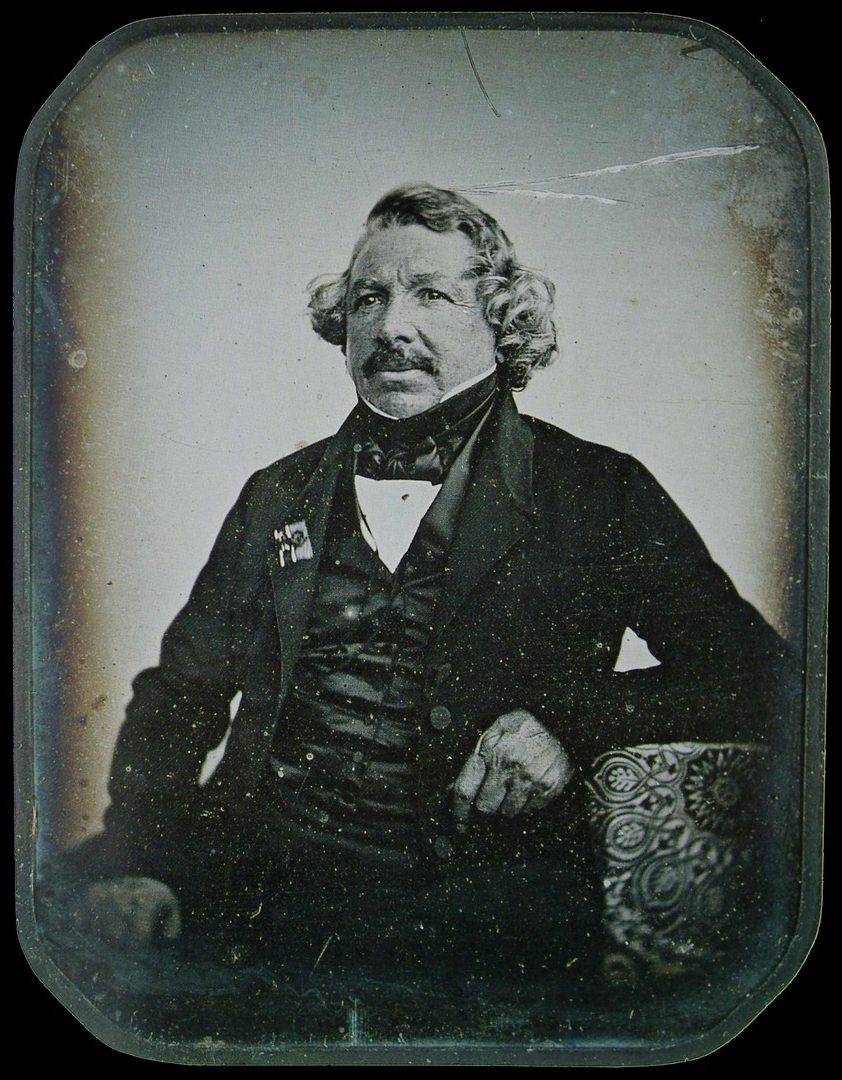
For twenty years, the only way to make a photograph was to hold a freshly exposed silver plate over an open dish of mercury heated to roughly 75 degrees Celsius and breathe whatever came off it. There was no safer method available, no alternative chemistry, and no warning label. The picture that resulted — sharp, luminous, unrepeatable — was called a daguerreotype, and for two decades it was the only photograph the world had.
The process is usually summarized as a single triumphant moment in 1839. In practice it was a specific, demanding sequence of steps, each one unforgiving, and understanding what actually happened inside the camera and the developing box explains both why daguerreotypes look the way they do and why almost nobody kept making them past 1860.
A mirror sensitized to light, then developed in poison
A daguerreotype begins with a sheet of copper electroplated with silver, buffed to a true mirror finish — any scratch or haze shows up in the final image, so polishing alone could take the better part of an hour. The polished plate was then placed face down over a container of iodine crystals in a closed box. Iodine vapor reacted with the silver surface to form a thin coating of light-sensitive silver iodide, and the plate had to go into the camera within minutes, before the coating degraded.
Exposure in the camera produced no visible picture. What existed on the plate afterward was a latent image, invisible to the eye, and the step that made it appear was the dangerous one: the exposed plate was suspended face-down over a pan of mercury heated until it gave off vapor, inside a wooden fuming box with a small window to watch the image emerge. The mercury vapor bonded selectively with the areas of the plate that had been struck by the most light, building up a fine amalgam that scattered light differently from the bare silver around it. That difference in reflectivity is the entire image. A daguerreotype has no ink, no dye, and no pigment; it is a topography of mercury sitting on a mirror, and it has to be tilted at the right angle to the light before a viewer can see anything on it at all. The final step was to fix the plate in a sodium thiosulfate bath so it would stop reacting to light, then often to gild it lightly and seal it under glass, since the surface is soft enough to wipe away with a fingertip.
Nobody, including Daguerre, ever fully explained how he found the mercury trick
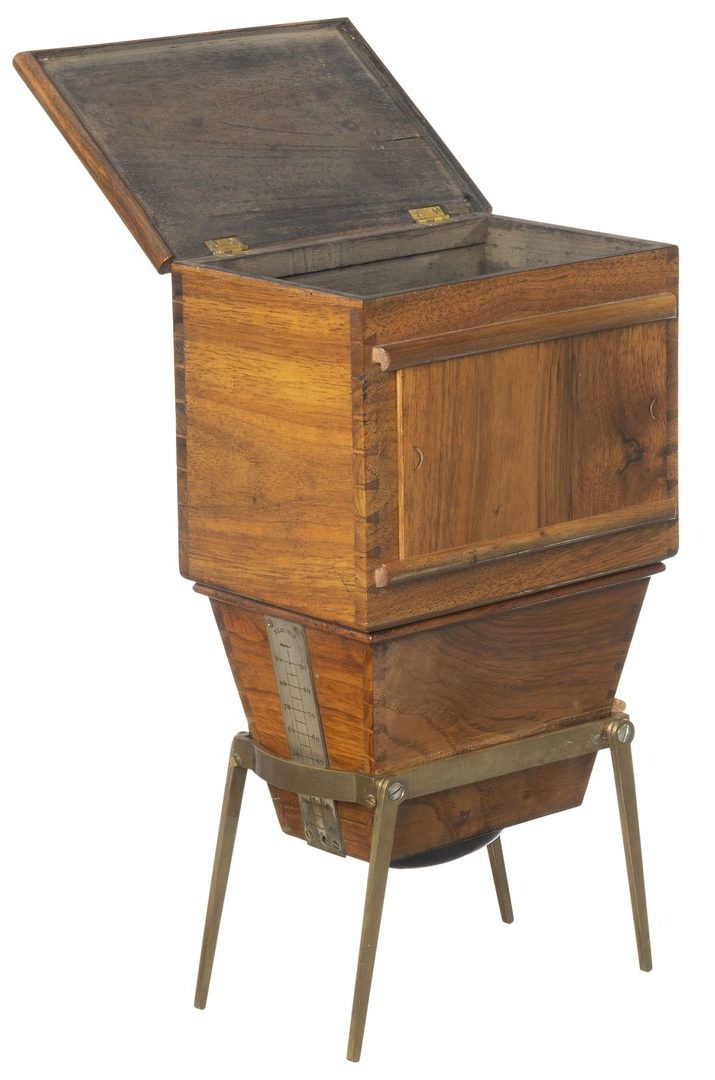
Louis-Jacques-Mandé Daguerre was not a chemist. He ran the Diorama, a Parisian theater built around enormous painted scenes and shifting light effects, and he had been chasing a way to fix the fleeting image in a camera obscura since the 1820s. In 1829 he partnered with Nicéphore Niépce, who had already produced a crude but real permanent image in 1826 using a process he called heliography. Niépce died in 1833 without a practical method, and Daguerre kept working alone for years afterward.
The mercury-development step is the crux of what made the process usable, and its discovery is usually told as a single accident: Daguerre supposedly left an underexposed plate in a chemical cupboard and returned days later to find a fully developed image on it, then hunted through the cupboard’s contents to find the cause. Which item gets blamed varies by the telling — a broken thermometer leaking mercury is the most common version, though other retellings point to a bowl of mercury or spilled mercury salts. What none of the surviving accounts agree on is the specific object, which is a reasonable sign that the story was cleaned up for public consumption sometime after the fact rather than recorded as it happened. Daguerre’s own laboratory notes and early experimental plates were mostly destroyed when the Diorama burned down in March 1839, so the earliest documentation that might have settled the question no longer exists.
France bought the invention and gave it to the world, with one exception
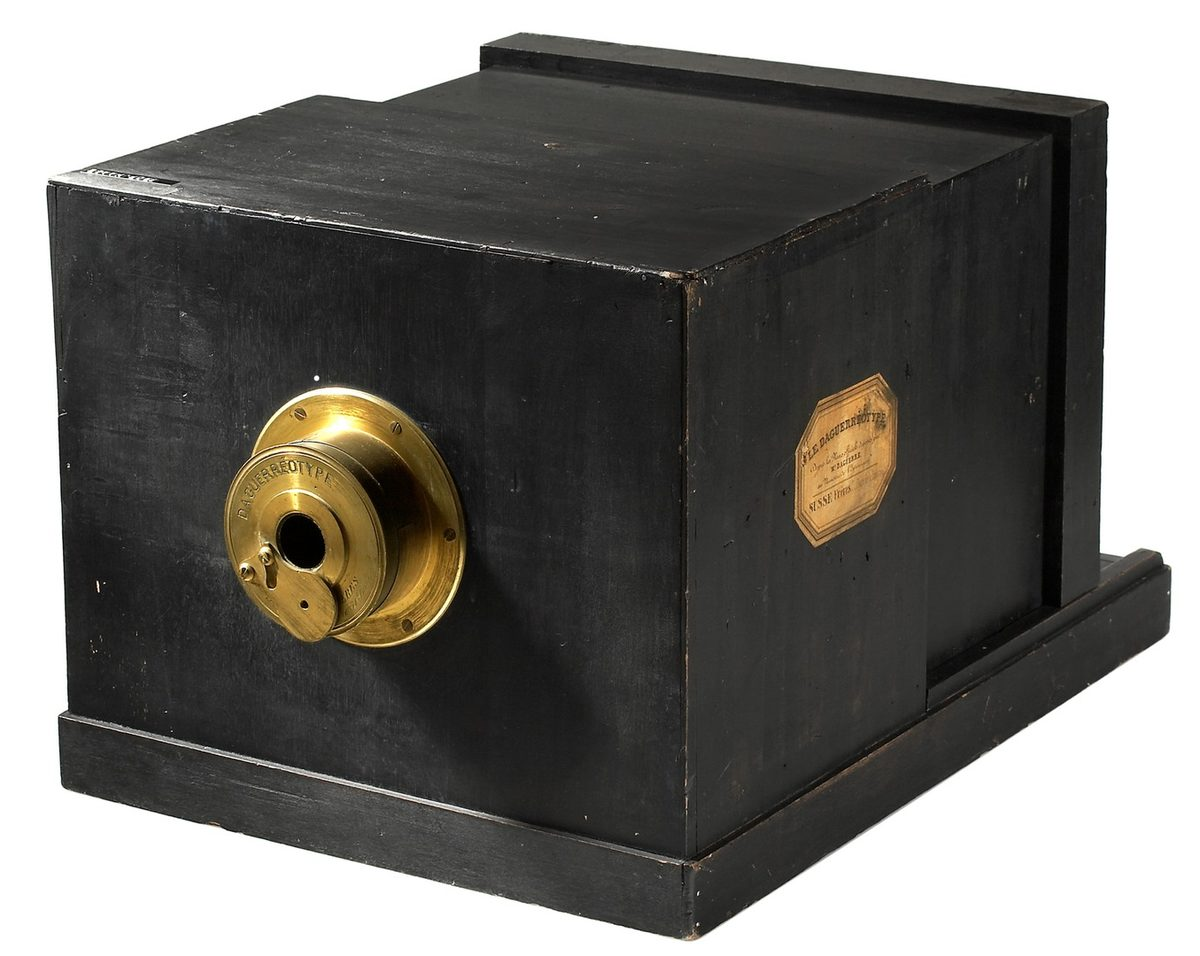
Daguerre went public in stages. On 7 January 1839 the astronomer François Arago showed sample daguerreotypes to the French Académie des Sciences without disclosing the method, which set off seven months of speculation in the Paris press. Arago, who sat in the Chamber of Deputies as well as the Académie, then arranged something unusual: the French state would buy the process outright, in exchange for a lifetime pension to Daguerre and a smaller one to Niépce’s son Isidore, and release the full method to the world for free. The complete instructions were read out at a joint session of the Académie des Sciences and the Académie des Beaux-Arts on 19 August 1839, with a crowd spilling into the courtyard outside to hear it.
Free to the world had one carve-out. Days before the August announcement, Daguerre’s agent quietly filed an English patent on the process, so any British daguerreotypist had to pay a licensing fee that photographers everywhere else avoided. That single administrative decision is a real part of why the craze that overtook Paris within months, and the United States within about a year, was slower to take hold in Britain.
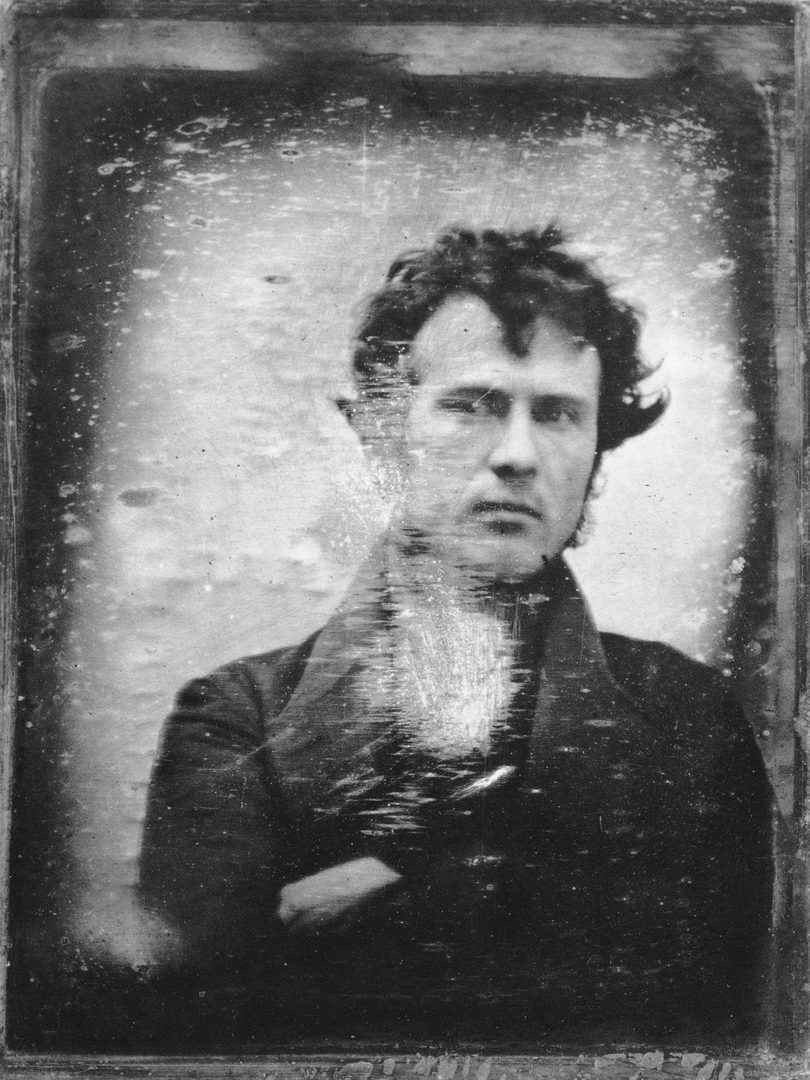
The first exposures took twenty minutes; a decade later they took seconds
The lenses fitted to the earliest daguerreotype cameras were slow, and the plates themselves were not very sensitive, so an exposure in full daylight could run from two minutes to twenty or more. That is the entire reason Daguerre’s own 1838 view of the Boulevard du Temple, ordinarily one of the busiest streets in Paris, shows an empty road: pedestrians and carriages moved across the frame too quickly to register, and the one figure who does appear, a man having his boots polished, simply held still in one spot long enough to be recorded. In Philadelphia in October 1839, a young lamp-store owner named Robert Cornelius built his own camera from a box and an opera-glass lens, walked into his back yard for the light, and sat for what is generally accepted as the oldest deliberate photographic portrait made in the United States — a pose he had to hold for roughly ten to fifteen minutes.
Portraiture at that exposure length was barely tolerable and sitters needed a hidden clamp behind the head just to stay still, which is a real part of why so many surviving daguerreotype faces look grim rather than relaxed. The fix arrived within two years: in 1840 the mathematician Joseph Petzval, working in Vienna, calculated a portrait lens roughly twenty times faster than the simple lenses Daguerre had used, and the optical firm Voigtländer built it into an all-metal camera in 1841. Combined with more sensitive plate chemistry developed in the same period, exposure times fell from minutes to well under a minute, and studio portraiture went from a novelty to a genuine business almost overnight.
Ventilate your mercury, one period manual actually warned
None of that solved the problem sitting at the center of the whole process: to develop a single plate, a daguerreotypist had to lean over an open source of heated mercury vapor, day after day, in a studio that was rarely built with anything like modern ventilation in mind. Mercury vapor is a neurotoxin that passes easily from the lungs into the bloodstream and accumulates with repeated exposure, and an open container of mercury evaporating at room temperature in an unventilated space can reach airborne concentrations dramatically above what would now be considered a safe workplace limit, before the mercury is ever deliberately heated to speed up development. Chronic low-level exposure of the kind a working daguerreotypist accumulated over years is associated with tremor, irritability, memory trouble, gum disease and loosened teeth, and kidney damage. One period trade guide put the danger plainly enough to be quoted since: readers were told to ventilate their mercury, because its fumes carried rheumatism, sciatica, and decrepitude along with the picture. There was no equivalent warning for the operators who later added bromine and chlorine fumes to their sensitizing routine to shave further seconds off exposure times, which introduced a second set of hazards on top of the first.
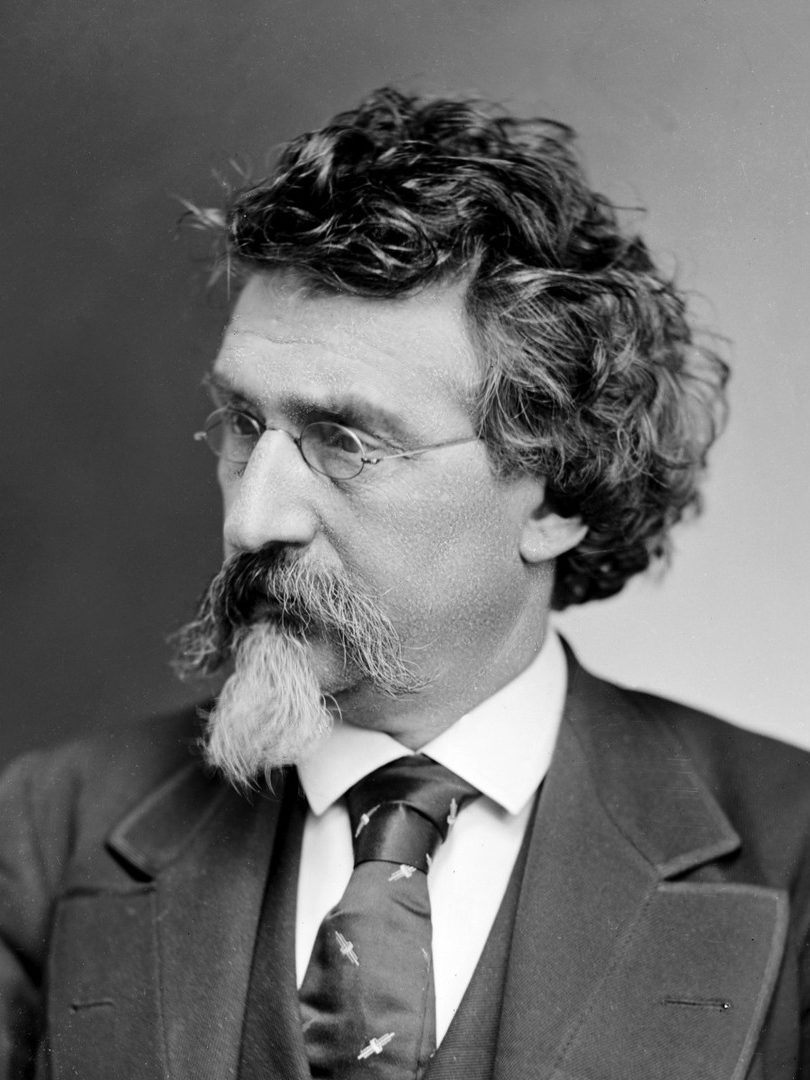
America took to the daguerreotype harder than anywhere else
The process spread from Paris outward within the year, but the United States adopted it with a particular intensity. The world’s first dedicated commercial portrait studio, run by Alexander Wolcott and John Johnson using a mirror-based camera of Wolcott’s own design, opened in New York in March 1840. Mathew Brady, later famous for photographing the Civil War, opened his first Broadway gallery in 1844 and by 1851 was taking top honors for his daguerreotype portraits at the Great Exhibition in London’s Crystal Palace, the same year he expanded into a second, more lavish New York studio. Prices fell fast as competition grew, putting a portrait within reach of people who would never have commissioned a painting, and the volume produced was enormous: in France alone, platemakers used more than five and a half tons of silver in a single year at the medium’s peak, nearly all of it destined to become portraits.
Every one of those plates was a singular object. Because the daguerreotype process produces a direct positive rather than a negative, there was no way to print copies; the plate that sat inside the camera during the sitting is the only picture that will ever exist of that exact moment. That is a large part of why surviving daguerreotypes were kept sealed behind glass in small hinged cases, treated more like lockets than like the disposable paper prints that would soon replace them.
A cheaper, faster process ended it within a decade
The daguerreotype’s dominance did not fade gradually; it was displaced. In March 1851 the English sculptor and photographer Frederick Scott Archer published the wet collodion process in the journal The Chemist, describing how to coat a glass plate with light-sensitive collodion, expose it while still wet, and produce a negative capable of yielding any number of paper prints in a fraction of the exposure time a daguerreotype needed. Archer, like Daguerre’s own government patrons a decade earlier, declined to patent it and gave the method away outright; unlike Daguerre, he gained nothing from it and died in 1857, six years later, in poverty. The daguerreotype could not compete with a process that produced reproducible prints at a fraction of the cost, and by the end of the 1850s it had all but disappeared from commercial use, surviving only with a handful of holdouts into the following decade.
Watch the full history
The video version covers Niepce and Daguerre’s partnership, the 1839 announcement, and the American portrait boom in about seven minutes.

Related reading
- Who Invented the Mousetrap? The Rat War That Made It Necessary
- Drying Fruit and Herbs: How a Farm Kept Food Without a Freezer | Old Ways
- Wax Cylinder Recordings: How an Office Machine Ended Up Saving Languages
- How Icehouses Worked Before Refrigeration: The Physics, the Industry, and the People Who Cut the Ice
Works cited
- Daniel, Malcolm. “Daguerre (1787–1851) and the Invention of Photography.” Heilbrunn Timeline of Art History. The Metropolitan Museum of Art, October 2004.
- Daniel, Malcolm. “The Daguerreian Age in France: 1839–55.” Heilbrunn Timeline of Art History. The Metropolitan Museum of Art, October 2004.
- Barger, M. Susan, and William B. White. The Daguerreotype: Nineteenth-Century Technology and Modern Science. Johns Hopkins University Press, 1991.
- “Daguerreotype Photography.” Collection Highlights, The Franklin Institute. Link.
- “Replica of 1840 Voigtländer, World’s First Metal Camera.” National Museum of American History, Smithsonian Institution.
- “[Robert Cornelius, self-portrait; believed to be the earliest extant American portrait photo].” Not an Ostrich: & Other Images from America’s Library. Library of Congress.
- Shumard, Ann. “Antebellum Portraits by Mathew Brady.” National Portrait Gallery, Smithsonian Institution, 2017.
- Harding, Colin. “A is for… Frederick Scott Archer, inventor of the wet-collodion process.” National Science and Media Museum Blog, 3 October 2012. Link.
- Grigonis, Hillary K. “A painter shut himself in a lab for two years trying to record light. A broken thermometer changed everything.” Digital Camera World, 15 August 2026. Link.