
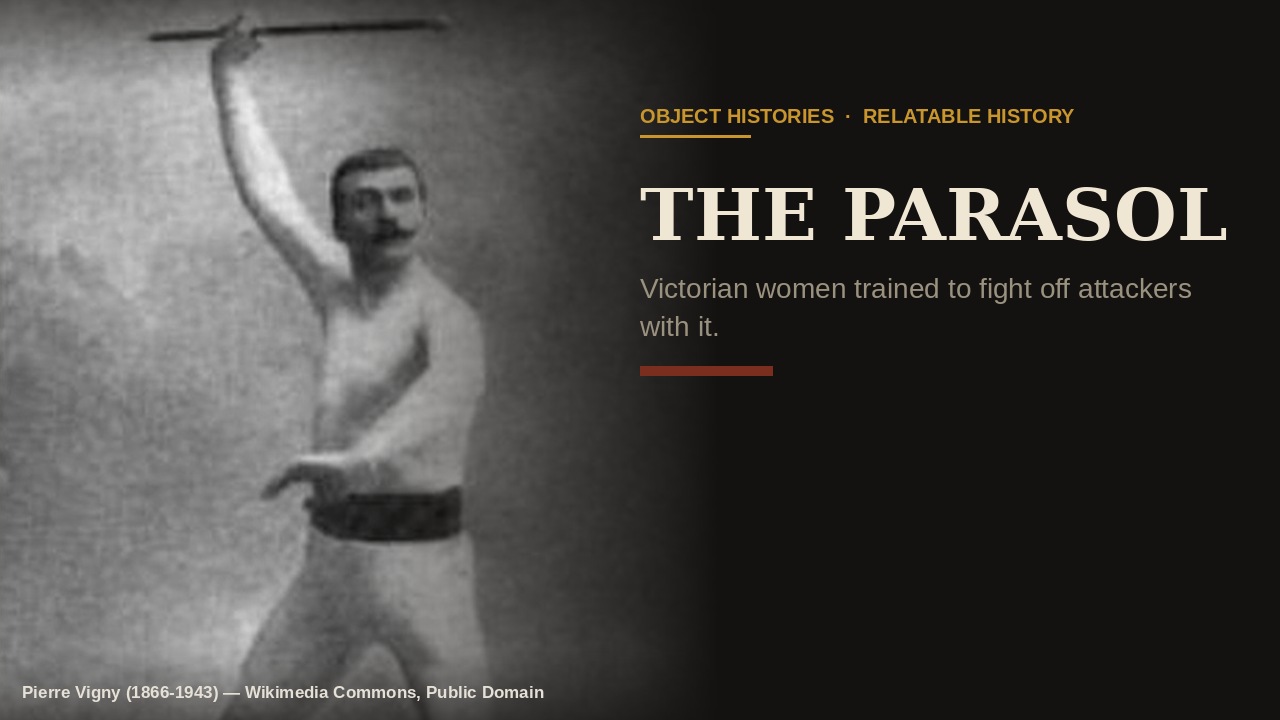
In the summer of 1899, a French fencing master named Pierre Vigny began teaching a self-defense system in London built around the one object nearly every respectable Englishwoman already carried: a folded parasol. By 1908 his own assistant, known in the press only as Miss Sanderson, was running women-only classes in it, and newspapers described her students as “capable with the stick as the sword.” None of that made the parasol a weapon. It only exposed one, because the steel-ribbed frame inside a mass-produced Victorian parasol was perfectly built to take exactly the kind of blow Vigny was teaching women to deliver.
That is the strangest chapter in a much older story, because for most of its documented history this object had nothing to do with rain, sunburn, or self-defense. It was a portable marker of who was, and was not, allowed to stand in manufactured shade, and in several civilizations that distinction was written directly into law. The parasol spent roughly four thousand years as an instrument of rank before it spent two decades as an instrument of resistance, and the second use only makes sense once you understand the first.
Here is how an object this simple ended up regulated by Chinese statute, written into a Burmese king’s official title, fought over by a London hackney-coach trade, and finally handed to suffragettes as a genuinely practical piece of street armor.
Egypt and Assyria carved the sunshade into a monopoly on rank
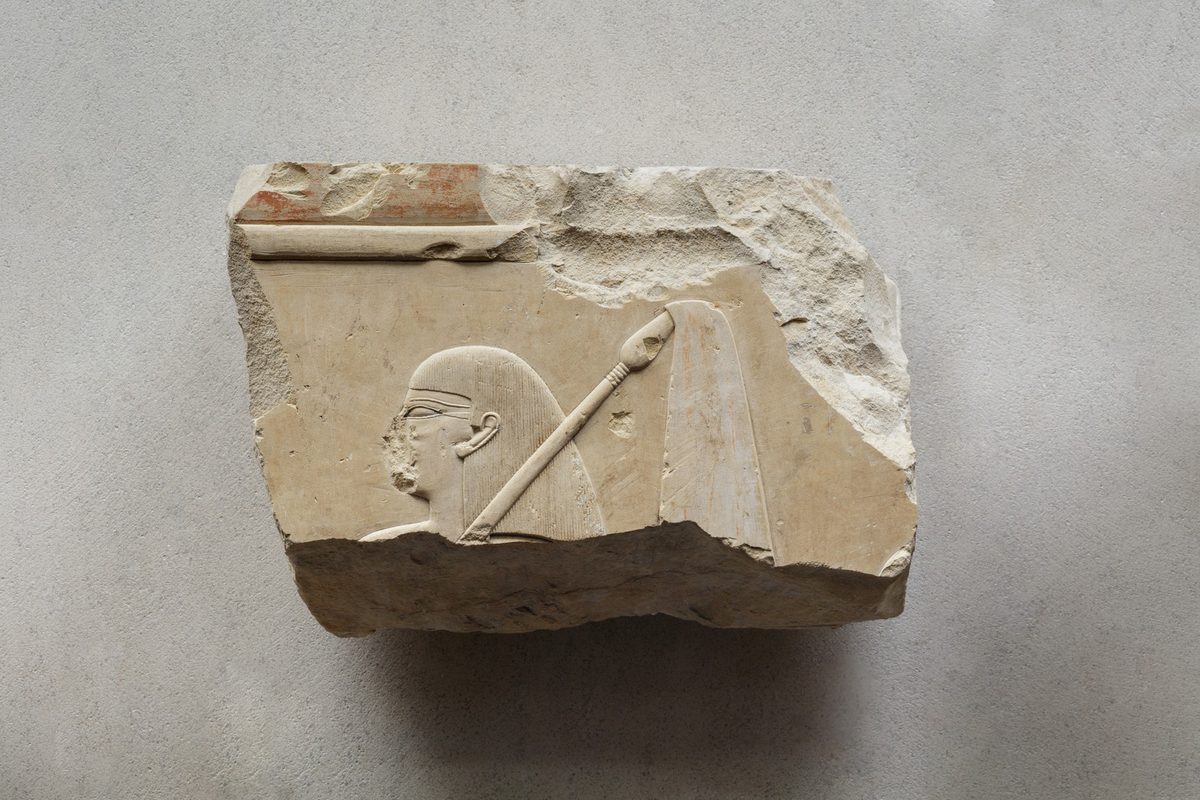
The earliest clear evidence for a handheld sunshade comes from Egyptian tomb reliefs of the Middle Kingdom, around 2051–2030 BCE, which show attendants holding a shade on a pole over royalty and over no one else. A relief from the tomb of Queen Neferu at Deir el-Bahri, now in the Metropolitan Museum of Art, shows exactly this: a servant, not the queen, doing the work of staying in the sun so someone more important didn’t have to.
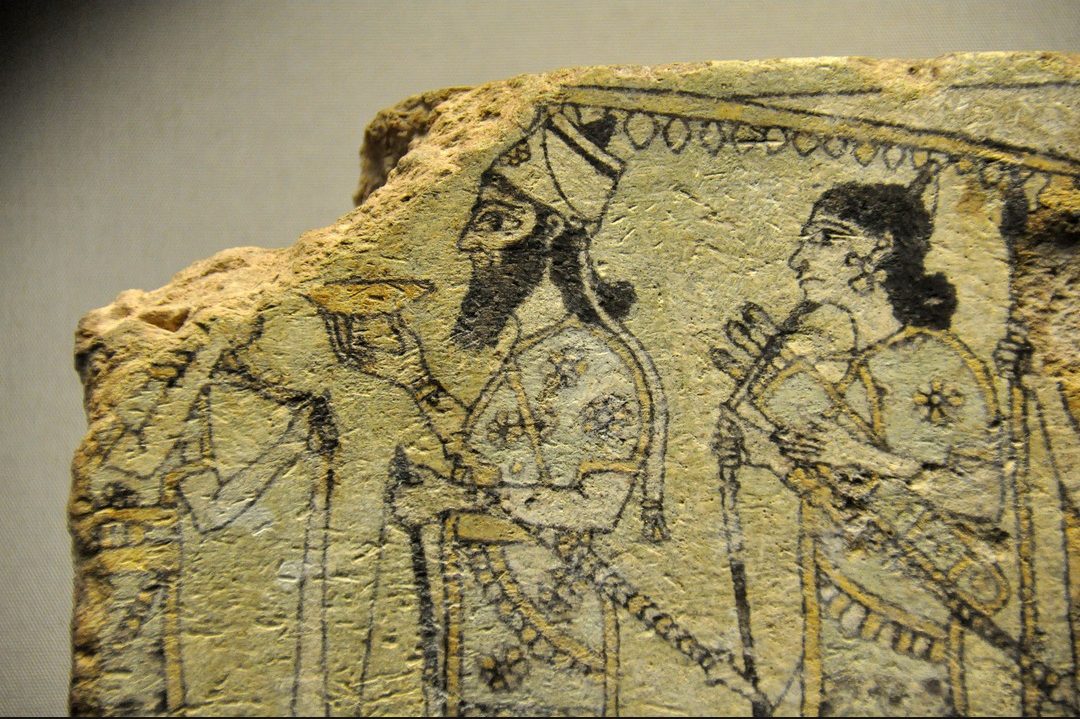
Assyria made the same point in stone a few centuries later, and made it more pointedly. A glazed tile from the palace at Nimrud, carved around 875–860 BCE and now in the British Museum, shows King Ashurnasirpal II celebrating after a bull hunt while an attendant holds a parasol over him. The nineteenth-century excavator Austen Henry Layard, who uncovered these reliefs, noted the pattern across dozens of similar scenes: the parasol was reserved exclusively for the monarch and was never shown borne over anyone else. A sunshade carved onto a palace wall wasn’t weather protection. It was signage, built to be read by anyone looking at the stone from across the courtyard.
China, Burma and Siam turned the same idea into actual statute
Later governments stopped relying on carved symbolism and simply wrote the rule down. The Great Ming Commandment, the foundational Ming dynasty legal code, devoted an entire article — Article 51 — to listing the types of dress, caps, parasols, burial plots and even bed curtains appropriate to each rank of subject, according to historian BuYun Chen’s study of Ming dress reform. Which precise material or color a parasol had to be at each rank is less completely documented than the clothing provisions in the same code, but the structure is unambiguous: in Ming China, the shade over your head was a legal category, not a consumer choice.
Southeast Asian monarchies went further and folded the object into the throne itself. The king of Burma held the formal title “Lord of the Twenty-Four Umbrellas,” with the exact number of tiered umbrellas permitted over his head fixed by royal protocol; an 1855 letter from the Burmese court even styled the king as ruler over “all the great Umbrella-wearing chiefs,” treating umbrella rank as a shorthand for the whole aristocracy. In neighboring Siam, the seventeenth-century French envoy Simón de la Loubère recorded that only the king could use a multi-tiered umbrella; nobles were limited to a single canopy of painted cloth. A nine-tiered white umbrella marking the Siamese monarch alone is a tradition still visible in Thai royal ceremonies today.
Europe imported the custom through popes, traders and the Silk Road
Europe picked up the habit comparatively late, and through the same channels that carried silk and porcelain. Medieval popes processed under ceremonial canopies held by attendants, a practice echoed in Renaissance depictions of the (later exposed as forged) legend of the Donation of Constantine. French gem trader Jean-Baptiste Tavernier documented royal processions in Tonkin, present-day Vietnam, dense with ceremonial umbrellas as early as 1679, and brought detailed firsthand accounts home with him. By the following century, aristocratic European women had begun carrying sun parasols of their own, adopting an accessory that had traveled the same maritime and overland trade routes as the luxury goods it was starting to accessorize.
For a long stretch after that, umbrella and parasol were effectively one word doing two jobs, used without distinction for rain or sun alike. English eventually split the two meanings apart, and it took one unusually stubborn Londoner to do it.
One philanthropist spent thirty years splitting ‘umbrella’ from ‘parasol’
Jonas Hanway, a philanthropist best known for founding the Magdalen Hospital, is credited as the first man to carry a rain umbrella habitually through London’s streets, beginning around 1750. According to William Sangster’s 1855 history of the umbrella trade, Hanway died in 1786 after having carried one for roughly thirty years — meaning he endured three decades of public mockery for it. Sangster records that umbrellas were, for a time, objects of open derision, “especially from the hackney coachmen, who saw in their use an invasion on the vested rights of the fraternity”: a pedestrian who could stay dry under his own umbrella had no reason to hire a cab in the rain, which threatened an entire trade’s livelihood.
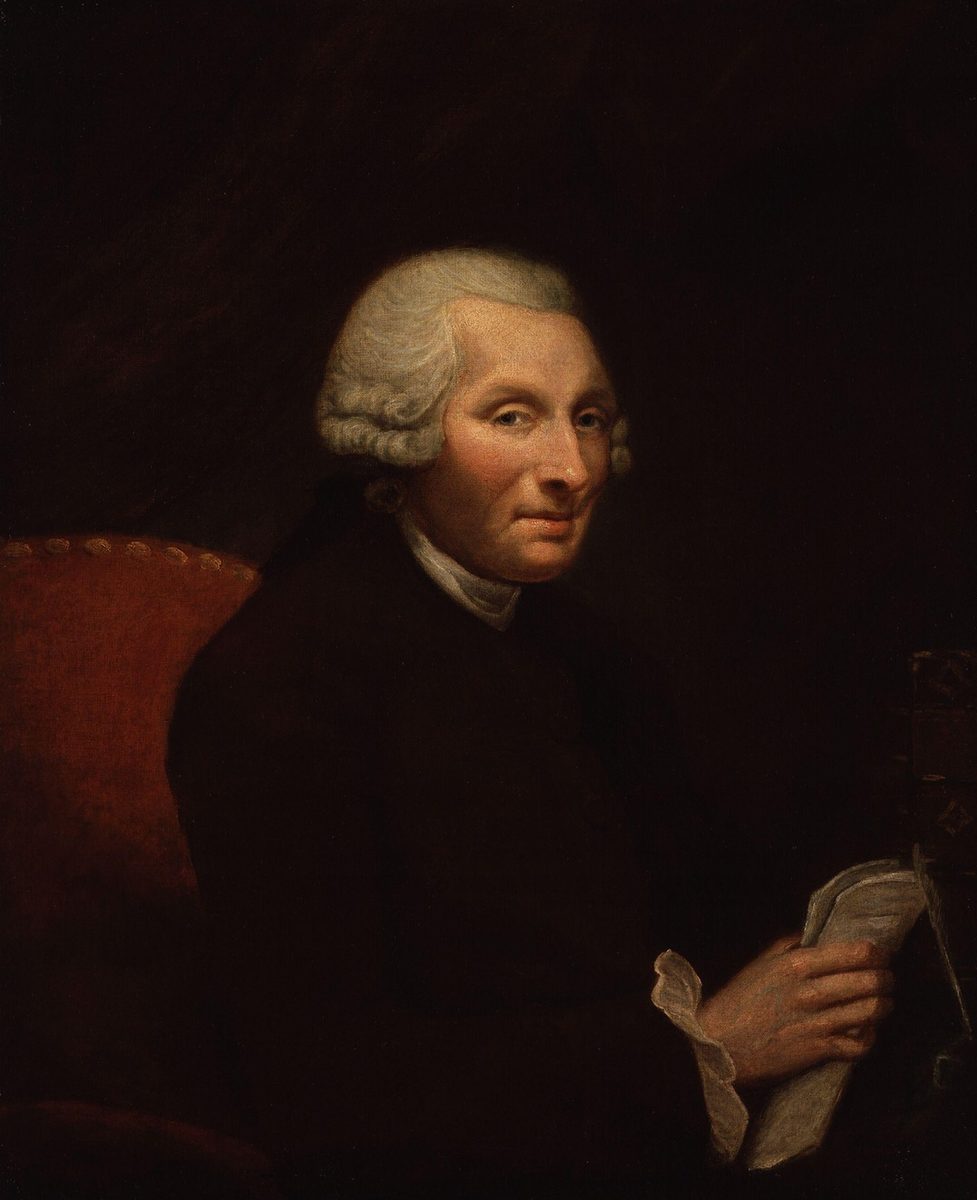
Hanway kept carrying his umbrella anyway, every day, until the sight of one simply stopped being remarkable. By the time he died, umbrella use was spreading fast enough across England that an umbrella manufacturer was advertising in the London Gazette within months. English finally had the vocabulary it needed: umbrella for rain, parasol strictly reserved for sun.
Steel ribs and a Sheffield factory made the parasol a middle-class object
The parasol went from aristocratic prop to mass-market accessory because of a change in materials, not fashion. Sheffield-area industrialist Samuel Fox began producing solid steel umbrella ribs at his works in Stocksbridge in the late 1840s, and by the 1880s steel frames had displaced the heavy whalebone ribs that had made earlier umbrellas and parasols bulky, fragile and expensive, according to the modern Fox Umbrellas company’s own account of its founder’s work. (The “Paragon” name the firm is remembered by only became a registered trademark decades later, under Fox’s son — a reminder that a company’s most famous brand name and its founding invention don’t always arrive in the same decade.) What mattered commercially was simpler: a lightweight steel skeleton meant a well-made parasol no longer required an aristocrat’s budget.
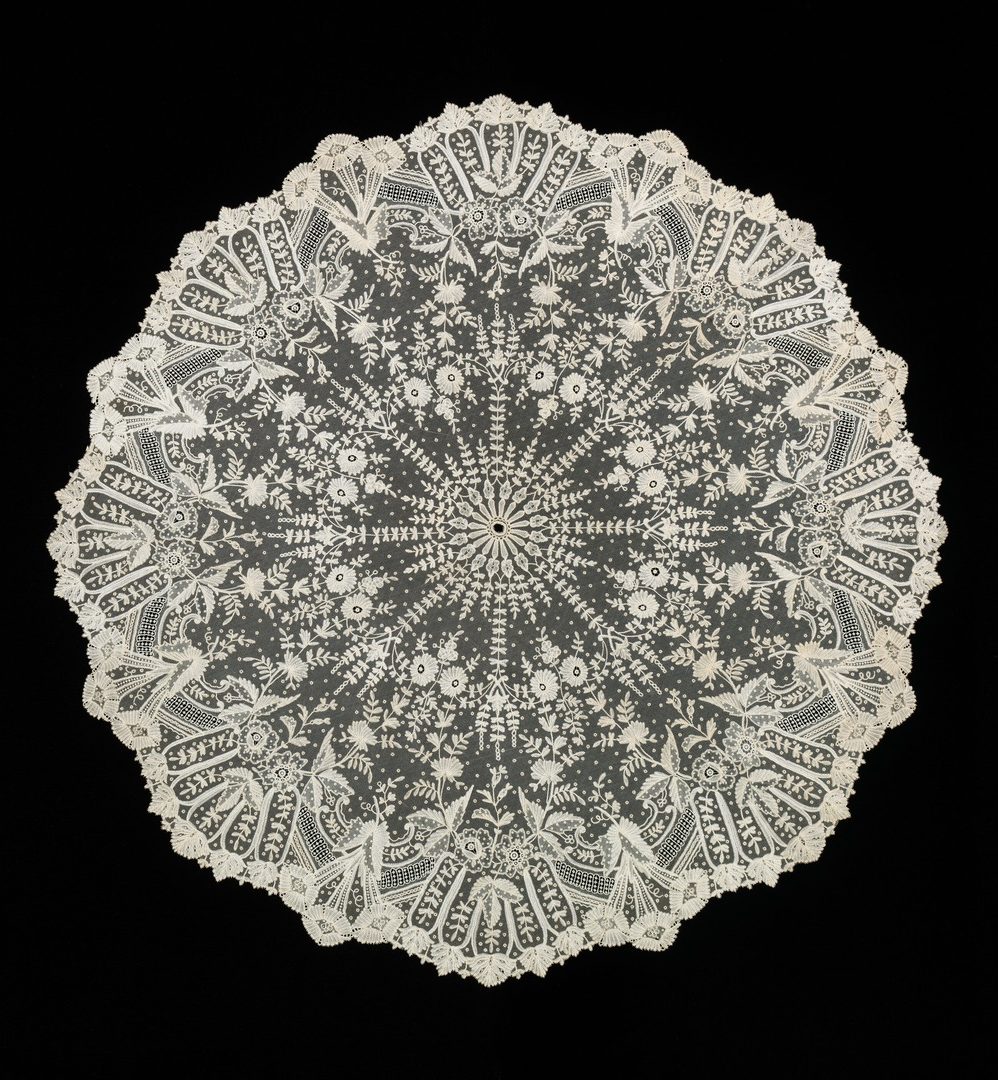
Once it was affordable, the parasol stopped being a practical necessity and became something closer to a performance piece — a lace-canopied, factory-framed accessory that said as much about a Victorian woman’s taste as her hat or her gloves did. It is also, not coincidentally, exactly the object a self-defense instructor would later look at and see a weighted steel rod that every fashionable woman already carried without a second thought.
A French swordsman taught Englishwomen to fight with their own parasol
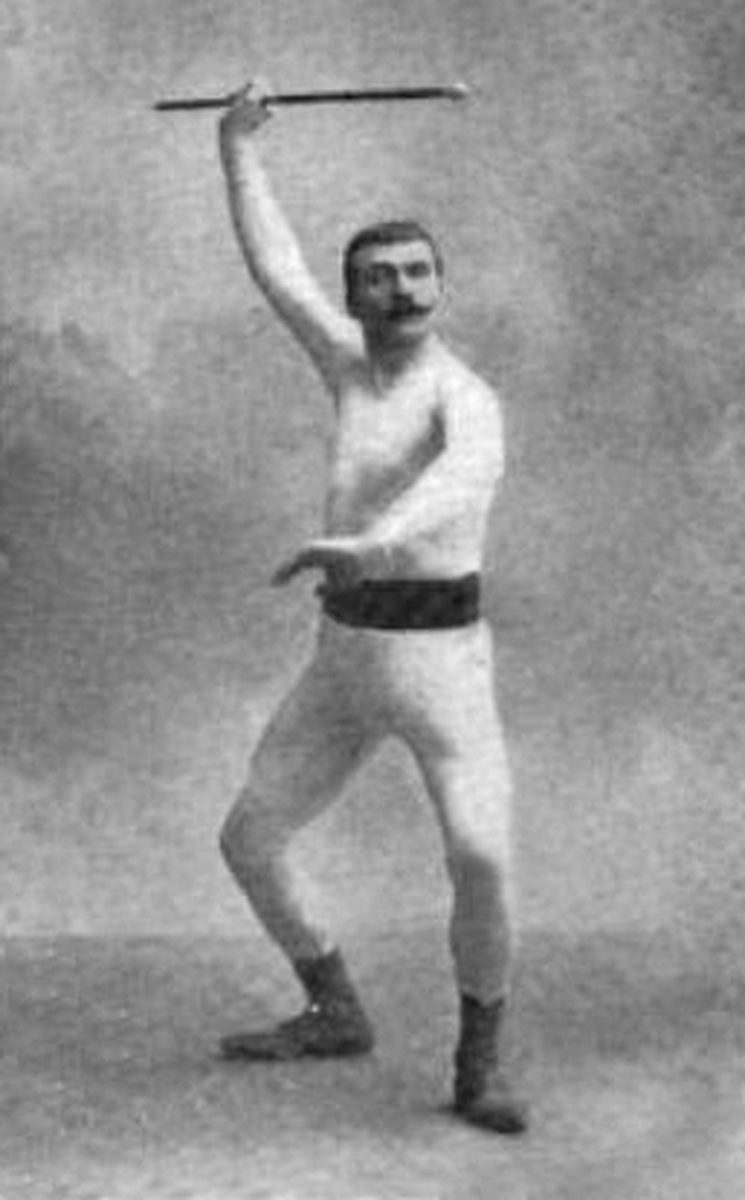
Pierre Vigny arrived in London in March 1899 as, in one contemporary review’s words, a “celebrated French swordsman and world champion of walking stick play and la savate.” He joined E. W. Barton-Wright’s Bartitsu Club as an instructor and later opened his own school on Berners Street in 1903, where he built a self-defense method combining his cane-fighting background with the specific hazards of a Victorian city street. His own assistant and eventual wife, remembered in the press only as Miss Sanderson, took the system in a more targeted direction: by 1908 she was teaching women specifically to use their umbrella or parasol as a functional striking weapon, not a fashion prop, and newspaper notices from the period describe her as “capable with the stick as the sword” against hired sparring attackers.
That same practical instinct carried straight into the suffrage movement a few years later. Trainer Edith Garrud taught jujutsu to members of the Women’s Social and Political Union starting in 1909, and in 1913 helped organize a roughly thirty-member unit called the Bodyguard, trained to physically protect union leaders from re-arrest under the so-called Cat and Mouse Act. The unit mainly relied on jujutsu holds and concealed Indian clubs rather than parasols specifically, but it belonged to the same broader moment: women who had no guaranteed legal protection on a hostile street deciding, deliberately, to make the ordinary objects they already carried do double duty.
A sunburned yacht trip ended the parasol’s job in about a decade
The parasol’s decline, when it came, had nothing to do with self-defense fashions falling out of favor and everything to do with a sudden reversal in what pale or tanned skin signified. Popular accounts trace much of the shift to designer Coco Chanel, who reportedly fell asleep in the sun on a yacht on the French Riviera in 1923 and returned to Paris sunburned — and, within a season, fashionably bronzed. Tanned skin, once a visible sign of outdoor manual labor that the wealthy had spent centuries avoiding, flipped into an aspirational, leisure-class look almost overnight. By 1929, swimwear advertisements that had shown women shaded under hats and parasols just two years earlier were showing women deliberately exposed to the sun instead, and Harper’s Bazaar ran a feature that same year declaring tanned skin fashionable outright.
Beach culture boomed on both sides of the Atlantic through the rest of the decade, and sunbathing itself, not shelter from the sun, became the entire point of a day outdoors. An object that had spent four thousand years announcing rank, and a brief, sharp interval demonstrating force, slipped quietly into costume-drama territory — carried today mostly for weddings and period reenactments, or, now that the dangers of UV exposure are understood all over again, as genuinely practical sun protection rather than a political statement.
Watch the full history
The video version covers the Egyptian and Assyrian origins, the Ming and Burmese laws, and Vigny and Sanderson’s self-defense system in just under six minutes.

What the parasol’s whole run actually demonstrates is how thin the line is between a status symbol and a tool, once the material happens to be strong enough. Egyptian and Assyrian sculptors carved it as pure signage. Ming and Burmese officials legislated it as pure hierarchy. Samuel Fox’s steel ribs turned it, by accident, into something a trained hand could use to fight back with. None of those three uses required changing the object itself in any meaningful way — only the context around the person holding it.
How many ordinary objects within reach right now are doing a similar kind of quiet double duty, waiting only for someone to notice?
Related reading
- The 2,000-Year History of the Cold Frame
- Were the Ulfberht Swords Really Made With Crucible Steel?
- How to Tell Real Berlin Wall Pieces From the Fakes
- The Diya: How a 5,000-Year-Old Lamp Became Diwali’s Icon
Shop
For more on the object’s full social history: Marion Rankine’s A History of the Umbrella is a readable deep dive into rain gear, sun shade and status all at once — available on Amazon.
Works cited
- Sangster, William. Umbrellas and Their History. London: Effingham Wilson, 1855. Link.
- Chen, BuYun. “Wearing the Hat of Loyalty: Imperial Power and Dress Reform in Ming Dynasty China.” In The Right to Dress: Sumptuary Laws in a Global Perspective, c.1200–1800, 416–434. Cambridge University Press, 2019. Link.
- The British Museum. Gypsum wall panel depicting the celebration after a bull hunt, with a royal parasol bearer. Nimrud, Iraq, 875–860 BCE. Museum number 124533 (registration 1849,1222.18).
- The Metropolitan Museum of Art. “Relief from the tomb of Queen Neferu: female attendant carrying a sunshade.” Thebes, Deir el-Bahri, ca. 2051–2030 BCE. Accession 26.3.353l, Rogers Fund, 1926.
- The Metropolitan Museum of Art, Costume Institute. “Parasol.” European, 1880s. Brooklyn Museum Costume Collection, accession 2009.300.3036.
- Fox Umbrellas Ltd. “Fox Umbrellas Ltd: Our History.” Company history of Samuel Fox’s steel umbrella-frame works, Stocksbridge. Link.
- Bartitsu Society. “Pierre Vigny’s London Self-Defence Exhibitions (June–July 1899).” Link.
- Suffrajitsu. “Miss Sanderson and the Womanly Art of Parasol Self-Defence.” Link.
- O’Hagan, Lauren Alex. “Women’s Self-Defence: How Ju Jutsu Played a Key Role in the Fight for Women’s Suffrage.” Journal of Victorian Culture Online, September 2, 2021. Link.
- Bennett DeMaio, Krista. “Why Do We (Still) Tan?” Skin Cancer Foundation, Sun & Skin News. Link.