
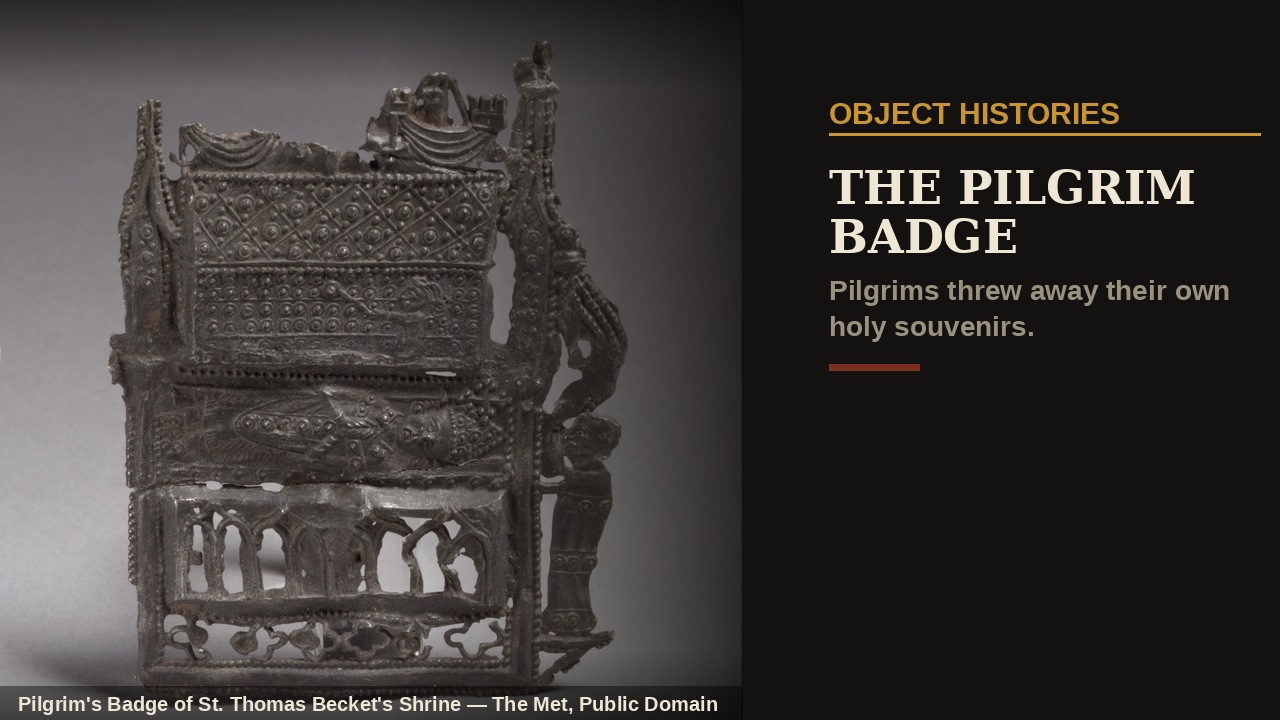
In 1857, two men who made their living digging the Thames foreshore near Shadwell found they could sell more medieval pilgrim badges than the river actually contained. So they started making their own. William Smith and Charles Eaton cast thousands of fake badges and medallions in home-made plaster moulds, sold them to delighted antiquarians as genuine finds, and kept going for more than a decade even after serious doubts set in. Part of what finally gave them away was the dates: some of their “eleventh-century” pieces were stamped in Arabic numerals, three centuries before Europe used them.
That two Victorian mudlarks could run a profitable forgery business on pilgrim badges says something the short companion video did not have room for: these were never a quaint, one-off keepsake. They were the product of a real medieval pilgrim badge industry: shrines ran casting workshops, licensed the moulds, and sold souvenirs by the thousand, much the way a museum gift shop sells postcards today. Understanding that industry is the way to understand why so many badges ended up abandoned in rivers and sewers, and why a convincing fake could fool experts for years.
What follows is how a badge like Thomas Becket’s was actually made and sold, how large his shrine’s output at Canterbury really was, the genuine scholarly dispute over why so many turned up in water, how Henry VIII shut the whole trade down almost overnight, and how the market for pilgrim badges quietly outlived the shrines that invented it.
Inside the Medieval Pilgrim Badge Industry’s Workshops
A pilgrim badge started as a design cut into a two-part mould of carved limestone or fired clay — one half shaping the front, the other, a “counter” mould, giving the back a matching ridge. Into that mould went molten pewter: a lead-tin alloy chosen because it melts at a low enough temperature to pour quickly and cheaply, again and again, from the same mould. Modern replicas made from surviving moulds suggest a single badge took only seconds to cast. A finished badge usually carried a cast pin and clasp so it could be pinned straight to a hat or cloak.
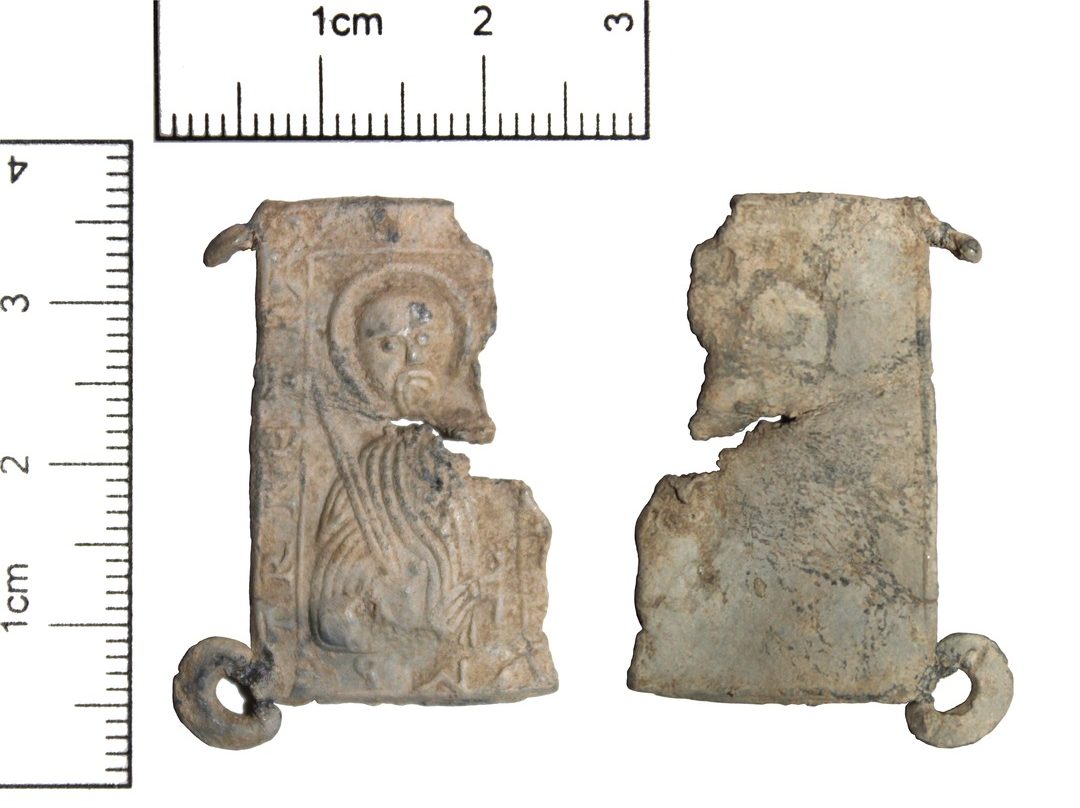
This was not cottage industry. Badge-makers rarely organised into formal guilds, but many worked in dedicated shops near a shrine’s gates, and some shrines ran the production themselves or licensed named workshops to do it, taking a cut of every sale. The arrangement served a second purpose besides income: a pilgrim who could buy an officially sanctioned souvenir had less reason to chip a splinter off the real shrine to take home instead, a problem serious enough that English cathedrals dealt with it for centuries — the same impulse that drove the trade in stolen bones and fragments chronicled in medieval relic theft.
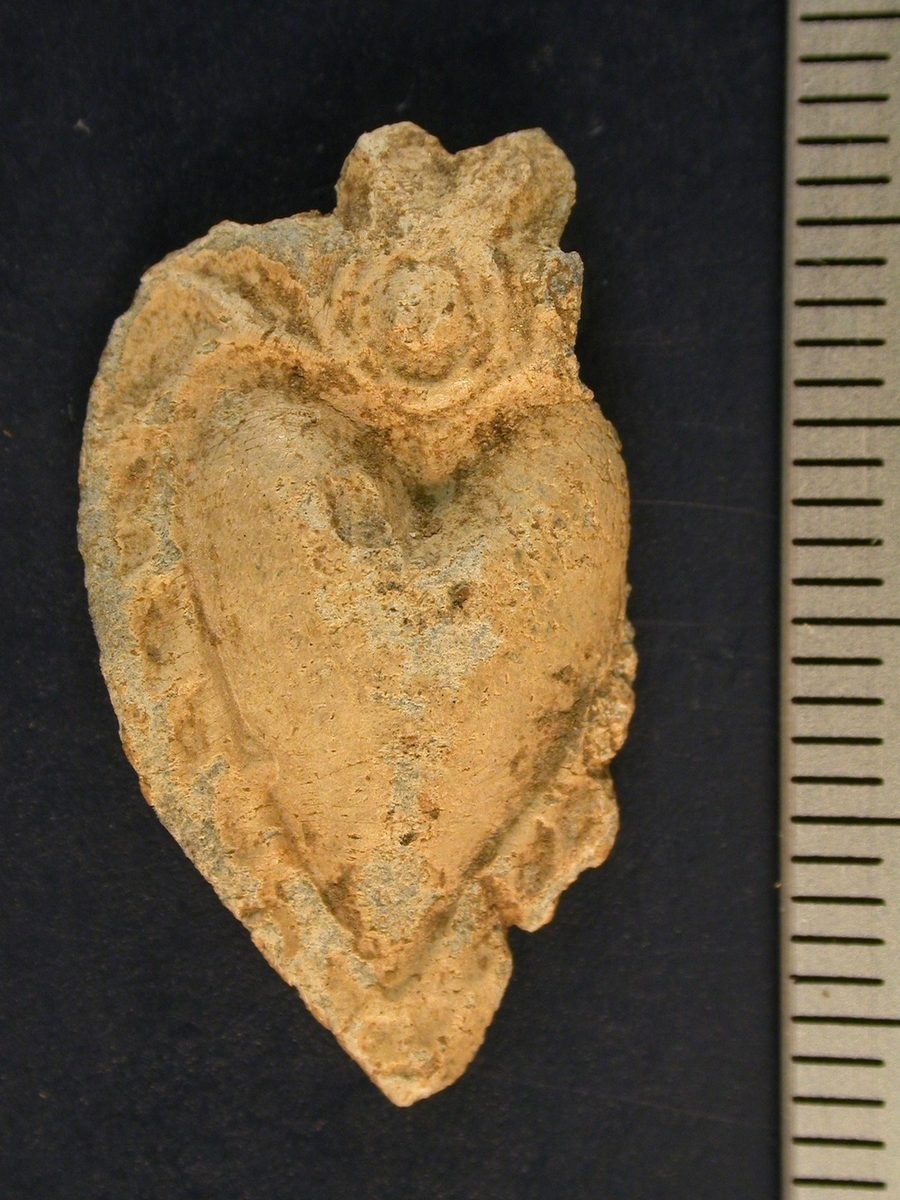
The same workshops cast objects with no religious content at all. Livery badges announced loyalty to a lord. Lovers exchanged small lead hearts as cheap jewellery. A separate, well-documented category of comic and occasionally bawdy charms — wings, legs, and other parody figures dressed as miniature pilgrims — survives in enough numbers that collectors still argue over what they meant. All of it came out of the same moulds, the same alloy, and often the same workshops as the devotional badges. Even a collection as large as Canterbury’s is understood to represent only a sliver of what actually circulated: a badge cost little, was expected to be lost or discarded, and nobody at the time had any reason to record how many left a given workshop.
A Becket Badge Preserves a Shrine That No Longer Exists
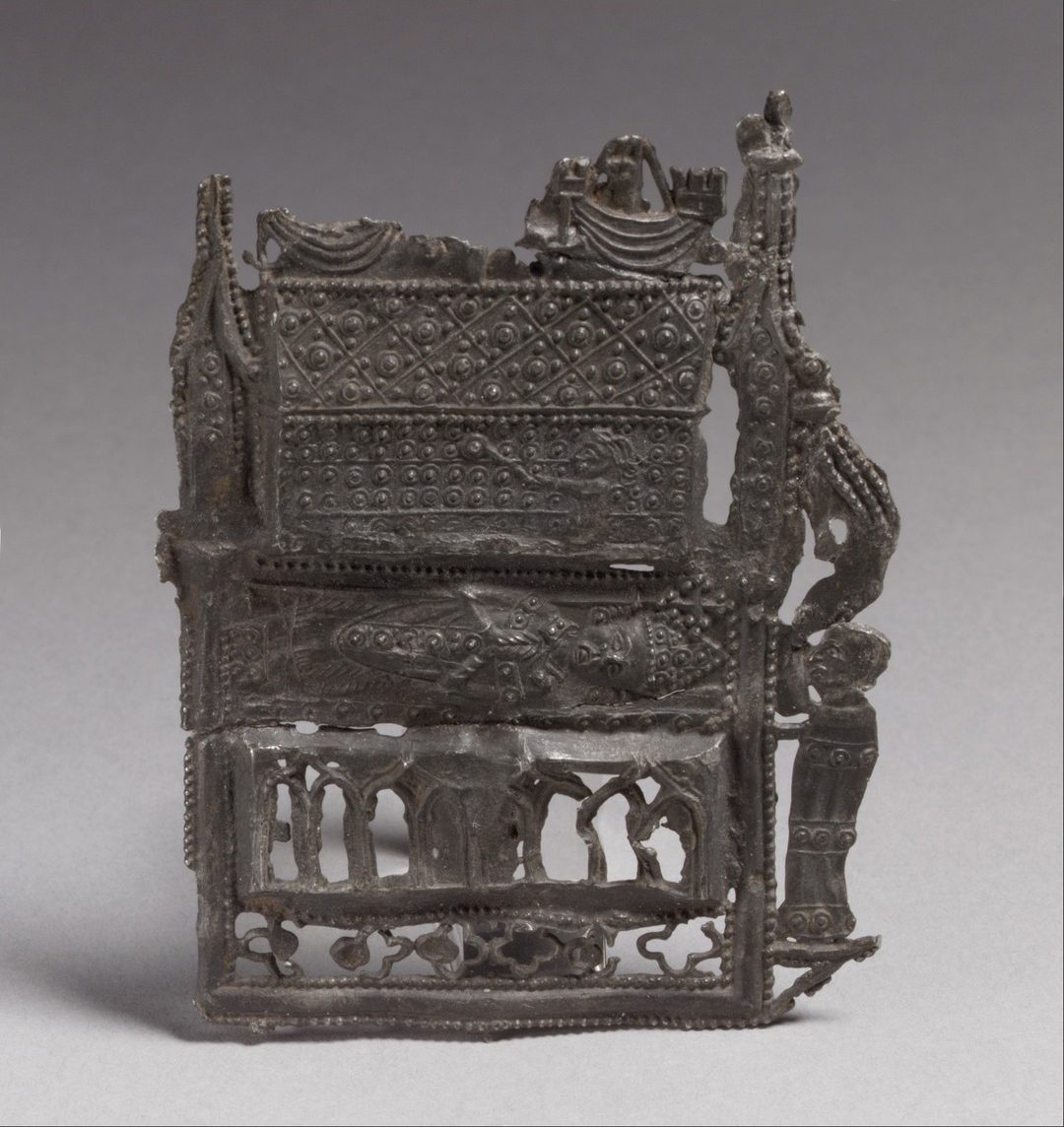
The most detailed badges did more than identify a saint; they recorded, in miniature, a building. A cast pewter badge in the Metropolitan Museum of Art, made in Canterbury around 1350–1400, shows Thomas Becket’s shrine exactly as it looked before Henry VIII’s agents tore it apart: a jewelled, gabled canopy topped with two model ships, a tomb effigy in church vestments, a figure pointing to a ruby said to have been a gift from the king of France in 1179, and another figure winching up the shrine’s cover on a pulley so pilgrims could view the relics inside. The goldsmith Walter of Colchester built the actual shrine for Archbishop Stephen Langton, who dedicated it in 1220. The badge is one of the few detailed records of what that structure looked like, because the structure itself no longer exists.
Simpler Becket badges sold in far greater numbers. A circular lead-alloy medallion in the British Museum, cast around the same period, carries Becket’s name on a ring of beading around a plain six-lobed boss — cheaper to cut, cheaper to cast, and still unmistakably his. Pilgrims who could not afford, or did not want, a miniature of the whole shrine could still wear proof that they had made the journey.
Canterbury’s Own Collection Shows How the Trade Actually Ran
The City of Canterbury now holds 282 pilgrim souvenirs between its two collections, dating from the thirteenth century to the early sixteenth. A little over a third, 109 of them, relate to Becket directly; the rest commemorate other saints and shrines entirely, a reminder that Canterbury’s badge trade was never a single product line. The single most common Becket type, with 58 surviving examples, shows just his head, almost certainly copying the separate head reliquary that stood in the cathedral until it too was destroyed in 1538. Eighteen more show the shrine encircled by a border, five are ampullae for holy water or oil, five carry just his initial, and four show his glove. One rare, broken fragment depicts Edward Grim, the monk who was wounded trying to shield Becket from the knights who killed him. Dates for individual badges like these are rarely written anywhere; specialists work them out from find-spot context, the finer points of the iconography, and details like the clothing shown on a badge’s figures, noting that badges tended to get smaller and flatter over the course of the fourteenth and fifteenth centuries, though wear and damage often make an individual piece’s original size hard to judge.
Most of these finds came out of the River Stour at three separate Canterbury sites, recovered after construction work near the river prompted systematic searching of the riverbed — the same recovery pattern, on a smaller river, that produces far larger hauls from the Thames in London.
Why So Many Ended Up in the Water Is a Live Argument, Not a Known Fact
The explanation repeated most often is that pilgrims threw their badges into rivers on the way home as a devotional act, a kind of thank-you offering for a safe journey, or sometimes to ensure one. It is a tidy story, and it may be true for some badges. But researchers working directly with the Canterbury river finds have been explicit that there is no concrete evidence for it as an actual ritual practice. Secular badges with no religious meaning turn up mixed in among the river badges in similar condition, which is hard to square with a purely devotional explanation. The alternative theories on offer are far less romantic: simple accidental loss from a pin that worked itself open, or workshop waste dumped by local badge-makers along with other scrap metal. Excavations of medieval sewers at Salisbury turned up pilgrim badges too, which supports the plainer reading that some badges were just thrown away once their owner was done with them.
Henry VIII Did Not Just Ban Pilgrimage, He Erased the Calendar Entry
Becket’s shrine was destroyed in September 1538, two years before Christ Church Priory itself was dissolved. Henry VIII treated the Becket cult as a specific political threat — a saint whose entire story was a churchman defying a king — and went after it accordingly, ordering Becket’s feast day struck from the church calendar entirely. Twenty-six cartloads of gold and silver were stripped from the shrine and carted off to London. Production of Becket badges, already slowing as pilgrimage itself declined earlier in the century, stopped for good. It was a strikingly modern kind of enforcement: not just closing a site, but working to erase the reason anyone had wanted to visit it, not unlike the way British Mandate authorities later tried to legislate a religious sound out of existence at the Western Wall shofar ban.
The Trade Outlived the Shrines by Three Centuries, as a Forgery Market
This is where Smith and Eaton, the Shadwell mudlarks from the opening, come back in. Once genuine medieval badges became a hot collector’s market in Victorian London, the two began forging their own around 1857, working from hand-cut plaster moulds and selling the results as real finds dug from the Thames. Their pieces were crude on close inspection — garbled pseudo-inscriptions, anatomically odd figures — and some archaeologists doubted them immediately. Others, including respected antiquarians of the period, defended them as genuine, and the resulting argument reached an inconclusive court case before a Fellow of the Society of Antiquaries finally exposed the fraud through a bit of deception of his own. Remarkably, Smith and Eaton kept producing and selling forgeries for roughly another decade afterward. Their fakes are collectible enough in their own right now that the British Museum catalogues one — a lead medallion stamped with a knight, a cleric, and a crowned figure — as an object of record, filed under its own forgery type series rather than mixed in with the genuine medieval badges it was built to imitate.
Finding One Today Still Requires a Government Permit
The river that once absorbed pilgrims’ discarded badges, deliberately or otherwise, is also what preserved them: the Thames’s cold, oxygen-poor mud is an unusually good environment for keeping soft lead alloy from corroding away entirely. Searching for them has gone from Victorian survival work — the writer Henry Mayhew described the river’s poorest scavengers in the 1850s as people “compelled from utter destitution” to pick through the mud for anything sellable — to a strictly regulated modern hobby. Searching the foreshore now requires a Port of London Authority permit, capped at 4,000 holders at a time and costing roughly thirty-five pounds a year, and anything a permit holder finds that might be of archaeological interest, a pilgrim badge included, has to be reported to a Finds Liaison Officer under the same Portable Antiquities Scheme that records metal-detector finds across the rest of England.

Would a given pilgrim have kept the badge, or let it go, the way so many apparently did? The honest answer, after all this research, is that nobody can say for certain, for any single one of the thousands now sitting in museum trays. What is certain is that the object was never meant to last three hundred years. It was meant to sell fast, prove a journey, and be replaced by the next pilgrim’s badge the following season — which makes it a little remarkable that so many of them, genuine and forged alike, are still around to argue about.
Watch the full history
The video version covers the badge itself, the saints it names, and the mudlarks still finding them today in about five minutes.

Related reading
- Furta Sacra: The Strange History of Medieval Relic Theft
- Cowrie Shell Money: How a Sea Snail Financed Four Continents
- The Tomb of Genghis Khan: A Decision Not a Mystery
- Why Blowing a Shofar at the Western Wall Was a Crime
Shop
Shop the styles/items featured in this article:
- Mudlark: In Search of London’s Past Along the River Thames (book)
- Handcrafted scallop-shell pilgrim pendant
Works cited
- Splarn, Lucy. “St Thomas Becket and the Pilgrim Souvenirs in Canterbury’s Collections.” Archaeologia Cantiana 142 (2021): 299–308. Kent Archaeological Society. Link.
- Halliday, Robert. “The Billy and Charley Forgeries.” Antiquaries Journal, published online 20 June 2022. Cambridge University Press for the Society of Antiquaries of London.
- “Pilgrim’s Badge of the Shrine of St. Thomas Becket at Canterbury.” Accession 2001.310. The Metropolitan Museum of Art.
- “Pilgrim badge; brooch.” Museum number 1896,0501.87. The British Museum.
- “Lead Billy and Charley badge.” Museum number 1916,0102.14. The British Museum.
- “The Reformation: The Endowment Charter of Henry VIII.” A History of Canterbury Cathedral in 20 Documents. Canterbury Cathedral. Link.
- “Port of London Authority Launches New Foreshore Mudlark Permit Scheme.” Port of London Authority, 2 October 2024.
- “What Is Mudlarking?” London Museum. Link.