
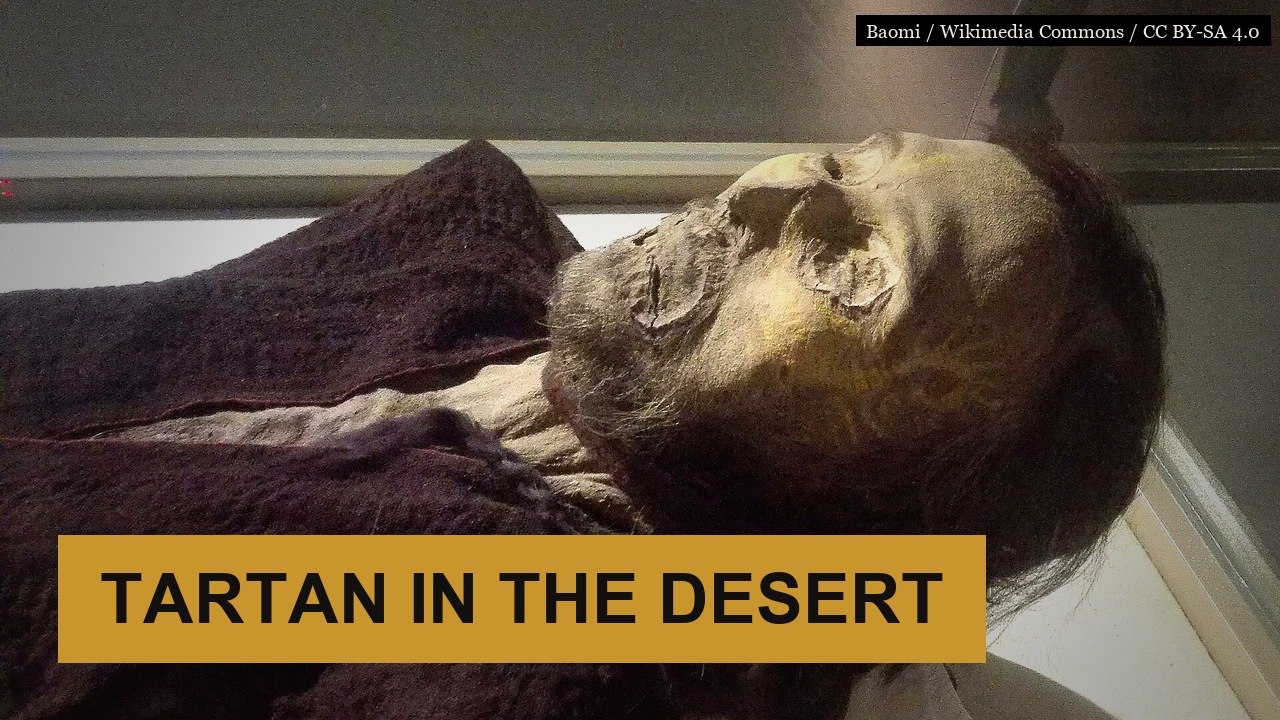
In 2021, a team of geneticists sequenced the DNA of thirteen Bronze Age bodies pulled from the Tarim Basin, a desert cemetery in northwest China, expecting to confirm what forty years of textiles, tools and facial features had already seemed to prove: that the people buried there had walked in from the west. The genomes said otherwise. Not one of the thirteen carried any trace of western steppe ancestry. None carried a signal from the irrigated oasis farmers of Bactria either. The population that left behind the most “European-looking” mummies in Asia turned out, on the molecular evidence, to have never mixed with anyone from Europe or the Near East at all.
That reversal did not happen because the earlier evidence was wrong. The cloth really was a checked wool twill that textile historians matched to fragments pulled from the Hallstatt salt mines in the Alps. The faces, preserved by salt and desiccation rather than any embalmer’s skill, really do look startlingly European to an untrained eye. What the 2021 study showed is that both things can be true at once — that a population can look, dress and eat like outsiders while being, genetically, some of the most isolated people ever sequenced.
Here is what three decades of excavation, textile analysis, Y-chromosome testing and whole-genome sequencing actually settled, in roughly the order the evidence arrived, and the one thing none of it has explained.
The desert preserved them. Nobody embalmed anything
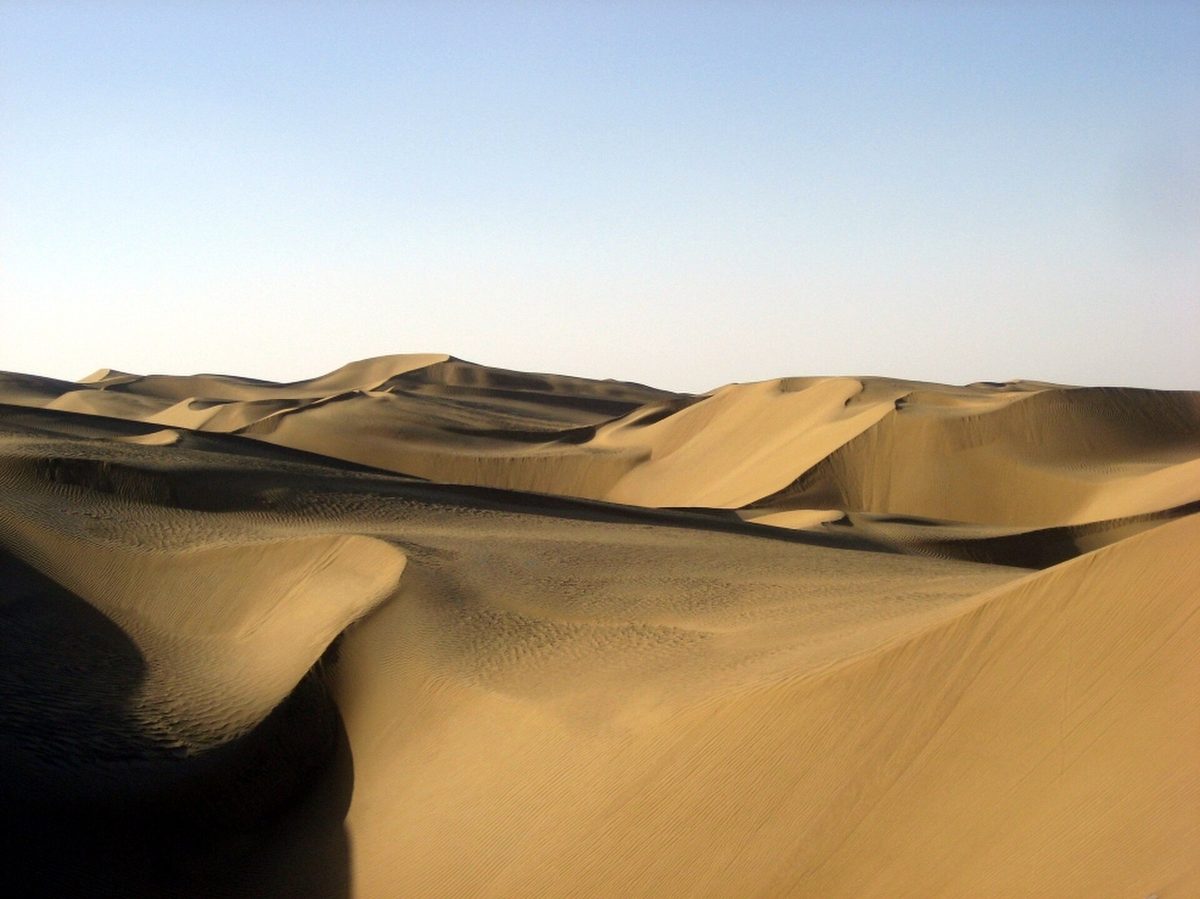
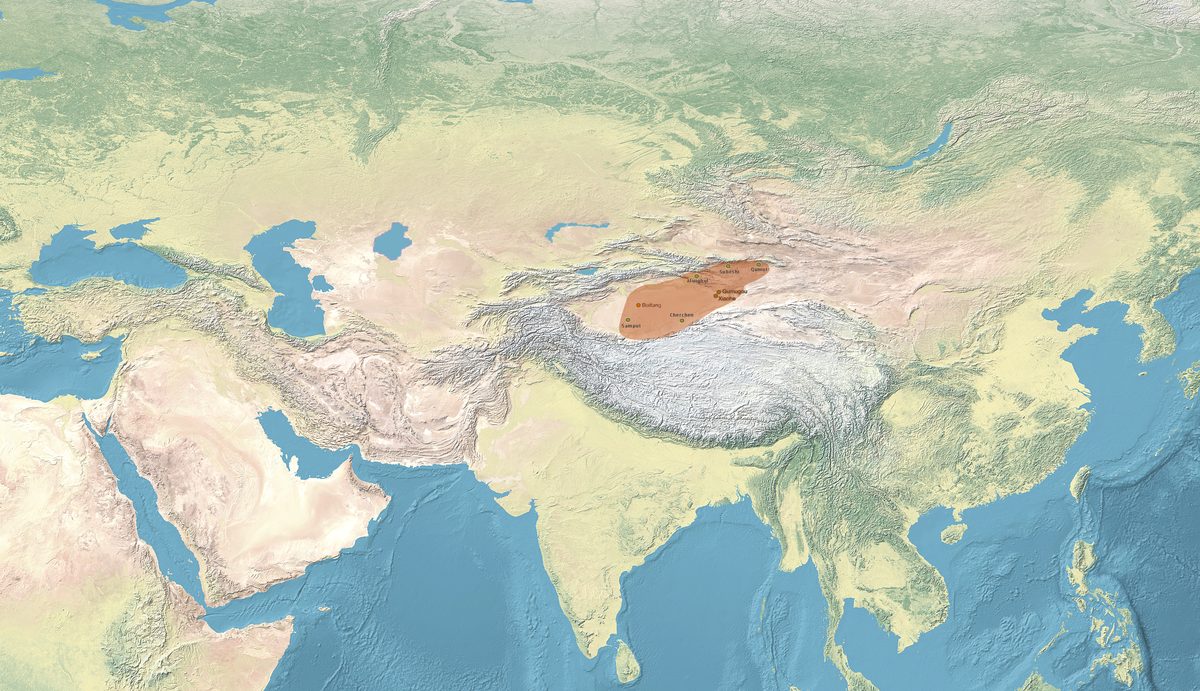
The cemetery sits west of Lop Nur, a lake that dried out millennia ago, on a low sand mound in one of the driest places on Earth. Almost no rain reaches the middle of the Taklamakan, the winters are harsh and the ground itself is salty — the same combination that keeps a ham in a smokehouse. Bodies buried here did not rot. They dried.
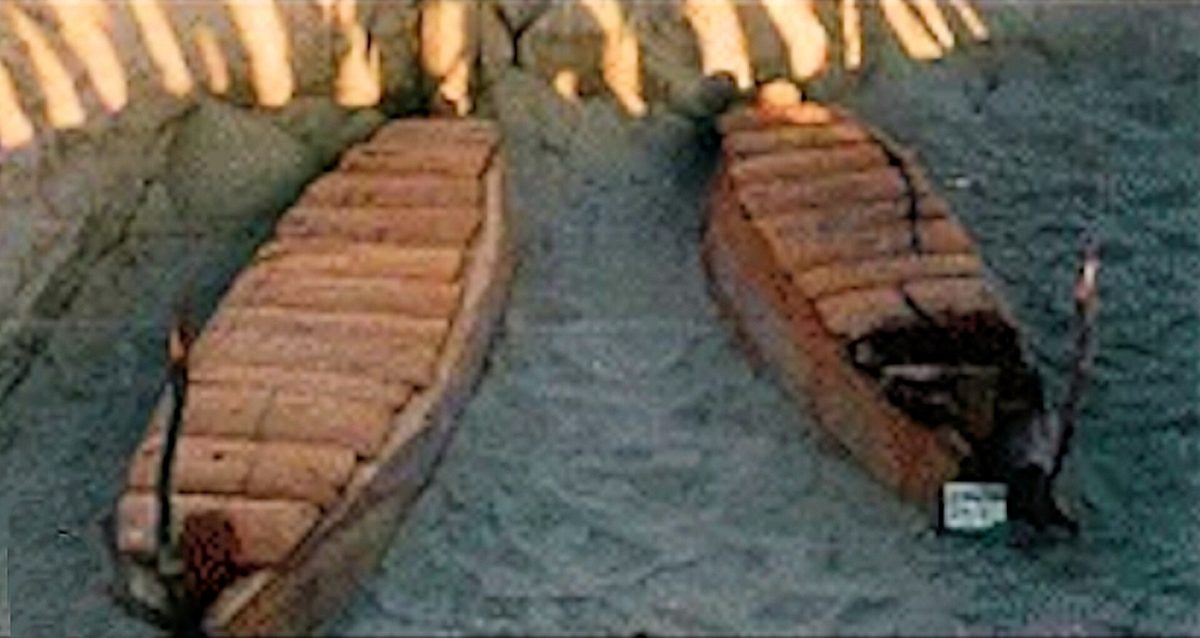
The burial method is identical from grave to grave. Two shaped planks are set over the body like an upturned boat, and the whole assembly is sealed under a sheet of fresh cowhide. As the hide dries it shrinks, cinching every seam shut, so the finished coffin is close to airtight. A poplar post stands at the head end of most graves; some carry an ox skull or a pair of horns lashed to the top. The cemetery holds roughly 330 graves in total, stacked in layers with the oldest at the bottom, and about 160 of them had already been emptied by looters before archaeologists reached them.
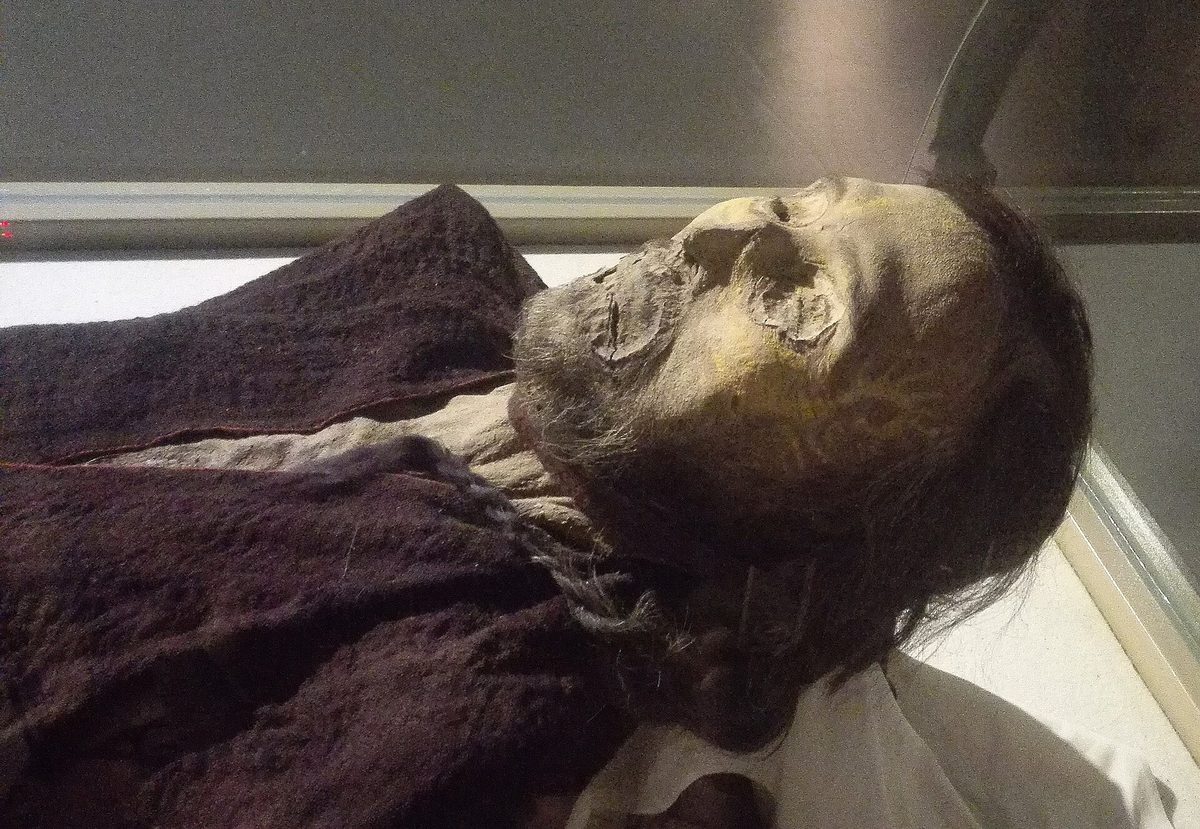
What survives in the unlooted graves is not a skeleton. It is a face, with eyelashes and braided hair intact, dressed in felted wool that still carries its original colour. Grave goods repeat with striking consistency: bows and arrows laid with the men, carved wooden figures, painted masks, and twigs of ephedra — a stimulant plant that does not grow on the basin floor and had to be carried in from the surrounding mountains.
A hunter found it in 1910. It then vanished for sixty-six years
A local hunter named Ordek came across the mound around 1910. Twenty-four years later he guided the Swedish archaeologist Folke Bergman back to the same spot, and Bergman’s field notes describe a mound bristling with wooden posts, their tops splintered by wind. Bergman opened twelve burials, removed roughly two hundred objects, and published his findings in 1939. Then the site was lost again — not destroyed, not looted on any scale yet, simply buried by shifting sand so thoroughly that nobody could relocate it for the next sixty-six years.
Chinese archaeologists from the Xinjiang Institute of Cultural Relics and Archaeology finally reopened the cemetery in 2002, with a full excavation season following in October 2003. By the end of that campaign they had uncovered 167 tombs. The site has since become one of the most tightly documented Bronze Age burial grounds in Central Asia, in large part because its isolation protected it from the kind of disturbance that erases a site’s internal chronology.
A checked wool tunic looked like a signed confession
One body, from a related site at Cherchen, was dressed in a red twill tunic and leggings woven in a check pattern — tartan, in everything but name. The textile historian Elizabeth Wayland Barber compared the weave to cloth fragments recovered from the prehistoric salt mines at Hallstatt in Austria, more than four thousand miles away. Another textile specialist, Irene Good, went further and called it the easternmost known example of true diagonal twill anywhere in the ancient world.
Twill is a weaving technique, not a fingerprint; it can be, and likely was, invented more than once by people who never met. But set beside the faces, the find looked less like coincidence and more like a signature — physical proof that whoever wove this cloth had either come from the west themselves or learned the technique from someone who had. For the people studying the site in the 1990s, it was the strongest single clue pointing toward a long walk out of Europe.
By 2010 the case for migration looked airtight
Victor Mair, a Sinologist at the University of Pennsylvania who had pushed hard to get the bodies properly studied at all, first saw them in 1988 and described the earliest group as remarkably European in appearance. By 1995 he was characterising that earliest cohort as exclusively European in physical type — a claim that drew heavy criticism at the time and has kept drawing it since. A related, equally unproven idea followed close behind: that these were speakers of an early form of Tocharian, an Indo-European language not actually written down in the basin until roughly two thousand years later. Barber herself warned against making that leap.
The physical anthropologists weighed in next, and their verdict was more cautious than either claim. A 2003 craniometric study by Brian Hemphill and J. P. Mallory, comparing 1,353 skulls across twenty-five ancient and modern populations, found the earliest Tarim group matching neither a steppe population nor the Bactrian oasis farmers. It formed a cluster of its own. Only after roughly 1200 BC, the study found, did later Tarim populations pick up measurable input from highland groups in the Pamirs and the Ferghana Valley — people who may have included the Saka, later known as intermediaries on what became the Silk Road.
Then, in 2010, a narrower test seemed to settle the whole question the other way. A study of Y-chromosomes from the male burials at the cemetery found that eleven of twelve carried the lineage R1a1a, a marker strongly associated with populations of the western steppe. For the next decade, that result read as confirmation written directly into the chromosomes: somebody from the west had fathered most of the men buried here.
Then the DNA came back with no steppe ancestry at all
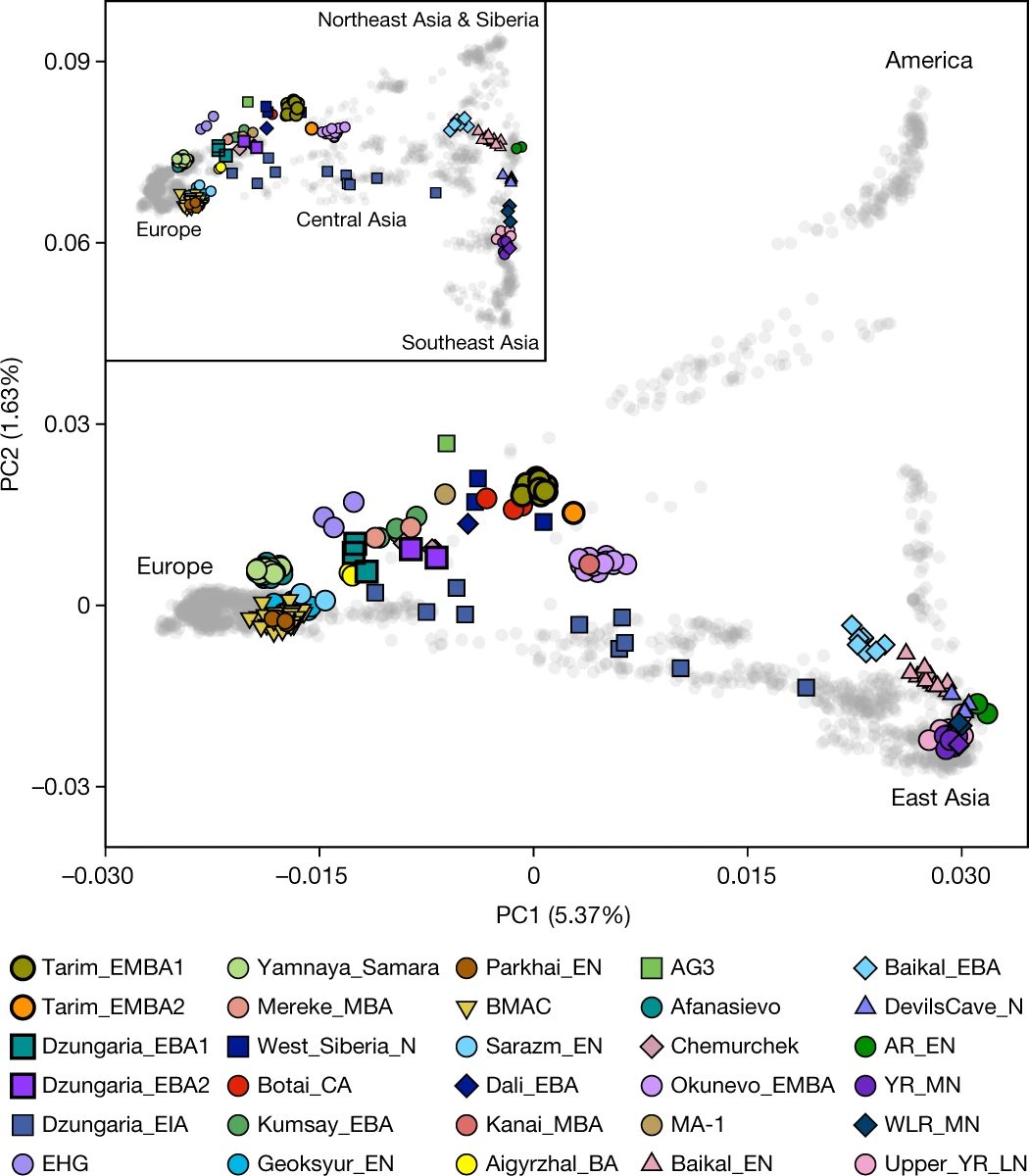
A single paternal lineage can travel through a population in ways that the rest of the genome does not follow, and in 2021 a team drawn from Jilin University, Peking University, Seoul National University and Harvard tested the rest of the genome directly. They screened thirty-three Bronze Age individuals and recovered usable genome-wide data from eighteen: five from Dzungaria, to the north, dated to roughly 3000–2800 BC, and thirteen from the Tarim sites of Xiaohe, Gumugou and Beifang, dated to roughly 2100–1700 BC.
The Dzungarian samples served as the control, and the control worked exactly as it should: those five individuals derived about 70 percent of their ancestry from the Afanasievo culture, an eastern arm of the western steppe world. The method could plainly detect steppe ancestry when steppe ancestry was present.
In the thirteen Tarim individuals, it detected none. Models built around Bactrian oasis ancestry failed too. What the thirteen carried instead was startlingly old: about 72 percent of their ancestry traced to the Ancient North Eurasians, a population spread across northern Eurasia during the last Ice Age that had since nearly vanished everywhere else, surviving today mainly in Siberian and Indigenous American populations, and even there making up at most around 40 percent of anyone’s ancestry. The remaining 28 percent traced to ancient populations near Lake Baikal in northeast Asia. The researchers dated this genetic profile itself to roughly nine thousand years old, evidence that the population had passed through a long, severe genetic bottleneck well before anyone built the first boat-shaped coffin at Xiaohe.
Isolated genes, cosmopolitan habits
None of which means these people lived cut off from the world around them. The same 2021 study scraped hardened dental plaque from the teeth of seven individuals buried in the cemetery’s oldest, lowest layers and recovered milk proteins — beta-lactoglobulin, alpha-S1-casein, alpha-lactalbumin — matched to cattle, sheep and goat. Not one of the seven carried the genetic variant that lets an adult digest lactose comfortably. They were drinking dairy, as adults, while almost certainly lactose intolerant.
Their wheat traced back to west Asia. Their millet traced to east Asia. Their ephedra came down from the mountains ringing the basin. Christina Warinner, the Harvard anthropologist who co-led the genetic work, has summed up the contradiction plainly: a population that was genetically about as isolated as it is possible to be, while living a culturally cosmopolitan life built almost entirely on things, crops and practices borrowed from elsewhere.
The migrants did eventually arrive — just much later
The 2021 genomes answer where the earliest known residents of the Tarim Basin came from. They do not mean nobody from the steppe ever reached the region. A second genetic study, published in 2025, sequenced twenty-four individuals from sites in the far western Tarim Basin spanning the later Bronze Age into the Iron Age, and found that those later western populations carry strong genetic ties to the Andronovo and Sintashta cultures of the Middle-to-Late Bronze Age steppe — evidence of at least two separate waves of steppe ancestry reaching the wider Xinjiang region over time, arriving well after Xiaohe’s earliest burials and in a different part of the basin.
So the long walk from the west did eventually happen. It simply happened later, and to different people, than the twill tunic and the European-looking faces had suggested. The population in the boat coffins had already been established in the Taklamakan, trading across a continent’s width without once marrying into it anyone who had made the journey themselves, for longer than anyone studying the cloth in the 1990s had any reason to suspect.
The genomes have answered who the earliest Tarim Basin residents were related to. They have not explained how a population this genetically closed off learned a weaving technique otherwise known only from the far side of Eurasia, or why, sitting on a crossroads of trade for centuries, it kept its gene pool shut while leaving its door wide open to everything that crop, herd and loom could carry in.
Watch the full history
The video version walks through the excavation, the textile comparison, and the 2021 genomes in just over eight minutes.

Related reading
- The Purpose of the Longyou Caves Is Still Not Settled
- Were the Ulfberht Swords Really Made With Crucible Steel?
- What Was the Wow! Signal? Inside Astronomy’s Most Famous Unsolved Case
- What Actually Happened to Alexander the Great’s Tomb?
Works cited
- Bergman, Folke. Archaeological Researches in Sinkiang, Especially the Lop-Nor Region. Reports from the Scientific Expedition to the North-Western Provinces of China under the Leadership of Dr. Sven Hedin, VII. Stockholm: Statens Etnografiska Museum, 1939. Link.
- Mallory, J. P., and Victor H. Mair. The Tarim Mummies: Ancient China and the Mystery of the Earliest Peoples from the West. London: Thames & Hudson, 2000.
- Barber, Elizabeth Wayland. The Mummies of Örümchi. New York: W. W. Norton, 1999. Link.
- Hemphill, Brian E., and J. P. Mallory. “Horse-Mounted Invaders from the Russo-Kazakh Steppe or Agricultural Colonists from Western Central Asia? A Craniometric Investigation of the Bronze Age Settlement of Xinjiang.” American Journal of Physical Anthropology 124, no. 3 (2003): 199–222.
- Li, Chunxiang, et al. “Evidence That a West-East Admixed Population Lived in the Tarim Basin as Early as the Early Bronze Age.” BMC Biology 8 (2010): 15. Link.
- Li, Chunxiang, et al. “Analysis of Ancient Human Mitochondrial DNA from the Xiaohe Cemetery: Insights into Prehistoric Population Movements in the Tarim Basin, China.” BMC Genetics 16 (2015): 78. Link.
- Zhang, Fan, et al. “The Genomic Origins of the Bronze Age Tarim Basin Mummies.” Nature 599 (2021): 256–261. Link.
- Zhang, Fan, et al. “Bronze and Iron Age Genomes Reveal the Integration of Diverse Ancestries in the Tarim Basin.” Current Biology 35, no. 15 (2025): 3759–3766. Link.