
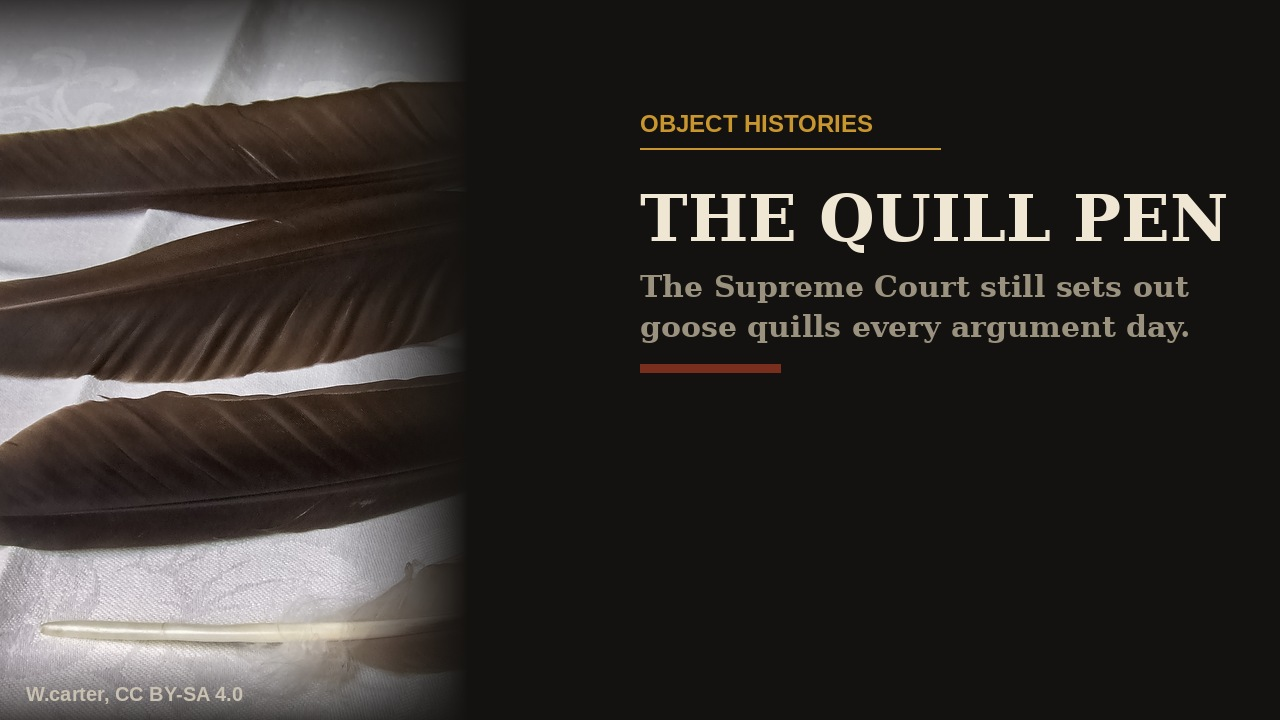
For twelve hundred years, the technology behind almost every important document in the Western world was a bird’s feather, a very sharp knife, and a few minutes of practice. Magna Carta, the Domesday Book, the Declaration of Independence, and the Constitution of the United States were all written this way — and knowing how quill pens were made explains a surprising amount about how those documents came to look the way they do, misspellings, blots, ink-starved letters and all.
It also explains a piece of everyday language that has outlived the object by two centuries. The small folding knife every writing desk once needed, kept only for one job, is still called a penknife. By the time this article is finished, it should be clear exactly what that knife was for.
Why a feather, and not a reed
The quill was not the first pen. Egyptian and Roman scribes wrote with a reed, a hollow plant stalk cut to a point and dipped in carbon ink. Reeds work, but they are brittle, they blunt quickly, and a reed’s natural stiffness limits how fine a line it can hold. Somewhere in the early centuries of the Christian era, in a shift no single document records, scribes began cutting the hollow shaft of a large flight feather instead.
By the time Isidore, bishop of Seville, sat down between about 615 and 636 CE to compile the Etymologiae — an attempt to catalogue everything the ancient world thought it knew, organized entirely around word origins — he treated the feather pen as an established, named tool alongside the reed. He called it penna, simply, feather. That word never left. The pen sitting in a drawer today is, etymologically, still a feather, however far it has drifted from one.

Only a handful of feathers on any bird would do
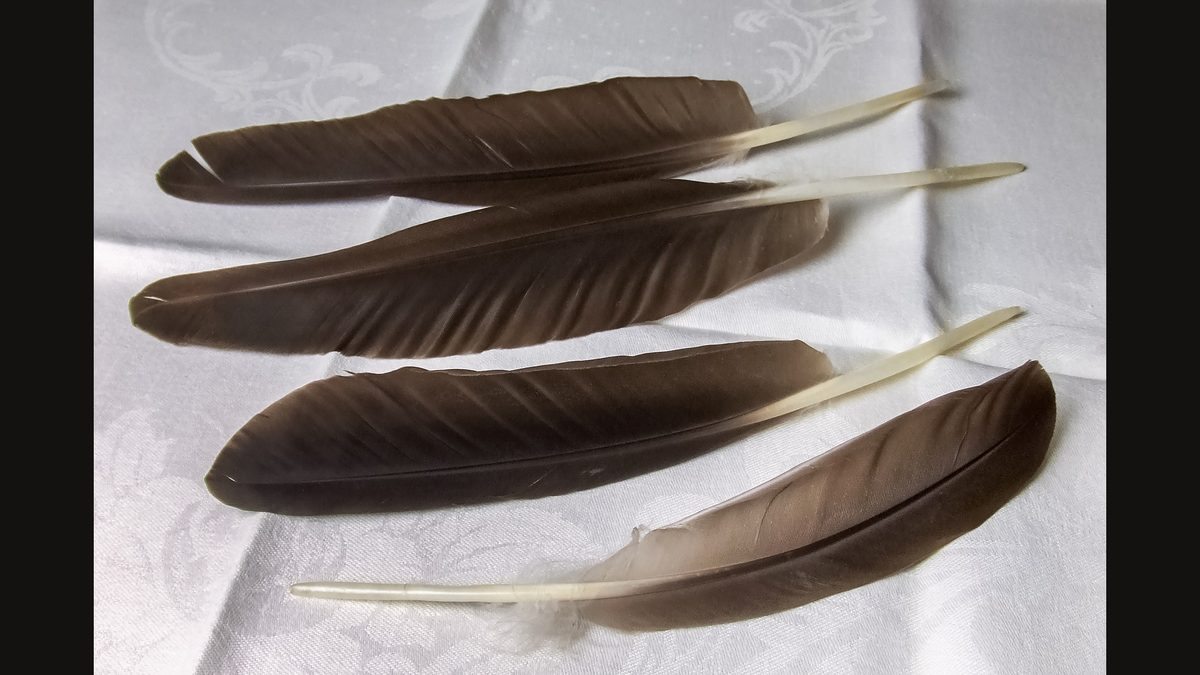
Not every feather could be cut into a working nib. Scribes wanted the primaries: the five or six long flight feathers at the outer edge of each wing, the only ones with a barrel wide enough and a wall strong enough to hold an edge. Everything else on the bird was waste for this purpose. Goose was the workhorse, cheap and kept everywhere in Europe. Swan quills were larger and stiffer, kept for big ornamental lettering. Crow and raven quills were small and hard and could be cut to an almost needle-fine point, which is why technical drawing nibs are still sold today as crow quills. In North America, turkey feathers filled in as a domestic substitute.
There is a detail here that gives away just how much this was a trade craft rather than an improvised convenience. A flight feather curves, and the curve runs a particular way depending on which wing it came from. A right-handed writer wanted a feather from the bird’s left wing, because the curve then arced away from the writer’s face rather than into it; left-handed writers wanted the opposite wing. Any pen supplier stocked both and knew exactly why a customer was asking.
Curing, cutting, and the knife named for the job
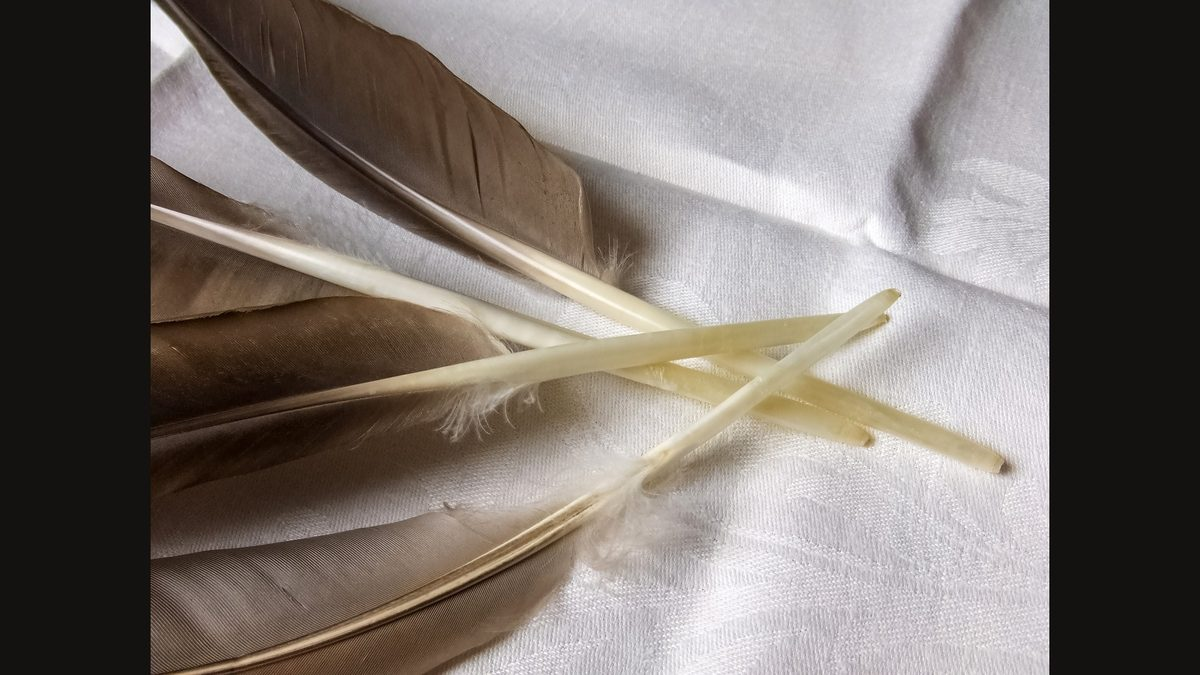
A feather straight off a goose is not a pen. It is greasy, soft, and full of membrane, and it will not hold an edge. It first had to be cured — the trade called this clarifying or dutching. The shaft was scraped clean, the loose membrane drawn out of the barrel, and the whole feather plunged into hot sand or hot ash until the fat cooked out of the keratin and the shaft hardened and went translucent. Only then was it ready to cut.
Cutting the nib itself took a practiced hand perhaps a minute: a knife sliced the tip at an angle, hollowed out the underside, split a narrow slit up the centre so ink could travel to the point by capillary action, and shaped the two shoulders that gave the nib its spring. And a cut nib did not last. Under steady use it wore soft within days, sometimes within a single long session of writing, and had to be recut again and again before the barrel grew too short to hold. A scribe working full time went through the same process the way a modern office goes through pencils, which is exactly why every writing desk, every counting house and every schoolroom kept a small, very sharp folding knife close at hand for no other purpose. It was named for that one job. A pen knife. The blade in a kitchen drawer today borrows its name from a tool for sharpening feathers.
The documents this method actually produced
Nearly every manuscript now kept behind glass in a national archive was written this way, one stroke at a time. Great Domesday, the survey William the Conqueror ordered in 1085 and had compiled the following year, was written by a single main scribe across most of its counties and then checked and corrected by a second; its companion volume, Little Domesday, covering Norfolk, Suffolk and Essex, was the work of at least six different hands, each with its own quill and its own habits of abbreviation. Magna Carta survives today in four exemplars from 1215, two of them held by the British Library, each produced by a professional scribe working from a single approved text.
The same method, essentially unchanged, produced the founding documents of the United States five and a half centuries later. On 17 September 1787, thirty-nine delegates in Philadelphia signed the Constitution using a silver inkstand made in 1752 by the Philadelphia silversmith Philip Syng — the same inkstand, by the National Park Service’s own account, that had already been used for the signing of the Declaration of Independence eleven years earlier. It survives today, one of only a small number of objects known to have been physically present at the Constitutional Convention, and it is on permanent public display at Independence Hall.
An industry, not a craft, by the time it collapsed
By the early nineteenth century the scale of quill supply had stopped looking anything like a village craft. Britain alone was importing feathers by the tens of millions annually from the Netherlands, Norway, Iceland, Germany, Poland and Russia to meet domestic demand; contemporary trade estimates for the 1830s put the total in the range of twenty million imported quill feathers a year, on top of whatever domestic geese supplied. Specialist pen-cutters worked this supply into finished nibs for sale: a London trade card surviving from around 1750 advertises Richard Green, “Pen-Cutter and Dealer in Quills,” at the Sign of the Hand and Pen-Knife on Fleet Street, selling Dutch quills, clarified quills, crow quills and office pens by the hundred, wholesale and retail.
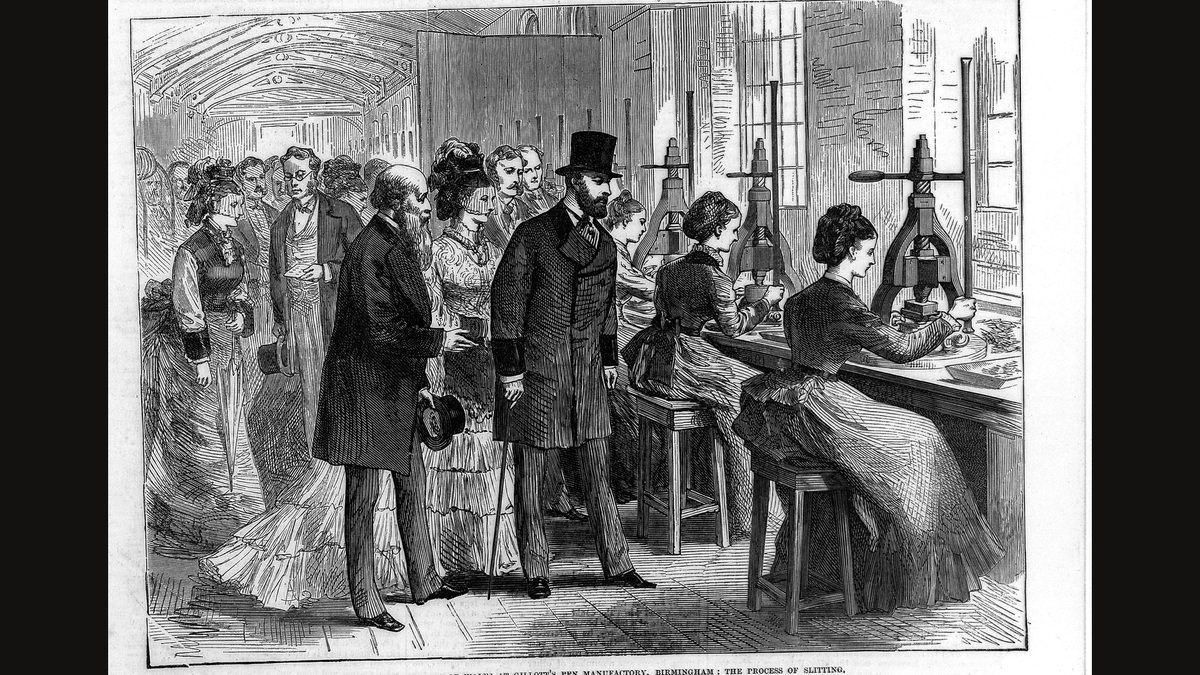
What ended this trade almost overnight was Birmingham. Hand-cut steel nibs had existed for decades and were expensive and generally poor. Starting in the 1820s, manufacturers there — most prominently Joseph Gillott, alongside Josiah Mason and John Mitchell — worked out how to press and slit steel nibs by machine, mostly using women workers at hand presses, at a volume no hand-cutter could approach. The numbers reported for Gillott’s own factory vary by source and by year, which is itself worth noting rather than smoothing over: contemporary trade figures credit him with roughly 70 million nibs in 1842 and over 100 million the following year, while the Pen Museum in Birmingham — the only UK museum devoted to the trade — credits the city as a whole with producing something like three-quarters of the world’s steel pens by the height of the industry, across some 129 firms employing roughly eight thousand workers. Whichever figure is closer, the shape of the story is the same: a nib that had cost several shillings by hand fell to a fraction of a penny by machine, and the quill-cutting trade did not decline gently so much as collapse within a couple of decades.
What survived the collapse
The steel nib that replaced the quill is, mechanically, a metal copy of one: the slit, the shoulders and the point are all directly descended from what a pen-knife once cut into a feather by hand. The Smithsonian’s National Museum of American History dates the quill’s role as the primary American writing instrument as lasting right up until the mass production of steel dip pens took hold around 1820 — effectively the same decade Birmingham’s presses started running.
And the object itself never fully disappeared from public life. Thomas Jefferson, who by the Monticello Foundation’s own count wrote something close to twenty thousand letters over his lifetime, kept a flock of geese at his Virginia estate for the specific purpose of never running short of a feather to cut. Two centuries later, the Supreme Court of the United States still places two matched, hand-cut goose quills at every seat at counsel’s table before oral argument, a practice the Court’s own history traces back to Chief Justice John Marshall’s earliest sessions in the early 1800s. The Court estimates it hands out roughly 650 pairs a year, mostly as keepsakes rather than working pens, and the lawyers who argue there almost always take them home.
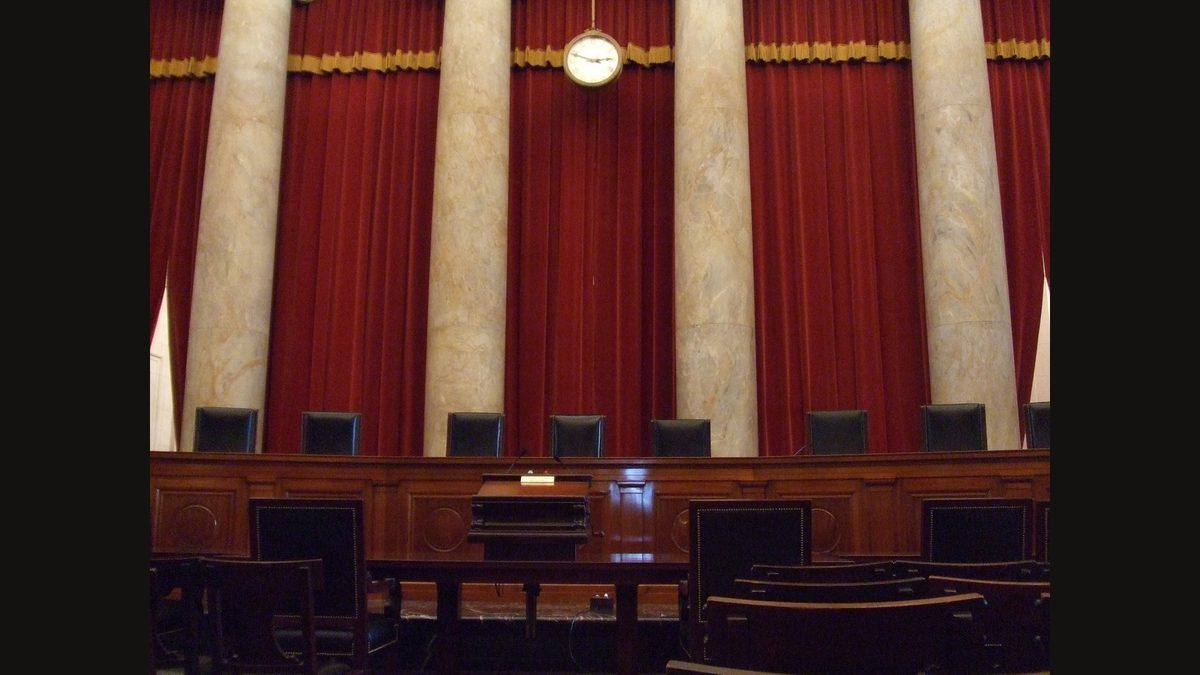
A twelve-hundred-year-old writing technology, laid out on a table, in front of people arguing about a case that did not exist when the practice began. Everything from the shape of a modern pen’s tip to the name of the knife in a kitchen drawer still carries a trace of the feather it replaced.
Watch the full history
The video version covers the same ground — which birds, which wing, and why Birmingham won — in just over five minutes.

Related reading
- How Sod Houses Were Built on the Nebraska Prairie: The Construction, the Homestead Act, and the Life Inside
- Why the Spittoon Disappeared: The Laws That Made Spitting a Crime
- How One Farmer’s Patent Rebuilt the American Barn
- Butter and Egg Money: How Farm Wives Financed the Household
Shop this history
A few things connected to this story, :
- Quill pen and ink set
- Steven Roger Fischer, A History of Writing
- Founding documents on antiqued parchment
Works cited
- Isidore of Seville. The Etymologies of Isidore of Seville. Translated by Stephen A. Barney, W. J. Lewis, J. A. Beach, and Oliver Berghof. Cambridge University Press, 2006. Book VI, on the reed pen (calamus) and the feather pen (penna).
- “Quill Pen.” National Museum of American History, Smithsonian Institution.
- “The History of the Steel Pen Trade.” Pen Museum, Birmingham. Link.
- Landow, George P. “Joseph Gillott’s Pen-Nibs, Sheet Steel, and the Writing Revolution.” The Victorian Web. Link.
- “Writing Instruments and Ink.” Thomas Jefferson Encyclopedia, Thomas Jefferson Foundation, Monticello.
- “The Court and Its Traditions.” Supreme Court of the United States. Link.
- Weiss, Debra Cassens. “What Do Supreme Court Advocates Do With Their Feather Quill Mementos?” ABA Journal. Link.
- “Domesday Book.” Research guide, The National Archives (UK). Link.
- “Magna Carta, 1215 and Beyond.” Education resource, The National Archives (UK). Link.
- “The Great Essentials Exhibit.” Independence National Historical Park, U.S. National Park Service. Link.