
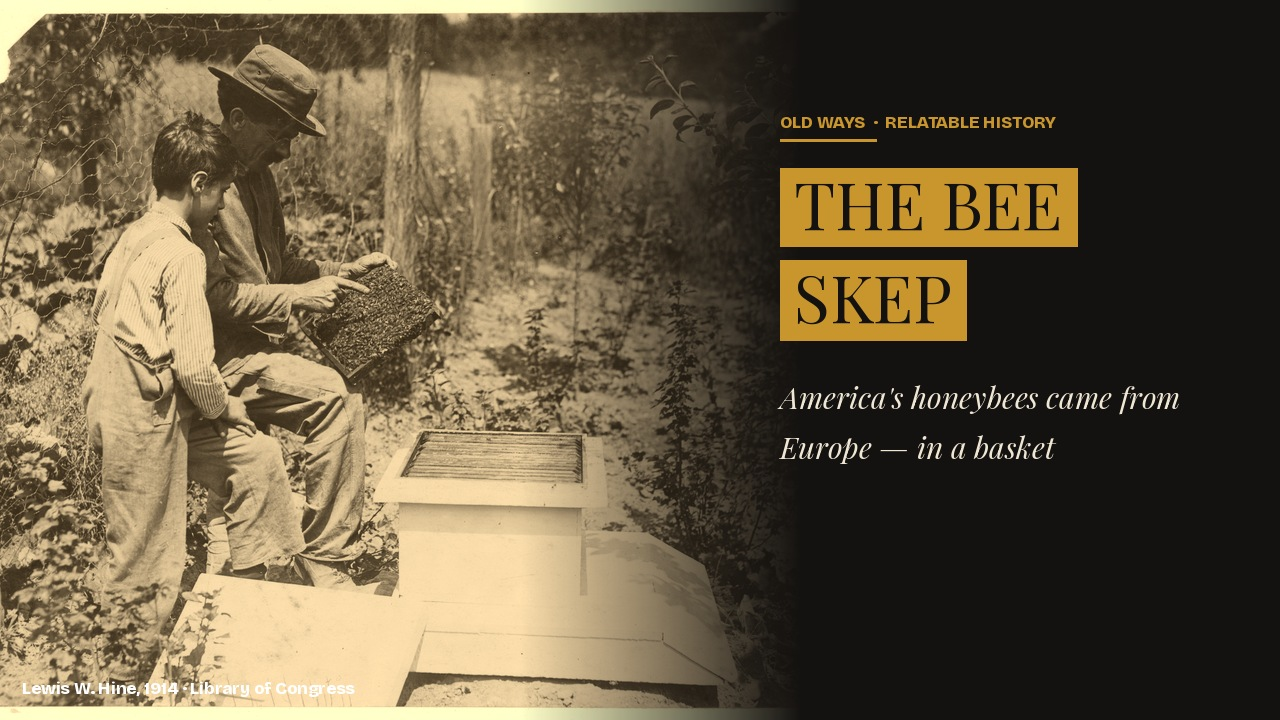
Honeybees are not native to the Americas — except that, fourteen million years ago, they were. In 2009 a paleontologist sorting through Miocene-era shale from west-central Nevada recognized a wing print he had never expected to find on this continent: a fossil honeybee, the first Apis species ever identified in the Western Hemisphere. Apis nearctica had been extinct for millions of years by the time European colonists started shipping live hives across the Atlantic in the 1620s, which means every honeybee working a North American flower today is an immigrant’s descendant, not a survivor’s. This is the story of how skep beekeeping worked, in the two centuries between that first shipment and the invention that ended it.
Those first colonial shipments arrived as cargo, packed the same way settlers packed seed corn and breeding stock. The Virginia Company’s own letter to the colony, dated December 1621, lists beehives among the seed, fruit trees, pigeons and rabbits sent over that winter, and the hives were ashore at Jamestown by early 1622. A popular tradition holds that Native observers called the newcomer insect the “white man’s fly,” reading a swarm in the woods as a sign that settlers would soon follow. At least one historian has traced that specific phrase to a seventeenth-century missionary’s translation choice rather than to any Native American idiom on record, which is a useful reminder that even a widely repeated bit of colonial folklore deserves a second look before it gets treated as settled fact.
What is not in dispute is the hive those bees were shipped in. From that first Virginia landing until 1852, nearly every household that kept bees in Britain and colonial America kept them in a skep — a domed basket with no frames, no drawers and nothing a beekeeper could remove without tearing the whole nest apart. That single design limitation shaped two centuries of beekeeping, and it is why, for most of that span, taking the honey usually meant killing the colony that made it.
A Woven Basket With Nothing You Could Take Apart
A skep was built from a single rope of straw, usually rye straw, coiled as thick as a finger and stitched ring by ring with thin strips of split bramble or willow. It was the same coiling technique used for grain baskets and cheese molds, worked by hand into a dome that held roughly a bushel and a half of bees and comb, then set on a plain board or garden shelf. Skep-making was a real cottage trade in its own right — village skeppists coiled and sold them at market alongside ordinary baskets, well into the nineteenth century.
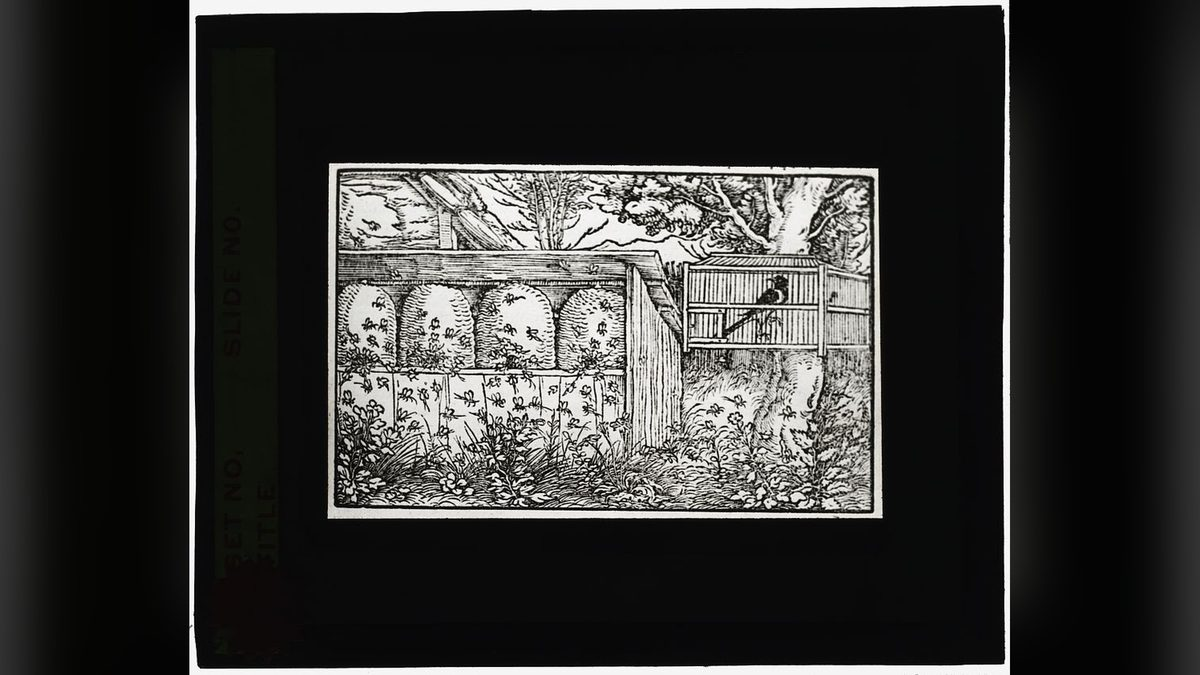
In England, many skeps lived out of the weather in bee boles: arched recesses built directly into a south-facing stone garden wall, one basket to a niche. Dr. Eva Crane began formally cataloguing them in 1952, and the resulting Bee Boles Register, now held by the Eva Crane Trust after the International Bee Research Association transferred it in 2022, documents more than 1,600 sites across the United Kingdom and Ireland — stone walls still standing with the recesses built into them, whether or not anyone has kept a skep there in a century.
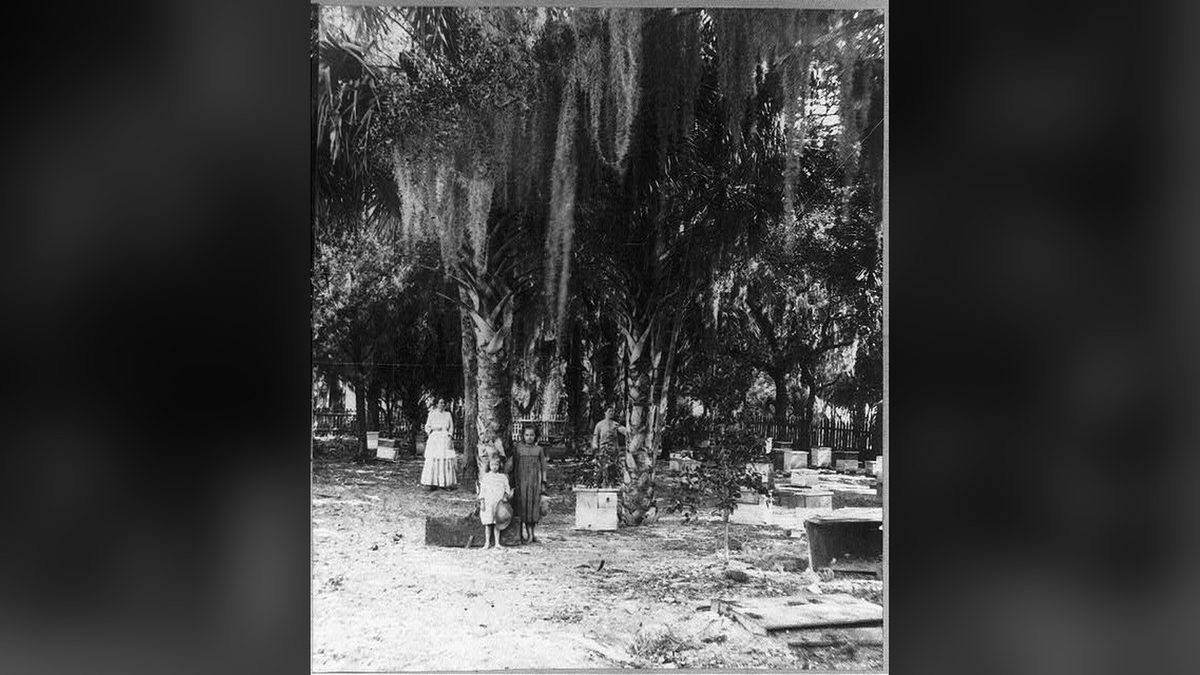
In the American South, settlers often skipped the woven basket altogether and used a “bee gum” instead: a yard-long section cut from a hollow black-gum or sweetgum trunk, stood on end with a board laid over the top. The wood’s stringy, interlocked grain made a hollowed log resist splitting, and the name stuck so firmly in vernacular use that in parts of the rural South, any beehive at all — basket or box — was simply called a gum. Appalachian hunters went further still, tracking wild colonies back to a hollow tree by releasing a marked bee and timing its “beeline” home, a skill documented in oral-history collections right up to living memory.

How Skep Beekeeping Worked: Two Tricks That Could Spare the Colony
A skep could not be opened for inspection, but a patient beekeeper had two workarounds. The gentler was supering: cutting a hole in the top of the main skep and setting a smaller basket, called a cap, over it, so a strong colony would store its surplus honey up there, away from the brood nest below. Lift the cap in autumn and a beekeeper had real honey without touching the colony that made it.
The second was driving: turning a full skep upside down, setting an empty one mouth-to-mouth on top of it, and drumming steadily on the sides until the whole colony marched upward into the new basket, leaving the old comb behind to be cut out clean. English beekeepers such as Thomas Wildman were demonstrating driving and other non-lethal handling methods as early as the 1760s, and his 1768 treatise on the subject remained a standard reference for decades afterward.
Both tricks shared the same limitation: they only worked on a hive strong enough to spare the honey, and most skeps, most years, weren’t. For the majority of baskets every autumn, harvesting still meant killing the bees first.
Taking the Skep Usually Meant Killing It
The standard method was the brimstone match: a strip of cloth dipped in melted sulfur, lit, and dropped into a pit dug beneath the hive, which was then flipped upside down over the fumes until every bee inside suffocated. Beekeepers called the whole operation “taking the skep,” and it was final — there was no colony left afterward to rebuild.
The practice had a cruel internal logic. Beekeepers naturally took their heaviest, most productive hives first, since those held the most honey worth the trouble. That meant the strongest, most successful colonies were destroyed every single year, while the weaker hives that hadn’t produced enough honey to bother killing were the ones left standing to swarm and breed. It was a slow-motion selection pressure running in exactly the wrong direction, and nobody at the time had a name for it. It simply ran, season after season, for as long as the skep remained the standard hive.
Tending the Hives Was Steady, Unpaid Work
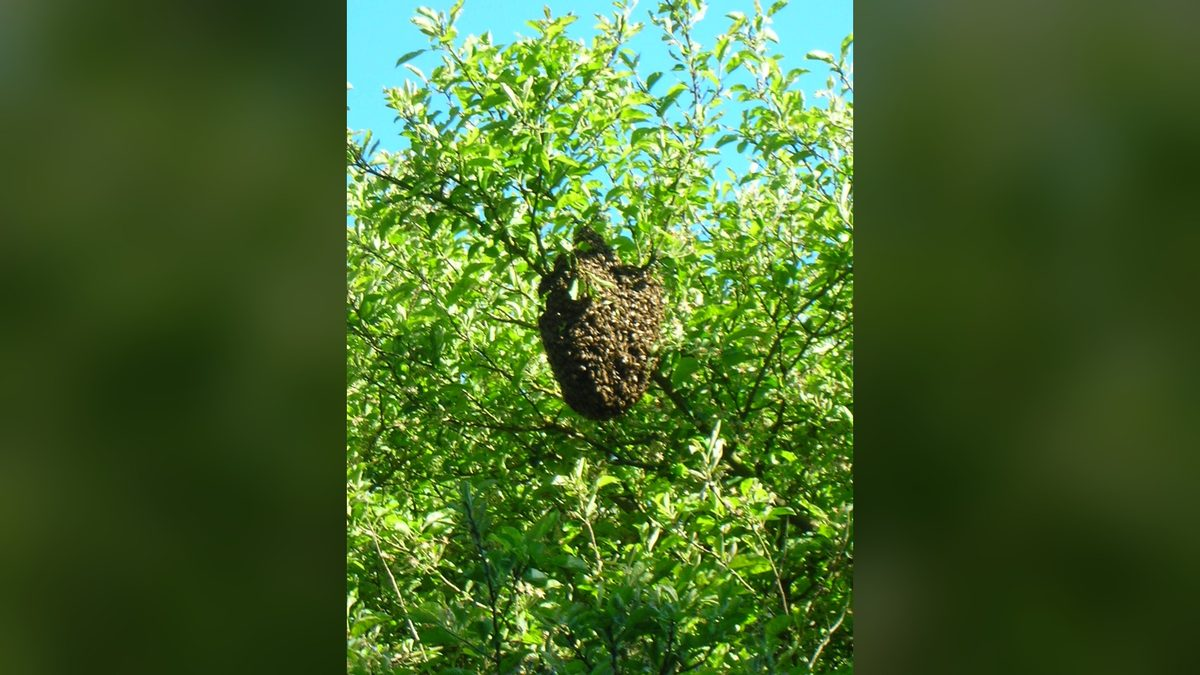
On most farms, the bees fell to the women of the household, worked in alongside churning, canning and the rest of a kitchen’s year-round labor — the same kind of unpaid, essential work that kept a farm’s summer kitchen running. Spring meant watching for swarms: when a hive grew crowded, roughly half the colony would leave with the old queen and settle on a nearby branch, and whoever caught that cluster in an empty skep got a new hive for free. Timing mattered enough to produce its own proverb, repeated on both sides of the Atlantic: a swarm in May was worth a load of hay, a swarm in June a silver spoon, and a swarm in July wasn’t worth a fly — because a late swarm had no season left to build stores before winter.
Honey was one of the only sweeteners most households had before refined sugar became cheap and common — a scarcity that, in other parts of the same farm economy, also drove the maple sugar economy. Beeswax rendered from broken comb was just as valuable, dipped into candles or worked into thread wax and furniture polish, so that nothing from a taken hive went to waste. Bees were woven into family life past the pantry, too: it was common practice, when someone in the household died, to walk out to the skeps and “tell the bees” — speaking the news to the hive directly, often tying a scrap of black cloth to the basket, in the belief that a hive left uninformed might sicken or abandon its skep for good. The American poet John Greenleaf Whittier gave the custom its best-known treatment in a poem titled simply “Telling the Bees,” published in 1858, by which point the practice was already old enough to be nostalgic. It survived in parts of New England and rural Britain well past the point where anyone kept bees that way any more.
The Three-Eighths-Inch Gap That Ended Two Hundred Years
The skep’s run ended with one precise observation. In 1851, an American clergyman named Lorenzo Langstroth noticed that bees consistently left a gap of about three-eighths of an inch around any piece of comb — neither sealing it with propolis nor building new comb through it. Make every gap in a hive exactly that width, he reasoned, and a beekeeper could build frames that lifted straight out without disturbing the comb beside them. He patented the movable-frame hive in 1852 and laid out the whole system the following year in The Hive and the Honey-Bee: A Bee-Keeper’s Manual, which became the standard American reference on the subject for the rest of the century. For the first time, a person could open a colony, take its honey, and hand the empty comb straight back for the bees to refill.
An Austrian-born beekeeper named Franz von Hruschka finished the job in the winter of 1864 and 1865 with the centrifugal honey extractor, a hand-cranked drum that spun honey out of the comb by force alone and left the wax intact to be reused. Exactly how he arrived at the idea is less settled than the invention itself: one popular story credits a child swinging a basket of comb in a sling, while historians have floated a less romantic alternative — that Hruschka adapted the spinning drums of a nearby sugar refinery, which separated crystallized sugar from molasses the same way. Either way, a beekeeper could now get more honey, more often, from a hive that never had to be killed to harvest it.
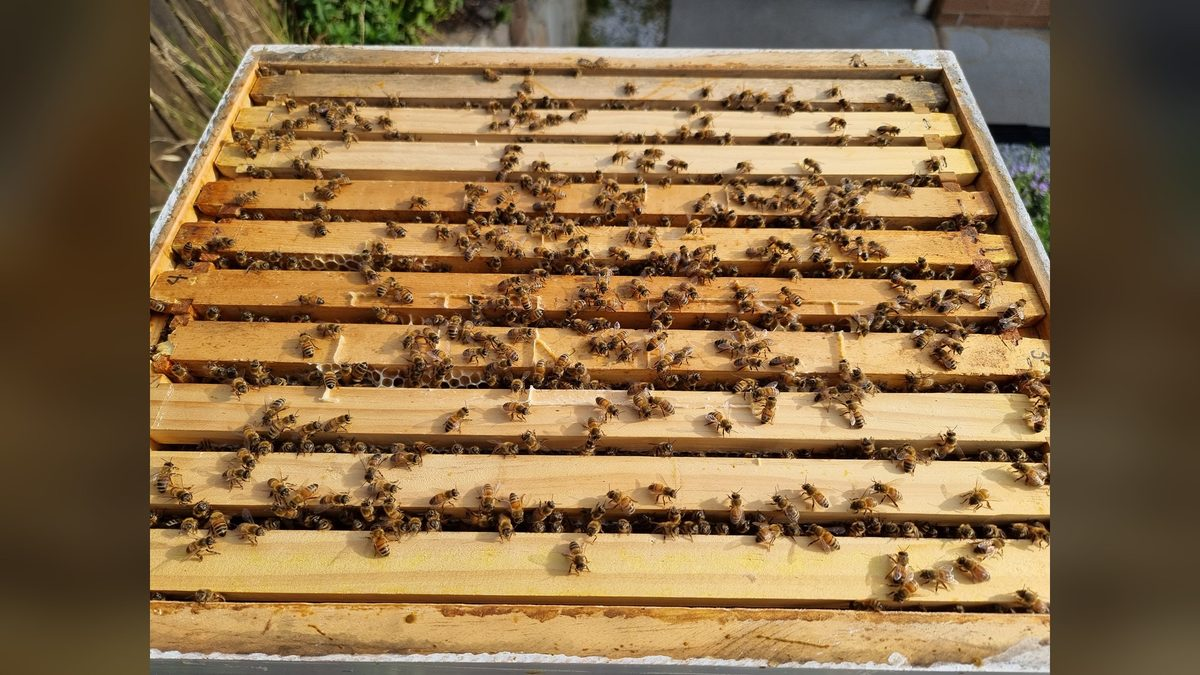
Skeps did not disappear overnight, but their working days were numbered once a cheaper, non-lethal alternative existed. They lingered afterward mostly as swarm-catchers and garden ornaments, which is the only reason so many survive to be photographed today. A handful of hobbyists still keep one, usually for the look of the thing, but no commercial beekeeper has relied on a skep in well over a century.
The skep era lasted a little over two hundred years — a brief chapter next to the fourteen million years Apis nearctica had already been extinct before a single colonial ship crossed the Atlantic, and a shorter one still next to the roughly four hundred years honeybees have now been back on this continent. What changed in 1852 wasn’t the insect. It was the relationship: a farm household went from managing a colony through controlled, annual destruction to being able to open the hive, look inside, and hand the comb back intact.
Plenty of the skep’s era survives only because it stopped being useful before it could be worn out or thrown away — the same reason a root cellar or a water-powered grist mill can still be found standing on an old farm, a solution to a problem that refrigeration and the factory eventually solved outright. How would you get honey without losing the bees that made it? For two hundred years, the honest answer was: usually, you wouldn’t.
Watch the full history
The video version covers the shape of a skep, the sulfur-pit harvest, and the 1852 frame hive that replaced it in about nine minutes.

Related reading
- How Cider, Not Beer, Became Colonial America’s Everyday Drink — cider was the other everyday farm drink honey money sometimes bought
- How a Water-Powered Grist Mill Turned Wheat Into Flour, No Cash Involved — another water- and wind-powered workaround from the same homestead toolkit
- Who Really Worked in America’s Summer Kitchens — the same unpaid household labor that tending the skeps fell under
- The Maple Sugar Abolition Movement That Almost Worked — the other home-grown sweetener farms leaned on before cheap refined sugar
- How a Root Cellar Kept Vegetables All Winter: The Farm’s Biggest Refrigerator Was a Hole in the Ground — a root cellar solved by digging what a skep solved by weaving
Shop the history
- The World History of Beekeeping and Honey Hunting, by Eva Crane — the standard scholarly history this article draws on.
- Beekeeping skep baskets
Works cited
- Engel, Michael S., Ismael A. Hinojosa-Díaz, and Alexandr P. Rasnitsyn. “A Honey Bee from the Miocene of Nevada and the Biogeography of Apis (Hymenoptera: Apidae: Apini).” Proceedings of the California Academy of Sciences, 4th ser., 60, no. 3 (2009): 23–38.
- Crane, Eva. The World History of Beekeeping and Honey Hunting. Routledge, 2000. Link.
- Langstroth, L. L. Langstroth on the Hive and the Honey-Bee: A Bee-Keeper’s Manual. Hopkins, Bridgman & Co., 1853. Link.
- Wildman, Thomas. A Treatise on the Management of Bees. London: printed for the author, 1768.
- “About Bee Boles and the Register.” Eva Crane Trust / International Bee Research Association. Link.
- “A swarm in May is worth a load of hay…” The Oxford Dictionary of Proverbs, Oxford Reference.
- Mangum, Wyatt A. “An Early History of the Honey Extractor in America.” American Bee Journal, September 1, 2016. Link.
- Norman, Mark. “Telling the Bees: The Folklore of Bees and Beekeeping.” FolkloreThursday. Link.
- Grymes, Charlie. “Honeybees in Virginia.” Virginia Places, updated 2024. Link.
- Schenawolf, Harry. “Honey Bees in Early America: White Man’s Flies, Fact and Fiction.” Revolutionary War Journal. Link.
- “Keeping Company with Bees.” Folklife Today, Library of Congress, June 2024. Link.