
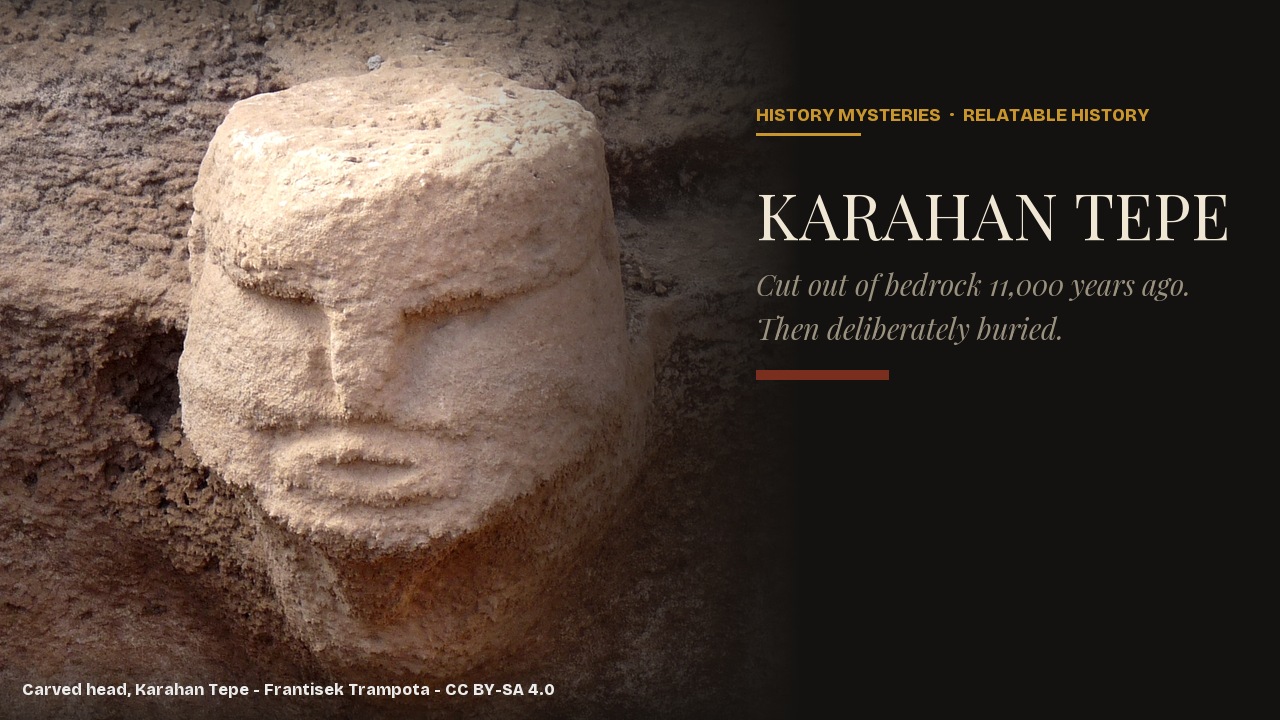
In the hill country east of Şanlıurfa, in southeastern Turkey, archaeologists dug into a chamber that people had cut directly out of bedrock roughly eleven thousand years ago — and found that its builders had, at some point, filled it back in with earth and broken stone. Nobody left Structure AB, as the room is now called, to collapse on its own. Somebody closed it, thoroughly and on purpose. The same thing happened at the nearby site that first put this landscape in headlines, and at both, nobody has a solid answer for why Karahan Tepe was buried on purpose.
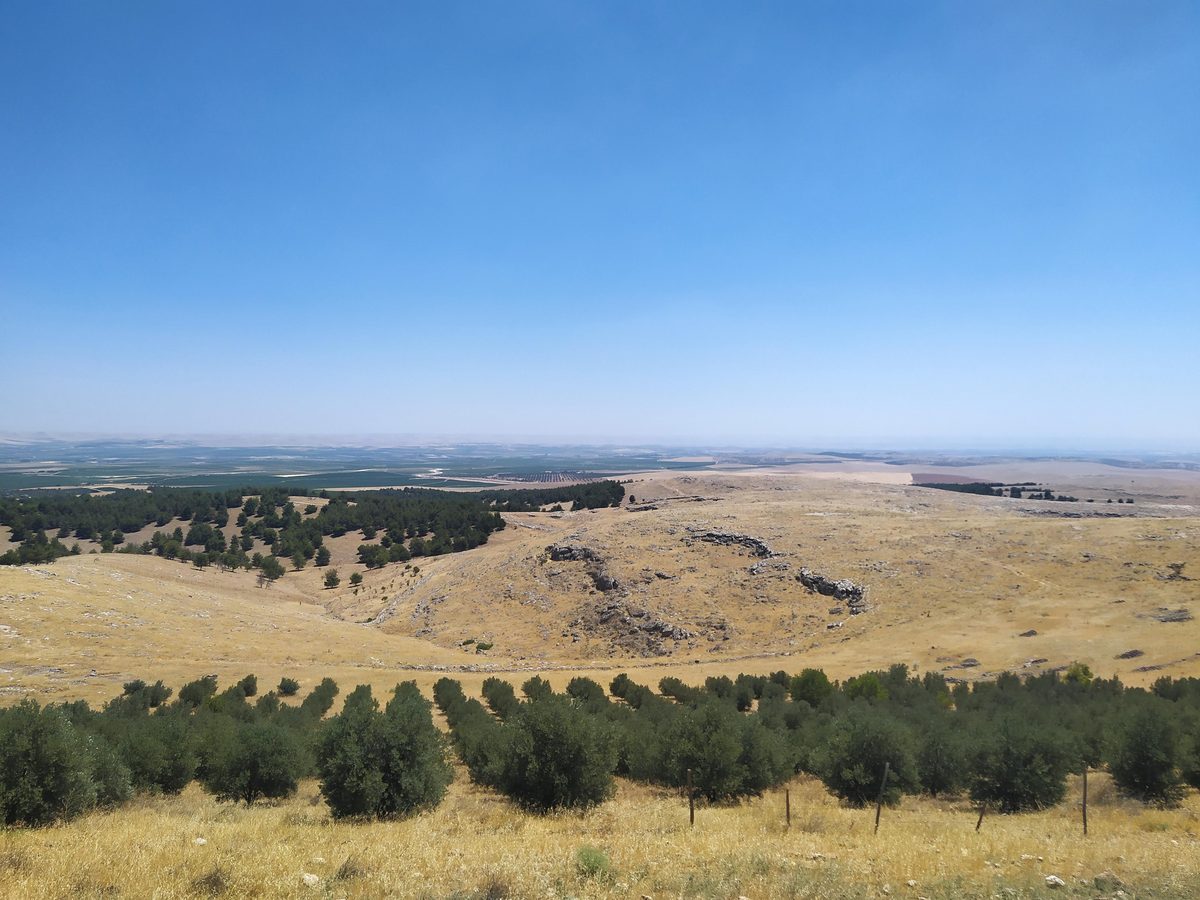
The chamber belongs to Karahan Tepe, a Pre-Pottery Neolithic site on a limestone ridge in the Tek Tek Mountains, part of the cluster of sites — including Göbekli Tepe and roughly a dozen others — that make up Turkey’s Taş Tepeler, or ‘Stone Hills,’ landscape. Most recent reporting dates the site to somewhere between eleven and twelve thousand years old, placing its main use in the tenth and ninth millennia BC — two thousand years before anyone nearby kept a flock or planted a field on purpose. Its builders had no writing, no pottery, and no metal tools — only the organisation to cut more than 250 T-shaped stone pillars, several straight out of living rock, and, apparently, the discipline to bury their own best work.
This is the fuller version of the story behind the carved head seen in most of the photographs: how the site was found and then left alone for twenty years, what the carvings actually show, why the team that first called a neighbouring site ‘the world’s first temple’ has spent a decade revising its own claim, and why the deliberate backfilling that let any of this survive remains unexplained.
A pillar is not a post — it’s a person, carved sideways
The find came early and the digging came late. In 1997, Bahattin Çelik of Harran University was surveying the Tek Tek Mountains when he noticed stone uprights breaking the surface of a hillside locals called Keçilitepe, or ‘Goat Hill.’ He published the find in 2000, in the specialist newsletter Neo-Lithics, counting more than 260 T-shaped pillars visible on the surface alone, without a single trench dug. Then the site sat untouched for two decades. Not far away, Göbekli Tepe — found independently and excavated from 1995 by the German Archaeological Institute’s Klaus Schmidt — had already become one of the most famous digs in the world, and it absorbed nearly all of the region’s archaeological attention.
Excavation at Karahan Tepe did not begin until 2019, under Necmi Karul of Istanbul University, as part of the Taş Tepeler programme backed by Turkey’s Ministry of Culture and Tourism. Even several seasons in, the team estimates only about five per cent of the site has been excavated, so everything that follows is necessarily a partial, regularly revised picture.
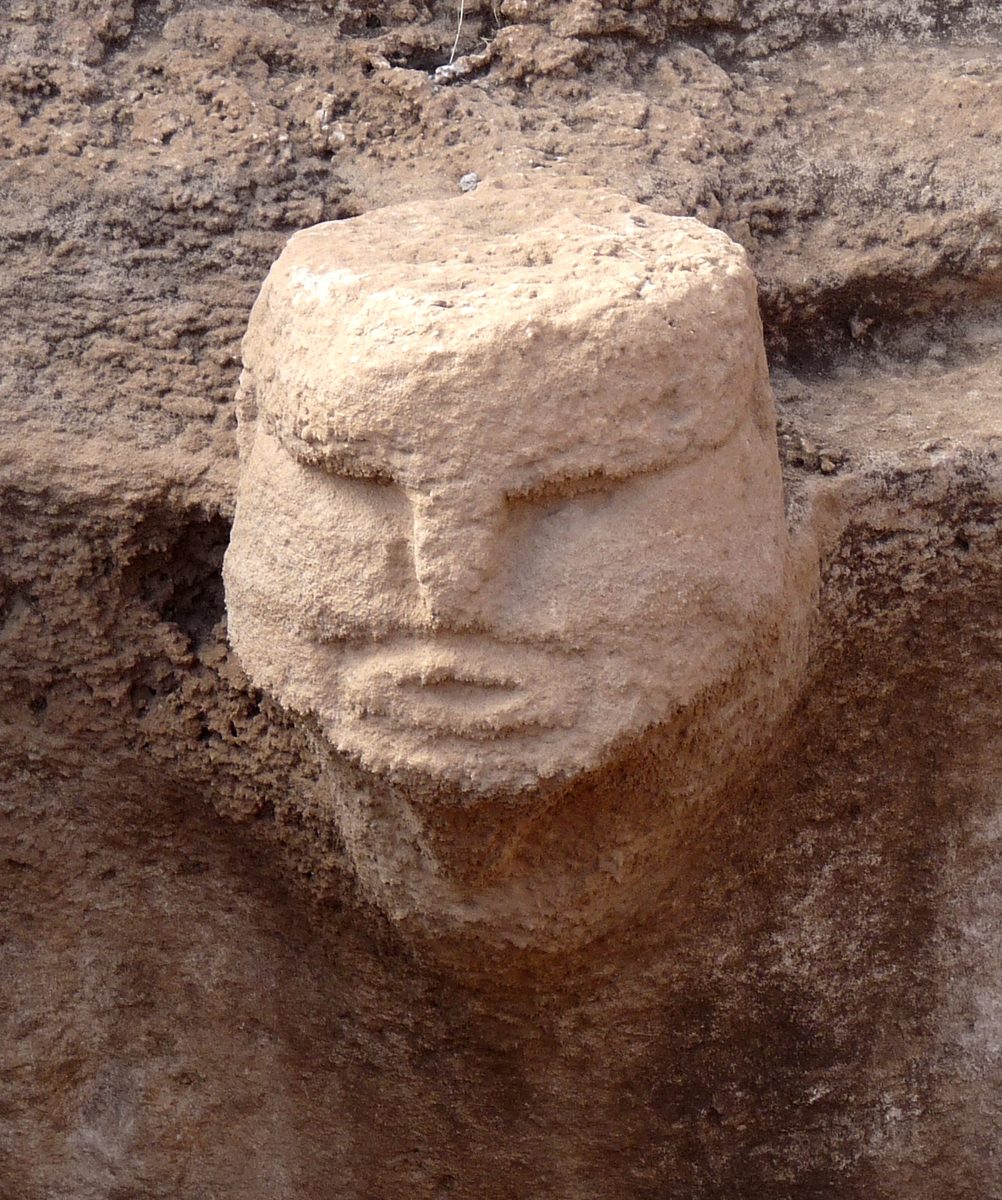
The site’s signature object is the T-shaped pillar, and the ‘T’ is doing representational work, not just structural work. The pillars are tall limestone slabs with a crossbar at the top; on the more elaborate examples, the crossbar is unmistakably a head, and the shaft below carries carved arms running down the sides, hands meeting at the front over a belt, sometimes an animal pelt rendered as a loincloth. Archaeologists reading these consistently conclude they are not decorative architecture. They are human figures, abstracted and shown from the side, standing in for people inside the buildings they support.
Structure AB was carved downward, not built upward
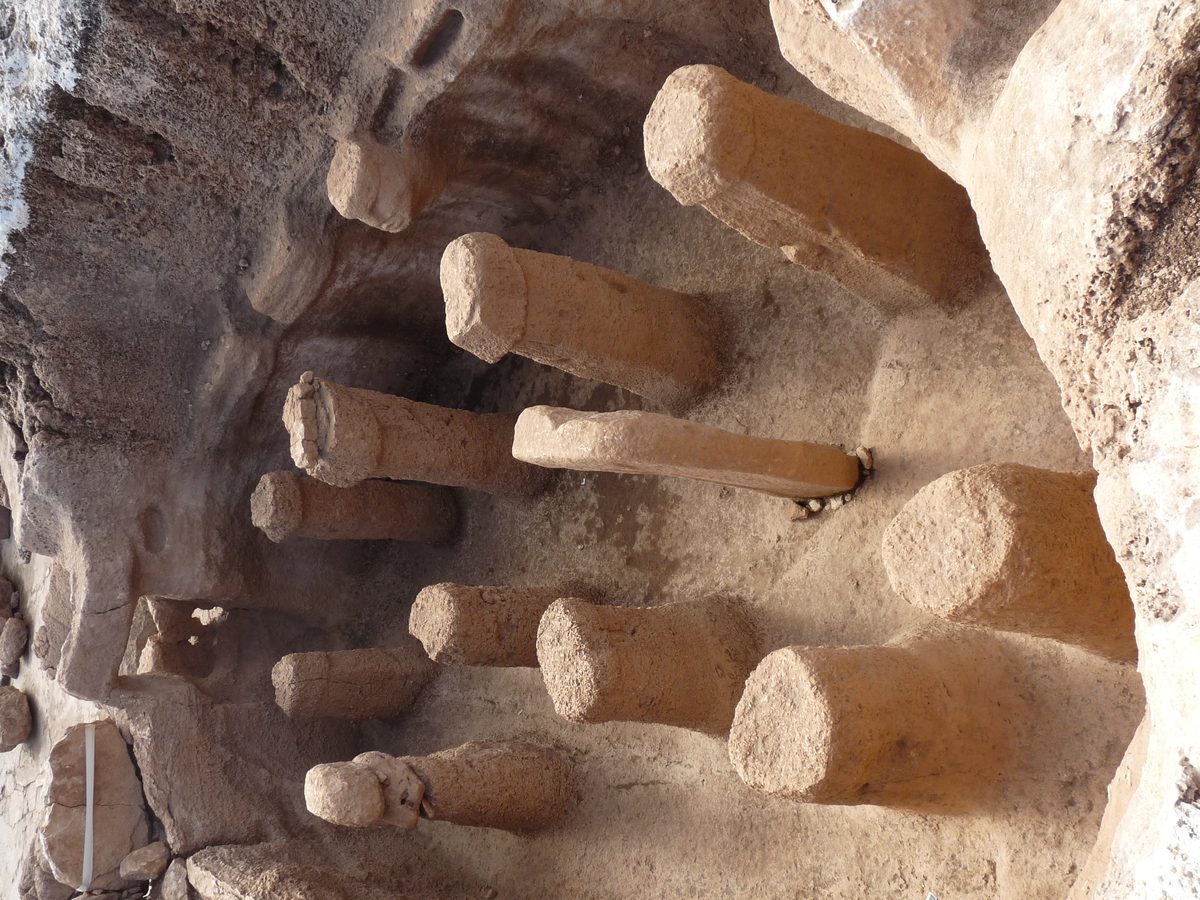
Most archaeological drama involves construction. Structure AB, the building that made Karahan Tepe famous, involved the opposite. Rather than raising walls, its builders cut a chamber down into the limestone bedrock itself and left eleven pillars standing inside it, carved from the same rock as the floor around them rather than quarried and erected separately. Karul, who has excavated the room, has been blunt about their form: “All pillars are erected and shaped like a phallus,” he told Live Science in 2021. In the wall above the pillars is the bearded, deep-set-eyed head seen in most of the site’s photography, carved with an elongated neck that runs back into the stone rather than ending at a shoulder line, so that from most angles it reads as watching the room rather than standing inside it.
A porthole-shaped opening connects Structure AB to a neighbouring structure, and Karul has floated — carefully — the idea that people once moved between the two in some kind of procession, passing the pillars and the carved head on the way through. He has also been careful to say that idea needs far more excavation and analysis before it can be treated as established. That caution fits almost everything here: the carving is well documented, but what it meant to the people who made it is still close to a blank, since they left nothing in their own words.
The faces keep arriving, and each one complicates the story
Karahan Tepe has produced an unusual number of carved human likenesses for a site this size, and each one has arrived with its own small controversy attached.
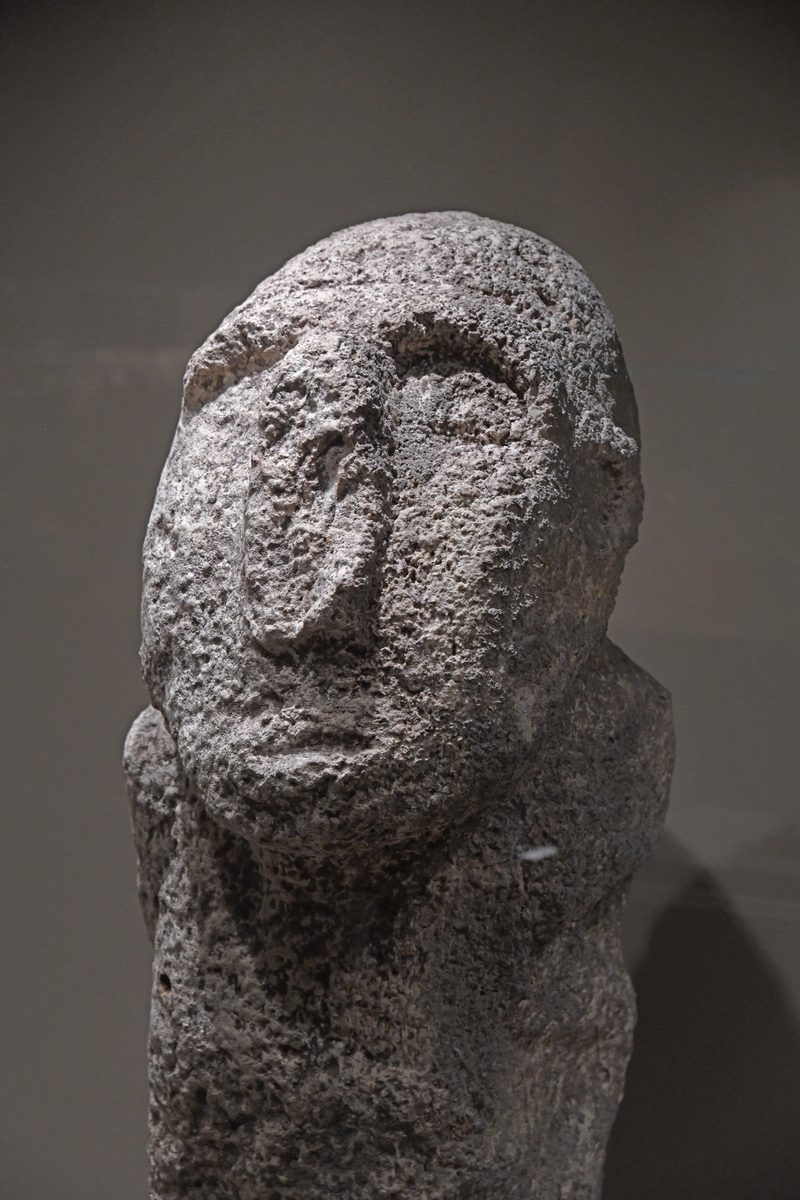
In October 2023, excavators working with the German Archaeological Institute lifted out a large seated human figure, reported variously as roughly 2.3, 2.4, and just over two metres tall depending on which announcement you read — a discrepancy that is itself a reminder that early-season figures often get revised once fuller analysis catches up with the headline. The figure’s ribs, spine, and shoulder bones are carved in sharp relief, details more often associated with a corpse than a living sitter, yet its seated pose and composed expression read, to some researchers, as unmistakably alive. A stone ledge beside it held flat plates and a small vulture sculpture. Whether the figure depicts a living person, an ancestor, or a deliberately ambiguous state between the two remains argued rather than settled.
The region’s most famous comparison piece predates all of this: Urfa Man, a 1.8-metre limestone statue found in the city of Şanlıurfa itself in 1993 and now in the Şanlıurfa Archaeology Museum, usually described as the oldest known life-sized human sculpture and dated to roughly 9500 BC.
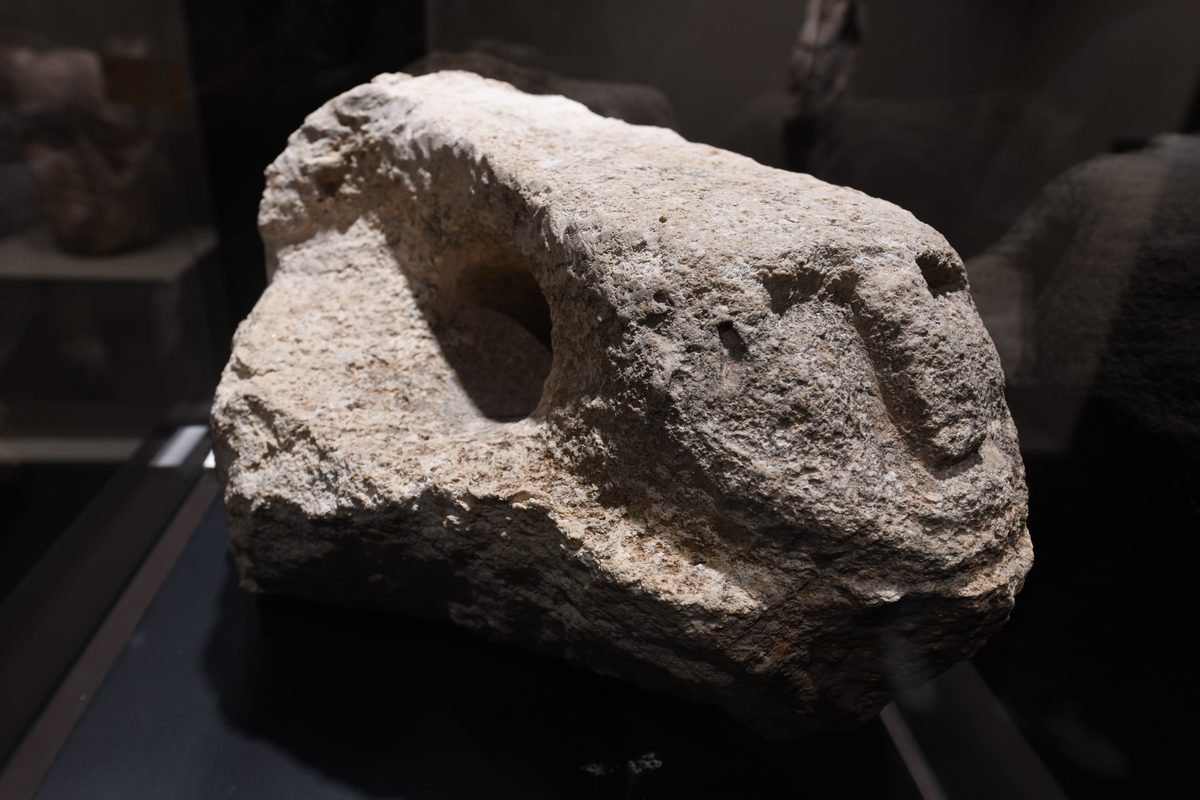
Then, in October 2025, came the pillar everyone has since seen a photograph of: a roughly 1.4-metre T-pillar carved with a simple human face — a prominent brow, a straight nose — found not standing in a shrine-like setting but doing the structural work of a buttress for a conical roof, in a building that also held ordinary grinding stones. It is the first human face ever found on a T-shaped pillar anywhere in the Taş Tepeler landscape, and Karul’s comment, relayed through The Art Newspaper, was understated: “It is fair to say that the only missing element in this pattern was the face.” Arms, hands, belts, and garments had already told archaeologists these pillars stood for people. The face, when it finally turned up, simply confirmed what the rest of the body had been arguing for years, and it turned up doing structural labour, not isolated in ceremonial splendour.
Karahan Tepe Was Buried on Purpose — and No One Can Say Why
Which brings the story back to where it started. Structure AB was not abandoned to fall apart. At some point after it was finished and used, someone packed it with earth and broken stone, deliberately and thoroughly enough that the fill is the specific reason the carvings inside survived at all, rather than weathering away in the open air for eleven thousand years. Göbekli Tepe’s enclosures were treated the same way, though the German Archaeological Institute’s own 2020 research summary now suggests at least some of that fill there may be ordinary settlement debris that slid downhill over time rather than one ceremonial act of burial — complicating the comparison rather than resolving it, since Structure AB’s fill reads, by every account so far, as more total and more deliberate.
The explanations on offer for a deliberate burial — some version of a decommissioning rite, a formal closing of a building at the end of its working life, or a purely practical move to stabilise a wall before it fell — are all plausible, and none is backed by direct evidence. They are informed guesses, and they stay guesses — much like the real explanation behind the Copper Scroll’s buried hoards, a deliberate act of concealment with no agreed motive attached to it.
Scale sharpens the mystery rather than softening it. At Göbekli Tepe, several pillars weigh multiple tonnes and had to be quarried and hauled into position — more labour, but an obvious solution. At Karahan Tepe, cutting the pillars directly from the bedrock removes the hauling problem and replaces it with a less forgiving one: there is no room for error. A mistake chiselled into bedrock cannot be swapped out the way a damaged quarried block might be. People organised that precision, sustained it across generations, and then chose, for reasons unrecorded, to bury the result.
The ‘world’s first temple’ is being revised by its own excavators
All of this sits inside an argument that has been running for two decades, and it is worth being direct about who has changed their mind.
When Klaus Schmidt began excavating Göbekli Tepe in 1995, he proposed that its circular, pillared enclosures were purpose-built ritual spaces with no ordinary domestic life attached — monuments built by hunter-gatherers who had not yet invented farming, which would mean organised religion came first and helped drive the later shift to agriculture, rather than the other way round. It was an elegant thesis, it inverted a textbook assumption, and it made Göbekli Tepe a household name; the site was formally inscribed as a UNESCO World Heritage Site in July 2018.
It has also been steadily revised since, including by people working the same soil. In 2011, the archaeologist E. B. Banning argued in Current Anthropology that the ‘fill’ inside Göbekli Tepe’s enclosures looks a great deal like ordinary settlement debris — flint tools, animal bone, dark organic-rich soil — rather than material brought in purely to bury a shrine, and that bedrock mortars and hearth-like features inside the buildings point to food processing, not just devotion — evidence, he concluded, for a resident population rather than visitors alone.
The German Archaeological Institute’s own later fieldwork went further. A 2020 summary of the 2015–2019 seasons described a rock-cut pit roughly eight metres across and 2.8 metres deep that excavators consider plausibly part of a rainwater-harvesting system — a cistern. It also describes ordinary buildings with hearths, bead and bone-tool production, and domestic-style flint, plus new radiocarbon dates showing the ‘special’ pillared enclosures were in use far longer, and more in parallel with ordinary buildings, than the original temple narrative assumed. The report’s own conclusion: the ‘World’s First Temple’ framing needs revising — and archaeologists, not only journalists, helped popularise it in the first place.
Karahan Tepe sits inside the same argument, not outside it. A T-pillar carved with a human face, holding up a roof in a room that also held grinding stones, is hard to sort cleanly into ‘sacred’ or ‘domestic,’ and researchers close to the material increasingly don’t try. Diet adds another thread: Karul has told Anadolu Agency that gazelle meat and legumes dominated the diet at Karahantepe, revising assumptions centred on grain, while Göbekli Tepe drew on a much wider range of species — a narrower economy nobody has fully explained either. Researchers now offer three live possibilities, none eliminated by the evidence: ritual centres whose gathering power helped drive farming’s spread; ordinary villages whose carved rooms simply survive better than daily life does, so modern observers over-read them; or a distinction the builders never recognised — a settlement with communal buildings at its centre, in a world with no concept that separated the sacred from the everyday.
What the record doesn’t say, and why that matters
It is worth being precise about what thousands of hours of excavation have not produced. There is no writing anywhere at Karahan Tepe, so there are no names, no inscriptions explaining intent, and no record of what language these rooms were named in. No human burials have turned up inside the special buildings excavated so far, which rules out the simplest explanation — that these were elaborate tombs — at least for now. Nothing tells researchers how long a pillar took to cut, whether the work was seasonal, or whether eleven standing pillars meant anything numerically at all. It is the same gap that leaves the full story of the Peking Man fossils unresolved: evidence that raises a question clearly enough, without supplying the answer to go with it.
A gap that size tends to get filled, and in Karahan Tepe’s case it has been filled by the lost-civilisation genre: hunter-gatherers, the argument runs, could not have organised labour on this scale, so credit must belong to some unrecorded, more advanced culture. The site’s own evidence argues against that at every turn. The limestone is local, quarried on the same hill. The tools used to cut it are local flint. The food in the middens is local gazelle and local legumes. The carving style belongs to the same idiom found at a dozen neighbouring sites currently being excavated under the same research programme, not an isolated anomaly — much like the dispute that still surrounds the Nebra Sky Disc, where physical evidence, not an appeal to lost outsiders, settles the question. If anything, the mundane sourcing makes the achievement more striking: people with no agriculture, no metal, and no writing organised skilled labour well enough to cut rooms from bedrock, and repeated the process for roughly fifteen hundred years.
Excavation continues each season, and each season so far has revised the picture rather than confirmed it. Of the broader Taş Tepeler landscape, only Göbekli Tepe currently carries UNESCO World Heritage status; Karahan Tepe remains, for now, a working excavation rather than a finished monument. The carved head in Structure AB is still in the wall, looking out at a room that was deliberately emptied of people and then deliberately filled with rubble, roughly eleven thousand years ago, for a reason its builders never wrote down.
Watch the full history
The video version covers the discovery, the carvings, and the temple-or-village debate in about nine minutes.

Related reading
- The Nebra Sky Disc Dating Dispute, Explained — another ancient-world object whose dating became a real scientific dispute.
- Linear Elamite’s Decipherment Evidence Has a Provenance Problem — a case where the evidence behind an ancient breakthrough turned out to be contested.
- The Copper Scroll Treasure Map: What Sixty-Four Lost Hoards Say — another ancient mystery where the physical evidence raises more questions than it answers.
- What Really Happened to the Peking Man Fossils? — how the physical record of a famous prehistoric find can simply vanish.
Works cited
- Çelik, Bahattin. “A New Early Neolithic Settlement: Karahan Tepe.” Neo-Lithics: The Newsletter of Southwest Asian Neolithic Research 2–3/00 (2000): 6–8.
- Banning, E. B. “So Fair a House: Göbekli Tepe and the Identification of Temples in the Pre-Pottery Neolithic of the Near East.” Current Anthropology 52, no. 5 (2011): 619–660.
- Clare, Lee. “Göbekli Tepe, Turkey – A Brief Summary of Research at a New World Heritage Site (2015–2019).” e-Forschungsberichte des DAI 2020, Issue 2: 81–88. Link.
- ÖzdoǾan, Eylem. “The Sayburç Reliefs: A Narrative Scene from the Neolithic.” Antiquity 96, no. 390 (2022): 1599–1605. Link.
- German Archaeological Institute. “Göbekli Tepe – The First 20 Years of Research, Part 1: A (Re-)Discovery (1994–1996).” The Tepe Telegrams, 2 June 2016. Link.
- Saraceni, Jessica Esther. “Prehistoric Phallus-Shaped Pillars Found in Turkey.” Archaeology Magazine, 21 October 2021. Link.
- Saraceni, Jessica Esther. “11,000-Year-Old Sculpture Uncovered in Turkey.” Archaeology Magazine, 23 October 2023. Link.
- Saraceni, Jessica Esther. “12,000-Year-Old Carving Found in Turkey.” Archaeology Magazine, 7 October 2025. Link.
- Republic of Türkiye, Ministry of Foreign Affairs. “Press Release No. 176, Regarding the Inscription of Göbekli Tepe to the UNESCO World Heritage List.” 1 July 2018. Link.
- Republic of Türkiye, Ministry of Culture and Tourism. “Do You Know the World’s First Life-Sized Human Statue?” Turkish Museums. Link.
- Hürriyet Daily News (Anadolu Agency). “Gazelle Meat, Legumes Dominated Diet in Karahantepe.” Link.