
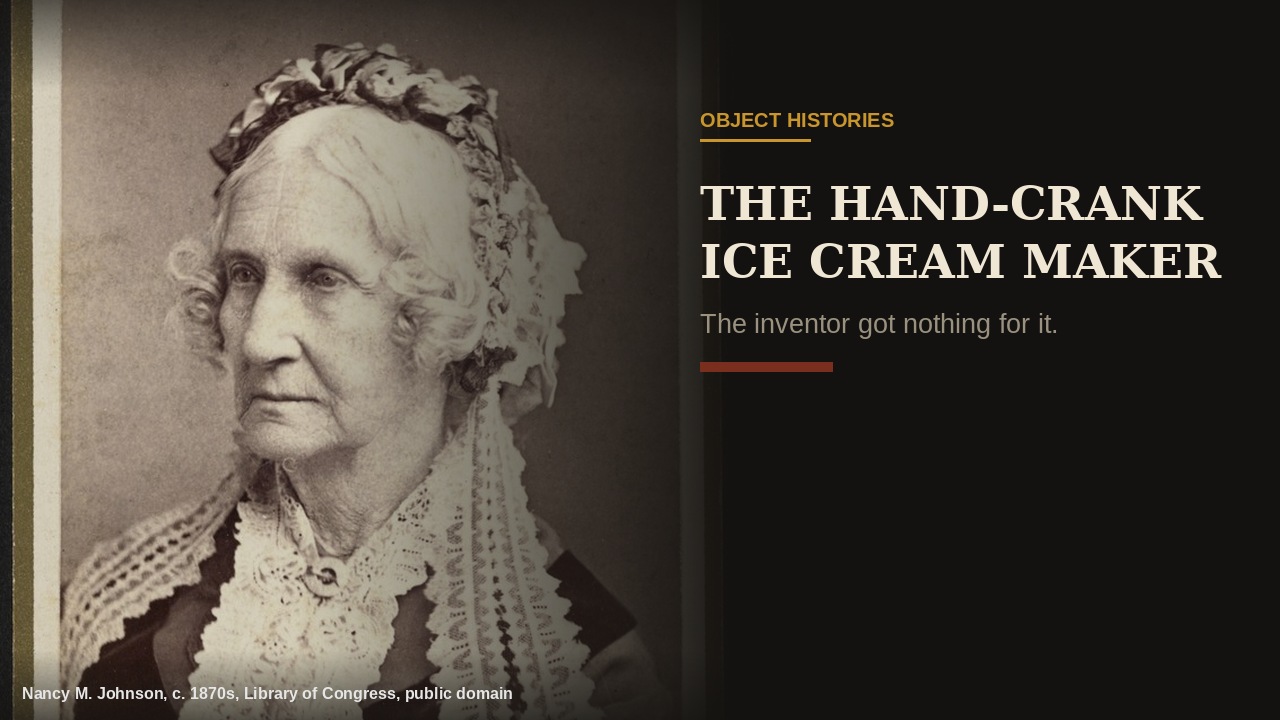
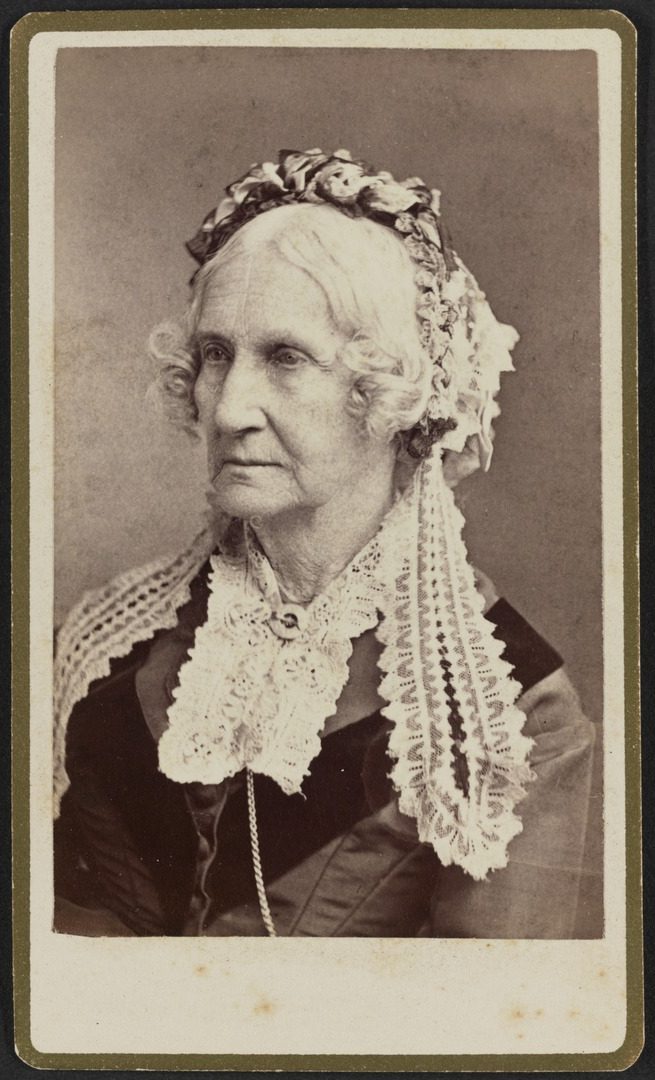
On September 9, 1843, the US Patent Office granted Patent No. 3,254 to a Philadelphia woman named Nancy M. Johnson for what she called an “artificial freezer.” It is, by any reasonable reading, the founding document of the home ice cream maker: a wooden tub, a hand-cranked cylinder, and a set of perforated paddles that still describe, component for component, the machine sold in stores today. If you want a direct answer to who invented the ice cream freezer, her patent drawing is it. Johnson sold the rights to her design for a single flat payment and, as far as the surviving record shows, never collected another cent from it.
She was not the only person reshaping American ice cream in that decade, and she was not even the one who got rich doing it. A few miles away in the same city, a Black confectioner named Augustus Jackson was building a wholesale ice cream business that would make him one of Philadelphia’s wealthiest residents — industrializing the same dessert that, until then, had belonged to households wealthy enough to afford both ice and the servants to scrape it by hand. Two very different American ice cream stories, running at the same time, in the same city, attached to two names most ice cream eaters have never heard.
This is the fuller version of both: what Johnson’s patent actually describes, what a Baltimore rival did with her design five years later, what Jackson built instead of a patent, and the separate industry — an ocean-spanning ice trade run out of Boston — that had to exist before any of this was commercially possible.
Ice cream was already an American habit, because keeping anything frozen was genuinely hard
By the time Johnson filed her patent, ice cream had already been part of elite American life for two generations, limited mostly to households that could manage both the ice and the labor. Thomas Jefferson kept a handwritten vanilla ice cream recipe, now held by the Library of Congress, that runs through roughly nineteen steps: cooking egg yolks and sugar into a custard, straining it, and freezing the result in a sabottière, a small cylindrical mold packed in ice and salt. The manuscript is undated, but Monticello’s own historians believe it dates to his years in France in the 1780s; an inventory of the Monticello kitchen taken in 1796 lists two “Freising moulds” among its equipment.
George Washington was buying similar equipment at Mount Vernon in the same years: a “Cream Machine for Ice” in May 1784, tin ice cream molds in 1792 and 1795, a dedicated ice cream spoon in 1796, and pewter and tin ice cream pots listed in his 1799 estate inventory alongside a French china service with its own dedicated ice pots and plates. Dolley Madison served it often enough at the President’s House that her guests wrote it down: a Scottish visitor recorded ice cream at one of her Wednesday “drawing rooms” in June 1809, gatherings held most weeks Congress sat, and other guests’ diaries describe it at dinners and New Year’s receptions through the 1810s.
None of that was effortless. Making ice cream meant packing a metal pot of sweetened cream into a wooden tub of ice and salt, then scraping the mixture by hand, continuously, for most of an hour, to keep it from freezing into one unworkable block. It was a job that fell to kitchen staff — paid, and in the Madisons’ case also enslaved — which is exactly why it stayed a dessert for households that could employ both.
Who invented the ice cream freezer? A genuinely clever patent, and then the record stops
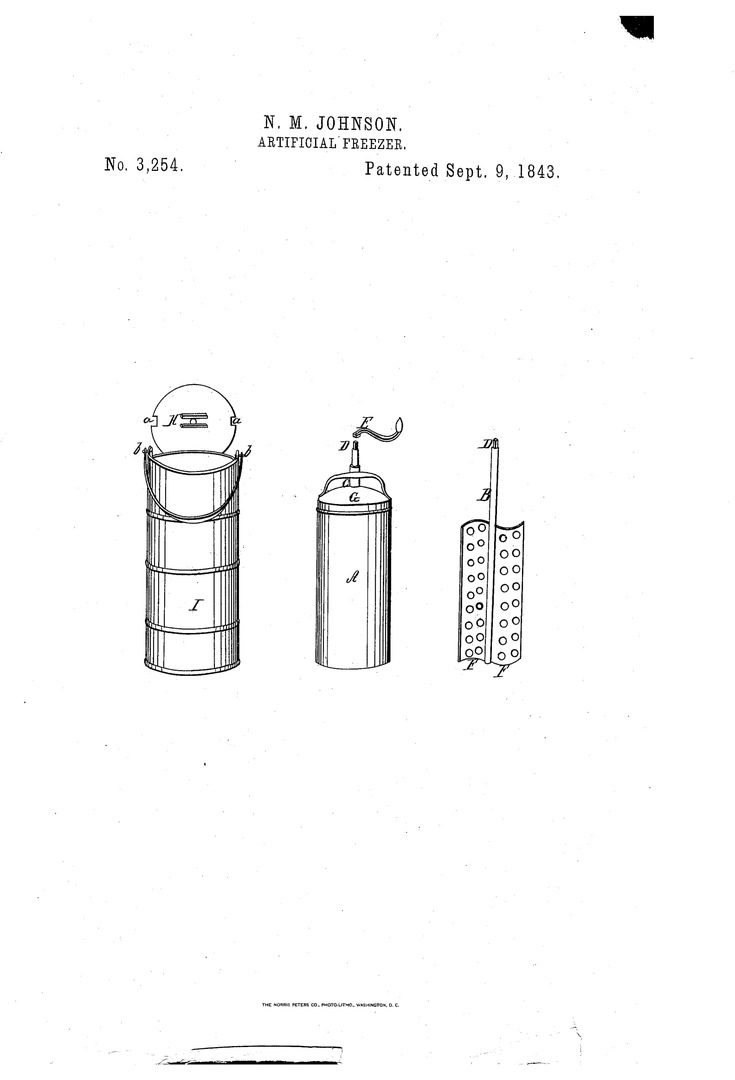
Johnson’s own patent drawing lays out three parts. A wooden tub holds the ice and salt. Inside it sits a metal cylinder, which holds the cream mixture. And inside that cylinder turns the part Johnson actually patented: a vertical shaft fitted with two or more perforated paddles, their holes roughly half an inch across, shaped in cross-section like a reversed letter S. A crank at the top, fitted with a non-conducting handle so the operator’s hand never touches cold metal, turns the shaft through a tube in the tub’s lid.
The mechanism is bidirectional by design. Turning the crank one way pushes the half-frozen cream outward against the cylinder wall; turning it the other way scrapes the frozen layer back off that wall and folds it toward the center, exposing fresh liquid to the cold surface. That scrape-and-fold action is the actual fix for the block-of-ice problem, more than the crank itself. Johnson specified materials by what they would touch: glass cylinders with hardwood or ivory paddles for acidic fruit ices, tinned iron for cream. She even worked out a way to cut the running cost, describing how the salt water draining off the ice could be evaporated so the salt itself could be reused several times over.
What her patent does not do is describe what happened to her afterward. It lists her only as “of Philadelphia,” with no occupation, no family, no later address given. Nothing in the surviving record explains why she sold the rights outright instead of licensing them, or what she did next. Reference works on the patent simply note that the rest of her life isn’t well documented — a flat admission that, for the person whose design is still turning in millions of kitchens, almost nothing else about her is actually known. The same gap shows up in another kitchen invention this site has covered, where the credited inventor’s own fate is thinner than the patent record he left behind.
Five years later, a Baltimore rival improved on “Johnston’s” design, misspelling her name while he did it
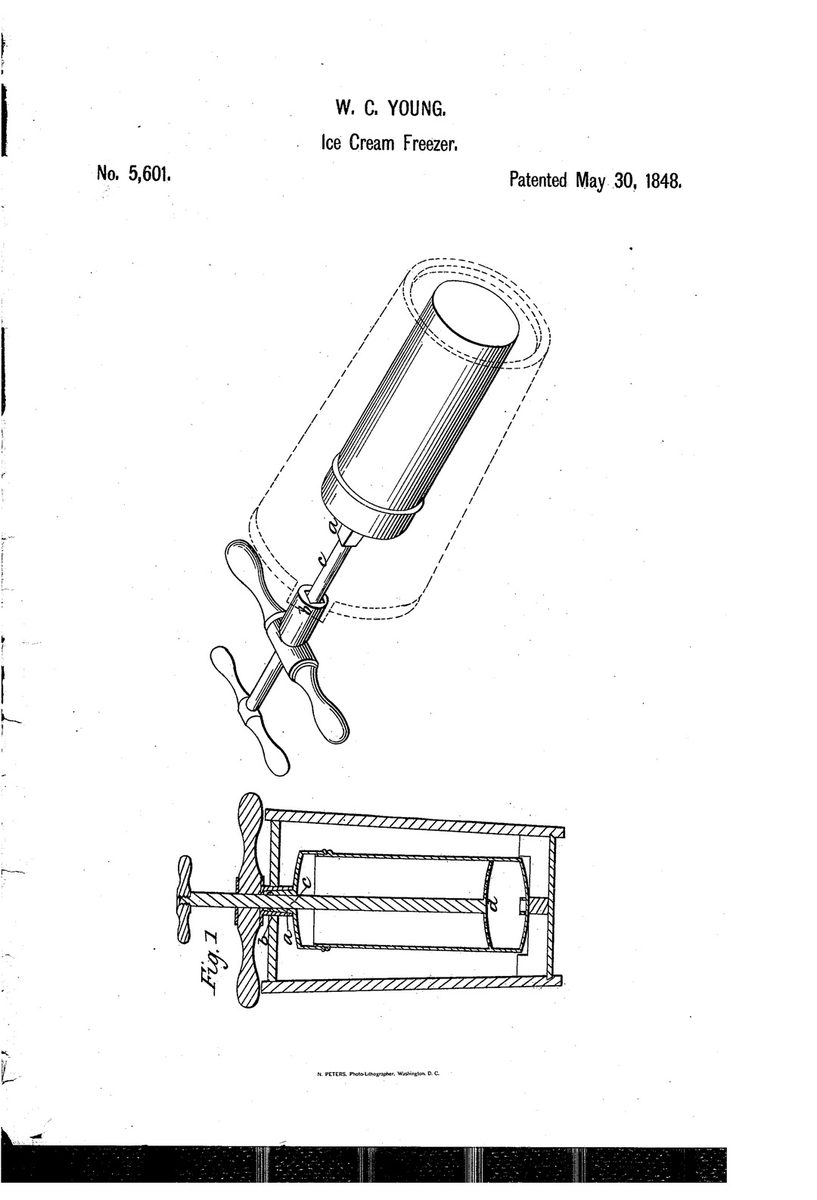
On May 30, 1848, the Patent Office issued No. 5,601 to William G. Young of Baltimore, assigned to a partner named H. Reip, for an improvement built directly on top of Johnson’s. Young’s own filing states that the best freezer then in use was “Johnston’s” — the paperwork misspells her name throughout — built on the same revolving-shaft-and-paddle principle. His insight was that freezing worked better if the tub itself moved, not just the cream inside it. His design fixed the lid in place while the whole cylinder turned beneath it, driven by a weighted cross-handle that doubled as a flywheel to ease the cranking, with a separate perforated beater stirring the cream on a second rod. Turning the entire freezer, he argued, pressed the cream harder against the cold wall than stirring alone ever could.
Young’s idea did not win out. Every hand-crank and electric freezer sold since has kept Johnson’s original arrangement — a fixed tub, a turning internal dasher — rather than Young’s rotating cylinder. But his patent is useful for a different reason: it is contemporary, dated proof that Johnson’s design was recognized, within five years, as the standard a competitor measured his own work against. He wasn’t claiming to have invented the idea; he was claiming to have improved on “Johnston’s,” its own small, backhanded kind of credit — the same way a separate household patent fight on this site also turned, eventually, on whose name was actually on the paperwork.
Philadelphia had a second ice cream story running in the same years
A few miles from wherever Johnson actually lived, Augustus Jackson was building something very different out of the same dessert. Born in Philadelphia in 1808, Jackson worked as a chef at the President’s House for roughly twenty years, from 1817 to 1837, cooking there for James Madison, James Monroe, John Quincy Adams, and Andrew Jackson in turn — a run spanning four administrations, which on its own makes him one of the more remarkable, least-known figures in the building’s early kitchen history. When he left Washington, he returned to Philadelphia and opened a catering business.
What Jackson built there was manufacturing, not invention. He developed his own ice cream flavors and packed them into tin cans rather than the one-off wooden tubs most households used, which let him distribute finished product wholesale to other Philadelphia ice cream parlors instead of making it fresh on demand in a single kitchen. The business made him one of the city’s wealthiest residents by the standards of the time, and it outlived him mostly as reputation rather than as a surviving recipe: his specific techniques were never written down in any form that survives. A 1928 newspaper piece revived his name decades after his 1852 death, crediting him as the first to make “modern” ice cream, and historians still use that framing today with an honest caveat attached — Jackson did not invent ice cream, which long predates him, and exactly what he changed about making it is now mostly reputation rather than a documentable recipe. What is documented is simpler, and in its way more useful to his legacy than a patent would have been: a tin-can packaging and wholesale distribution model that treated ice cream as a manufactured product with a supply chain, years before anyone sold a home freezer to do the same job at kitchen scale.
None of this was sellable without a separate industry: ice, shipped by the ton
A home freezer or a wholesale ice cream business both depend on the same unglamorous input: a reliable, affordable supply of ice, and in the early 1800s that supply barely existed outside a few lucky climates. The person who built it was a Boston merchant named Frederic Tudor, later nicknamed the “Ice King,” who in February 1806 loaded a brig called the Favorite with ice cut from his family’s property in Saugus, Massachusetts, and sent it roughly fifteen hundred miles to Martinique. Much of it melted during the three-week voyage, and the venture lost Tudor something like $4,500 — a near-total failure that would have ended most business plans on the spot.
Tudor kept at it anyway, and the fix was cheap: sawdust, a free waste product of New England’s lumber mills, insulated the cargo far better than anything he had tried before. By the 1830s his ice was reaching the Caribbean, Europe, and India — 180 tons left Boston for Calcutta aboard the brig Tuscany in 1833, with roughly 100 tons still frozen on arrival — and a horse-drawn ice plow, developed with engineer Nathaniel Wyeth, let his harvesting crews more than triple their output back home. By the time Johnson and Young were filing competing freezer patents, cut ice was something a middle-class household could simply buy by the block, which is the only reason selling anyone a home freezer made commercial sense at all — the same shipped ice that, decades later, kept the household icebox running too.
The freezer became a product, and ice cream became two more businesses
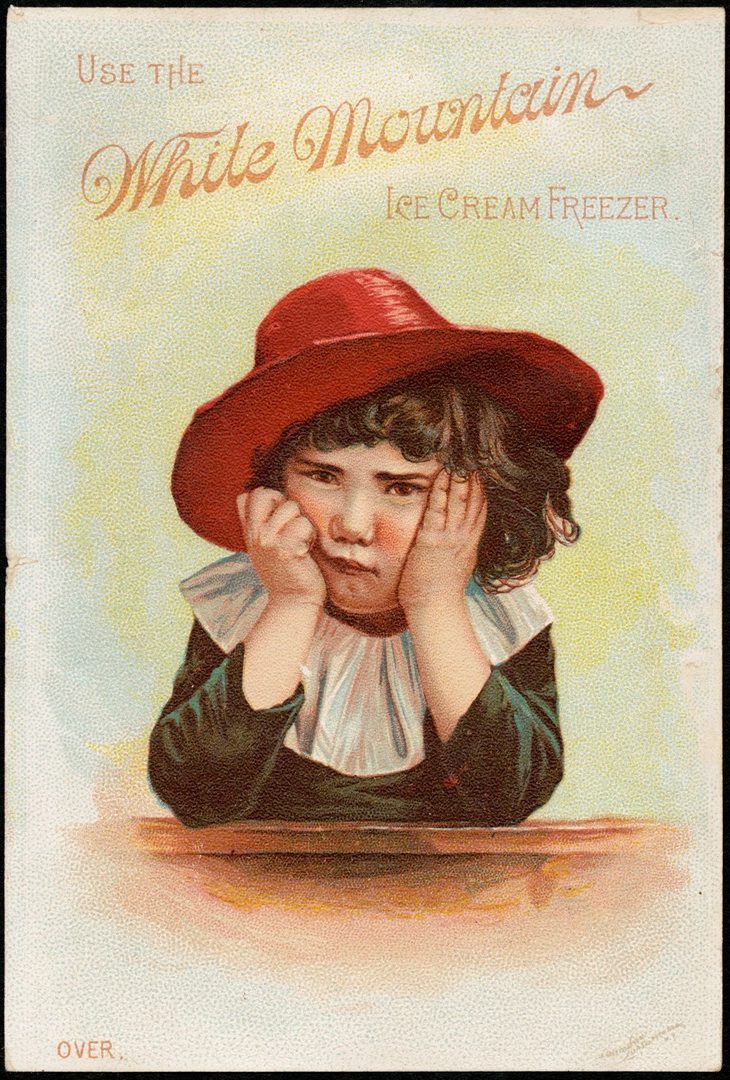
Once the mechanism existed and the ice supply was reliable, manufacturers moved in fast, advertising hand-crank freezers directly to households rather than waiting for orders — among them a firm making the White Mountain freezer in New Hampshire from 1872, which built an entire trade-card advertising campaign around it. The patent flood that followed is almost comic in its pace: four months after Young’s, on October 3, 1848, the Patent Office issued yet another improvement, No. 5,821, to a Philadelphia man named Eber O. Seamen, with its own side-mounted scraper blades. Dozens more followed through the rest of the century, each claiming a better dasher, gear ratio, or lid seal — the same crowded dairy-equipment market that drove Jefferson’s own household to the outsized cheese press this site has covered separately.
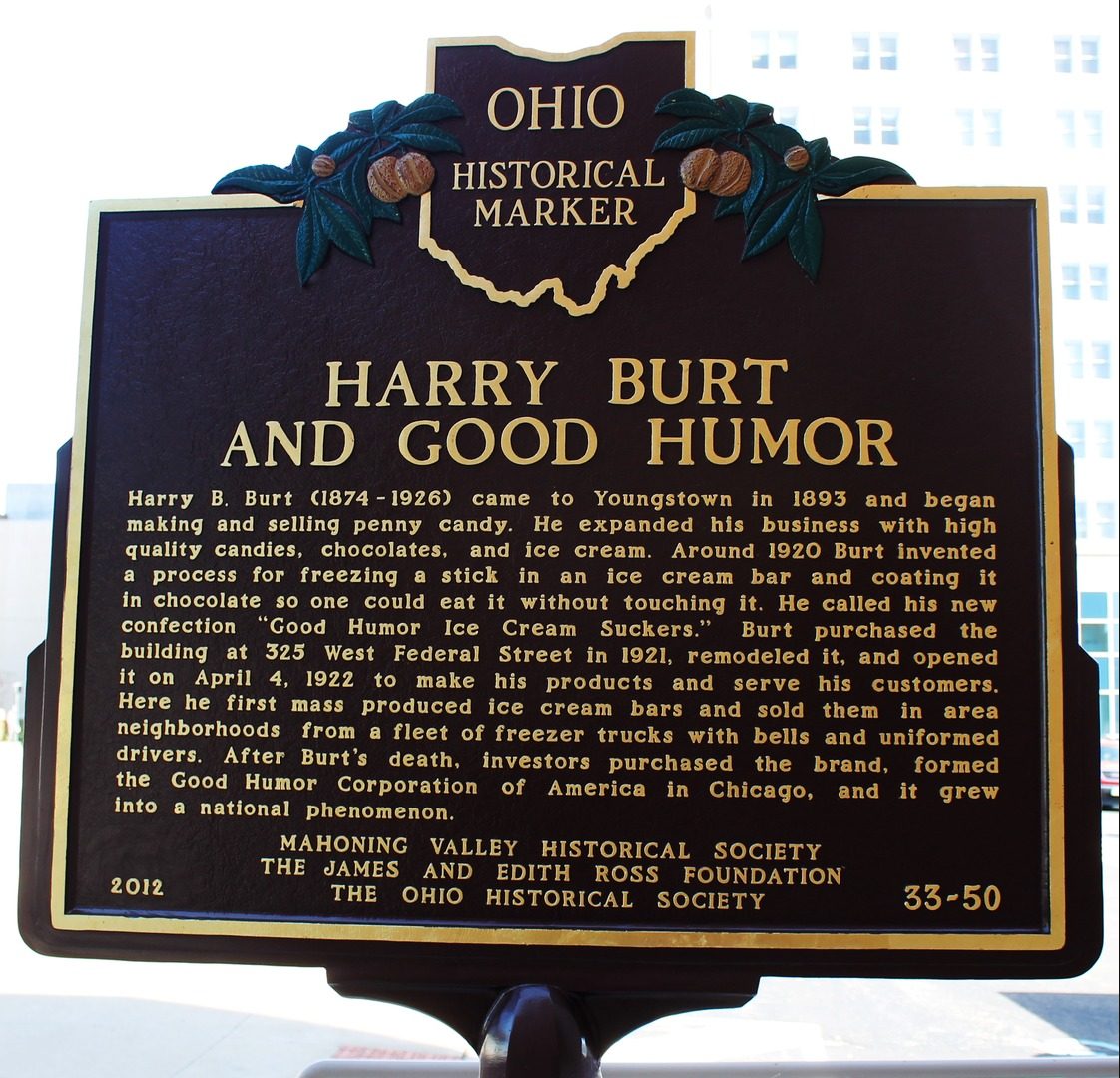
Ice cream’s next real transformation wasn’t about the freezer at all — it was about turning the dessert into something sold rather than made. In Youngstown, Ohio, a confectioner named Harry Burt had built up a candy business since arriving there as a teenager in 1893, and around 1920 or 1921 he worked out a process for freezing a bar of ice cream onto a wooden stick and coating the whole thing in chocolate, so it could be eaten without a bowl, a spoon, or a sticky hand. He filed for patents on the process and equipment in January 1922 and was granted them in October 1923 — though never one on the product itself, a gap that triggered a real legal fight. Burt sued the maker of the rival Popsicle in February 1925, arguing his process patent covered anyone using a similar method regardless of the product; the two companies settled that October, splitting the market so Popsicle kept water-ice treats and Burt kept ice cream. He died within the year, and his widow, Cora, ran the company until she sold the Good Humor name and patents outright — a flat, final sale that, in its own way, echoed how Johnson’s part of this story had ended eighty years before.
Watch the full history
The video version covers Johnson’s mechanism, Young’s rival design, and the ice trade that made both of them sellable, in about five minutes.

None of this required anyone to get rich, least of all the person whose patent drawing is still, in basic shape, what sits inside a modern ice cream maker. Johnson’s fixed tub and turning dasher beat out Young’s rotating cylinder, Seamen’s side-scrapers, and the dozens of others filed in the decades after. The two mechanical principles she laid out in 1843 — scrape the frozen layer off the cold wall, fold it back into the mixture, keep doing that faster than it can re-freeze solid — are still the entire job of the part inside an electric ice cream maker that almost nobody ever actually looks at.
What’s different today is who’s turning it. The crank Johnson invented is still spinning in millions of kitchens; it’s just a small motor doing the work now, not an arm, and not the woman who worked out, in a wooden tub in Philadelphia, exactly how that work needed to be organized. Reading her patent now, with its careful instructions for reusing the salt water to save a few cents a batch, it’s worth asking whether a single flat payment would have been enough for you either.
Related reading
- How the Apple Parer Worked, and Who Actually Invented It
- Wash Day Before Washing Machines Started With a Patent Fight
- The History of Cheese Pressing: From Roman Molds to Jefferson’s 1,235-Pound Wheel
- How Iceboxes Worked Before the Electric Refrigerator
Shop this history
The two items behind this video: Chocolate, Strawberry, and Vanilla: A History of American Ice Cream, the book that covers Johnson’s patent and the industry built on it in detail, and the Immergood hand-crank ice cream maker, a modern machine built on the same tub-cylinder-dasher-crank design Johnson patented in 1843.
Works cited
- Johnson, Nancy M. US Patent No. 3,254, “Artificial Freezer.” United States Patent Office, issued September 9, 1843. Link.
- Young, William G. US Patent No. 5,601, “Ice-Cream Freezer.” United States Patent Office, issued May 30, 1848, assigned to H. Reip. Link.
- Seamen, Eber O. US Patent No. 5,821, “Improvement in Apparatus for Freezing Cream.” United States Patent Office, issued October 3, 1848. Link.
- “Ice Cream.” Thomas Jefferson Encyclopedia, Thomas Jefferson Foundation, Monticello. (monticello.org/encyclopedia/ice-cream)
- “Ice Cream.” Digital Encyclopedia, George Washington’s Mount Vernon, Mount Vernon Ladies’ Association. (mountvernon.org/digital-encyclopedia/article/ice-cream)
- “Dolley Madison and Ice Cream.” The Montpelier Foundation, James Madison’s Montpelier. Link.
- Miller, Adrian. The President’s Kitchen Cabinet: The Story of the African Americans Who Have Fed Our First Families, from the Washingtons to the Obamas. University of North Carolina Press, 2017.
- Panaritis, Maria. “The Long Lost Father of Ice Cream.” The Philadelphia Inquirer, August 3, 2019. Link.
- Wagner, Tricia Martineau. “Augustus Jackson (1808-1852).” BlackPast.org. Link.
- Seaburg, Carl, and Stanley Paterson. The Ice King: Frederic Tudor and His Circle. Massachusetts Historical Society and Mystic Seaport, 2003.
- Moak, Jefferson M. “The Frozen Sucker War: Good Humor v. Popsicle.” Prologue Magazine, National Archives and Records Administration, Spring 2005. Link.
- “Harry Burt and Good Humor.” Ohio Historical Marker 33-50. Mahoning Valley Historical Society, the James and Edith Ross Foundation, and the Ohio History Connection, 2012. Link.