
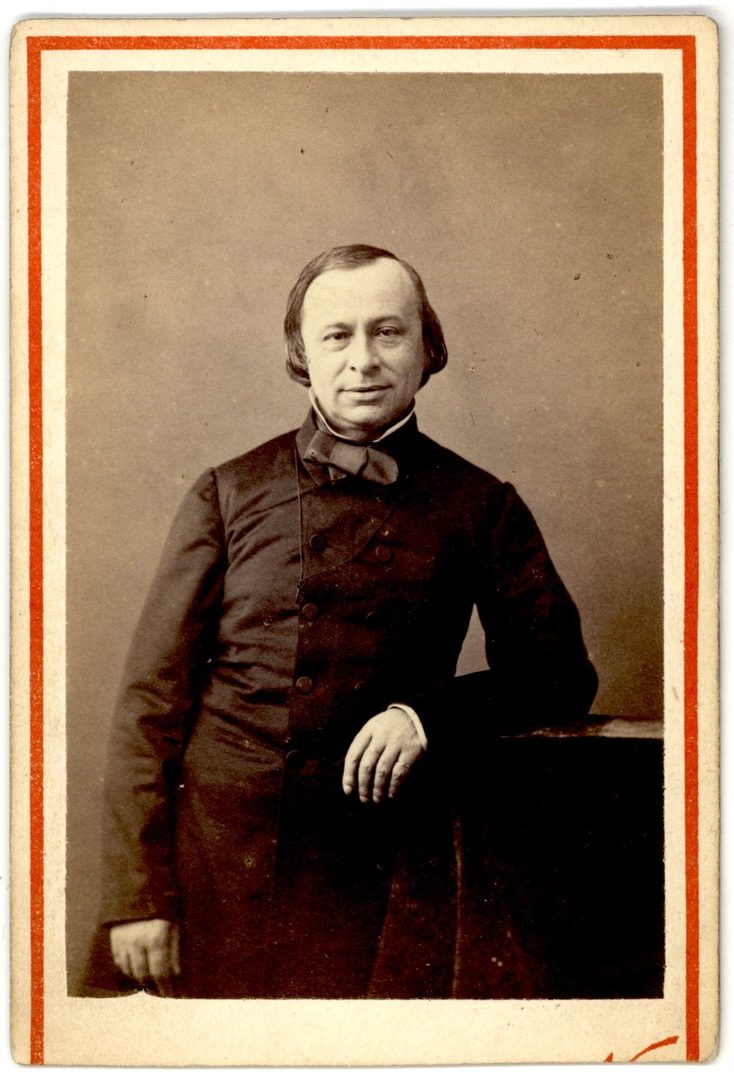
Somewhere above the heads of the roughly four and a half million people who visit the Statue of Liberty every year lies a broken shackle and a snapped length of chain, cast in the same copper as the rest of her. It sits at her right foot, half-swallowed by the folds of her robe, and almost nobody on the ferry ever sees it. It was not an afterthought. By the account of the man who first proposed the monument, it was close to the entire point.
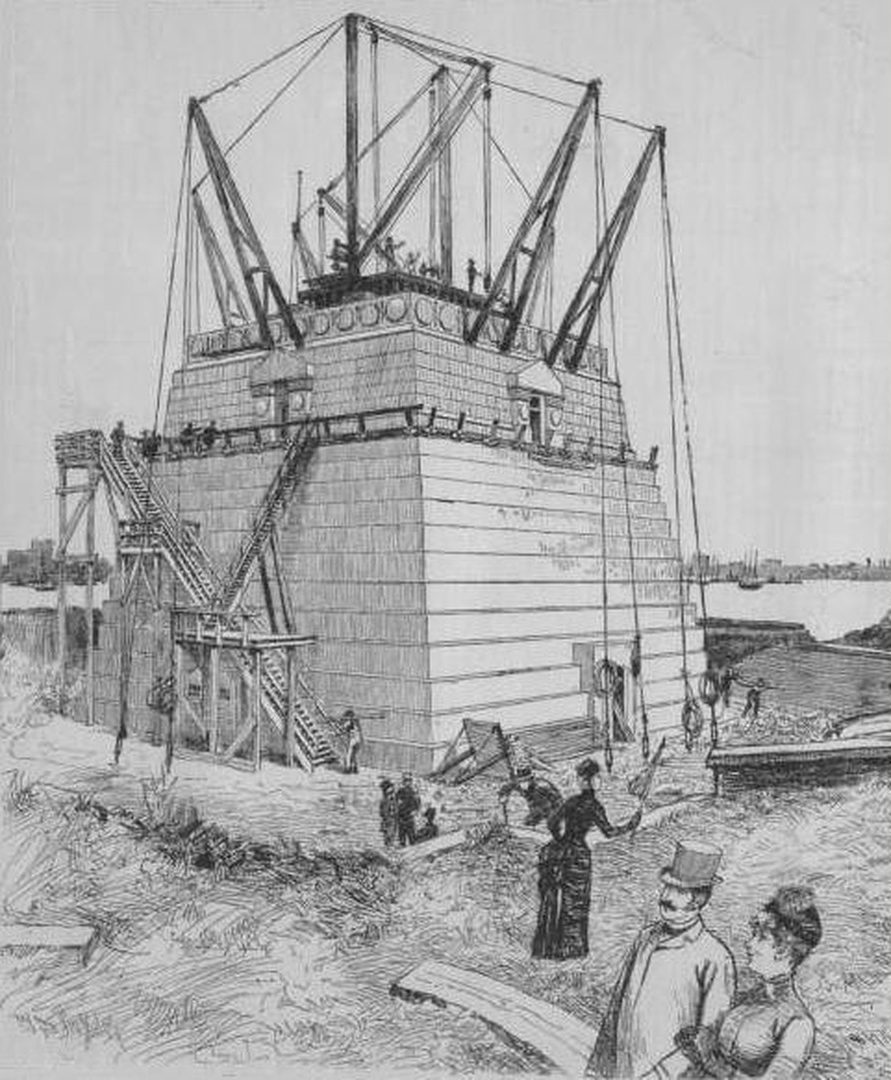
That man was Édouard de Laboulaye, and when he raised the idea of a French gift to the United States in 1865, he was not thinking about immigrants, Ellis Island, or a sonnet about the world’s “huddled masses.” None of those things existed yet. He was thinking about the Thirteenth Amendment, ratified that same year, and about what it would mean for France if a republic could survive slavery’s end and still call itself free. The Statue of Liberty’s connection to slavery is not a theory. It is in the bronze, and in the record of the man who conceived her. Historians just disagree about how much of that meaning survived the century and a half since.
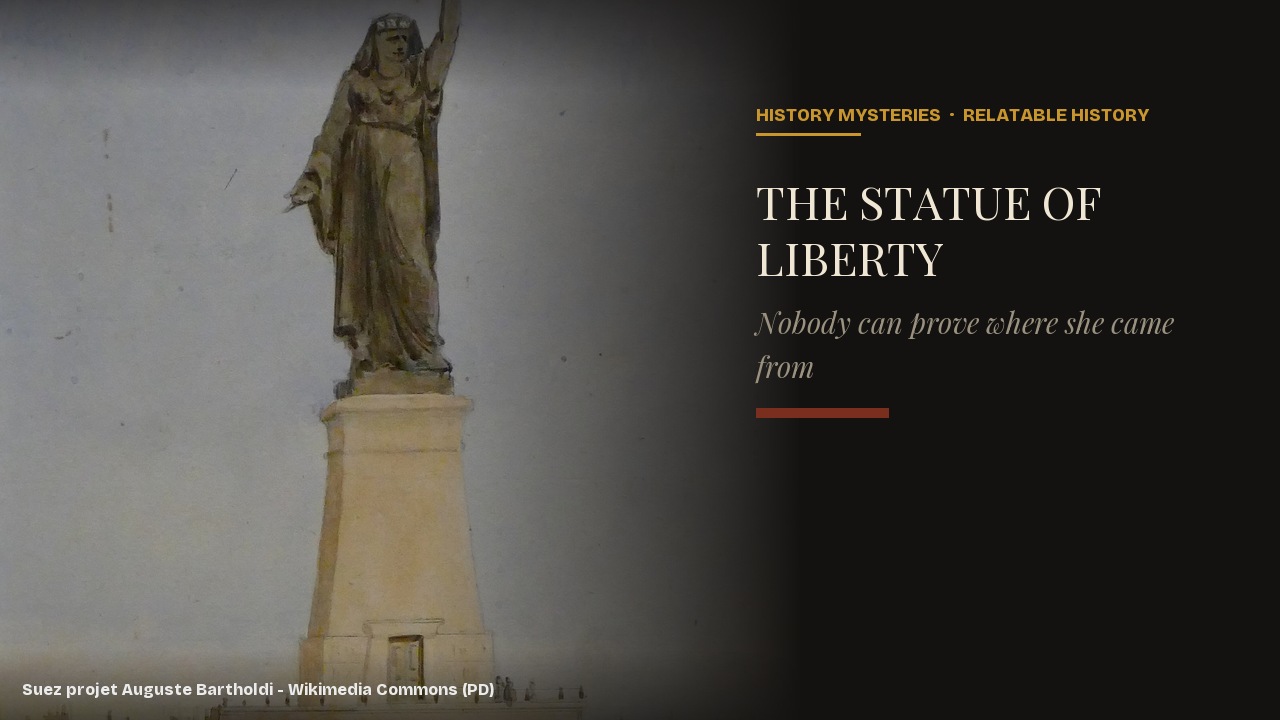
Almost everything repeated about the statue’s inspiration — a colossal lighthouse Bartholdi once pitched to Egypt, a legendary dinner party — concerns how she was designed. This is a different question, and a stranger one: what she was built for, who decided that, and how thoroughly the answer later got replaced with a different one.
Laboulaye proposed the statue to honor the end of slavery
Laboulaye was not a sculptor, an architect, or an American. He was a French legal scholar, one of Europe’s leading experts on the U.S. Constitution, who had spent much of his career arguing that France needed to recover the democracy it kept losing to emperors. He was also, concretely, an abolitionist: an honorary member of the Philadelphia branch of the Union League Club, and in 1865 the cofounder and president of the newly formed French Anti-Slavery Society.
For Laboulaye, the Union’s victory and the abolition of slavery were not just American news. They were evidence, aimed squarely at his own government, that a republic could outlast a moral crisis a monarchy had never had to face. In 1865 he began arguing that France should mark the moment with a monument to the United States — partly as tribute, partly as a none-too-subtle lesson to his own countrymen about what democracies were capable of. It took a decade for the idea to become an actual project: around 1875 Laboulaye brought in the sculptor Frédéric-Auguste Bartholdi, and that September the two men announced the Franco-American Union, the fundraising body that would split the bill in half. France would pay to build the statue itself; Americans would pay for the pedestal it stood on. They named her Liberty Enlightening the World, a title with no mention of immigration anywhere in it.
A broken shackle is cast into Liberty’s own feet
The clearest physical evidence of Laboulaye’s intent is not in any letter. It is on the statue itself. At Liberty’s right foot lies a broken shackle and a length of chain; the chain runs back under her robe and reappears at the left foot, its last link snapped open. From the ground it is nearly invisible, which is exactly why most visitors have never heard of it — you cannot see your own feet from a harbor ferry, and neither can anyone see hers.
It is not a minor decorative flourish. The statue’s full name, Liberty Enlightening the World, was understood at the time to mean the end of servitude in every form it could take, and a broken shackle is about as unambiguous a sculptural statement of that as exists. Bartholdi placed it where a triumphant figure strides forward and tramples whatever she has overcome — a classical pose for showing a conquered evil underfoot, the same pose used on older allegorical statues of Liberty or Victory treading on broken weapons. In this case, the thing underfoot was slavery, not an enemy army.
The pedestal nearly failed, and a newspaper’s readers saved it
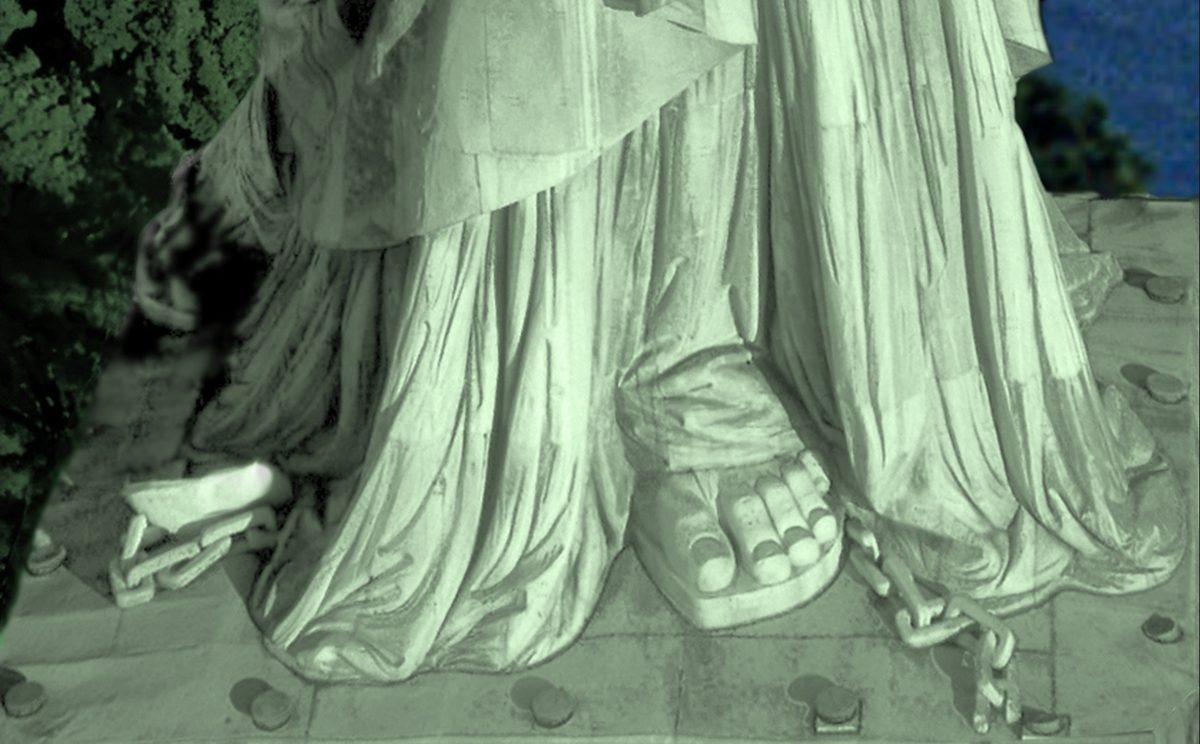
The split funding arrangement Laboulaye and Bartholdi set up in 1875 worked well on the French side; the statue itself was finished in Paris and shipped across the Atlantic in more than two hundred crates. The American side did not keep pace. By 1884 the American Committee for the Statue of Liberty had run out of money, and the half-built granite pedestal stood exposed and unfinished on Bedloe’s Island with no clear way to complete it.
The rescue came from an unlikely source: Joseph Pulitzer’s newspaper, the New York World, which had branded itself “the people’s paper.” Starting with an appeal printed on March 16, 1885, Pulitzer turned the pedestal fund into a reader campaign, promising to print the name of every single person who gave, no matter how small the gift. It worked past anyone’s expectation: by August 11, 1885, the campaign had raised more than $100,000 from roughly 125,000 donors, most of whom gave a dollar or less. The pedestal got finished in time for the dedication. The World, not incidentally, also sold a great many more newspapers along the way — the names of 125,000 donors, printed daily, made for a long and very popular subscription list.
For Black Americans, the 1886 dedication rang hollow
Liberty was dedicated on October 28, 1886, with Laboulaye’s abolitionist meaning still fresh enough that it should have landed. It mostly didn’t — not with the audience it might have meant the most to. The promise built into that broken shackle was, in 1886, nowhere close to true for African Americans, who were a generation into Reconstruction’s collapse and the rise of Jim Crow. The Black press of the period pushed back hard against the romantic framing of the dedication, and W. E. B. Du Bois later wrote in his own autobiography that he could not share the hope he assumed other passengers felt as their ship went past the statue.
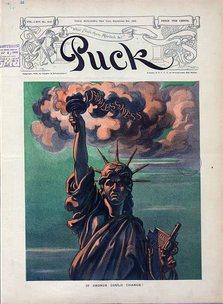
The gap between the statue’s stated meaning and the lived reality around her produced strange, bitter imagery of its own. Puck, the satirical magazine that was, by 1908, one of the most widely read publications of its kind in the country, printed a cartoon on September 9 of that year that borrowed Liberty’s own silhouette — shackle and all — to depict the violence and broken promises African Americans faced in the decades after emancipation. The joke, such as it was, turned the statue’s own abolitionist imagery against the country that had commissioned it. For much of Black America, the statue’s relationship to freedom stayed ambivalent for a very long time afterward, not because the original symbolism was unclear, but because the nation around the statue hadn’t caught up to it.
A fundraiser poem quietly rewrote what the statue was for
The idea that the Statue of Liberty exists to welcome immigrants has a specific, traceable birthday, and it is not 1886. In 1883, while the pedestal fund was still short of cash, the organizers of a charity art auction — former Secretary of State William Maxwell Evarts and the writer Constance Cary Harrison among them — asked a handful of poets to contribute work for the catalog. One of them was Emma Lazarus, a New York poet from a wealthy Sephardic Jewish family who had spent time at Castle Garden assisting Russian Jewish refugees detained there. On November 2, 1883, she produced a sonnet that cast the statue as the “Mother of Exiles” — a title nobody involved in actually commissioning the statue had ever used.
“The New Colossus” ran once in Pulitzer’s World and once in the New York Times, then faded. Lazarus died in 1887, a year after a dedication she never saw her poem attached to, and for the rest of that decade the sonnet was effectively forgotten. Ellis Island did not even open as an immigration station until 1892 — six years after the statue was already standing, dedicated to an entirely different idea. It took until 1901 for Georgina Schuyler, a friend of the late poet, to find a copy of the sonnet in a secondhand bookshop and campaign to have it properly memorialized. In 1903 — seventeen years after the dedication, and twenty after the poem was written — lines from the sonnet were finally cast onto a bronze plaque and mounted inside the pedestal. Only then did “give me your tired, your poor” attach itself, officially, to the statue Laboulaye had proposed to mark the end of a war instead.
Historians agree the first meaning existed. They disagree about what happened to it
None of this is seriously contested among historians who study the statue — Laboulaye’s abolitionist motives, the shackle, the eighteen-year gap before the poem took hold, are documented independently and corroborate each other. Where scholars differ is on how to characterize the replacement. Edward Berenson, the NYU historian who wrote The Statue of Liberty: A Transatlantic Story, puts it plainly: “One of the first meanings had to do with abolition, but it’s a meaning that didn’t stick.” Yasmin Sabina Khan, whose Enlightening the World traces the statue’s design history in detail, treats the shift less as an erasure than as the ordinary fate of public monuments, which tend to be reinterpreted by whichever generation needs them most. Both readings fit the same facts; they disagree only about whether “replaced” is a loss or simply what large public monuments do over time.
What is not in dispute is that the recovery of the original meaning has been recent and deliberate. When the current Statue of Liberty Museum opened on the island in 2019, its exhibits were built specifically to surface the abolition history alongside the immigration story the public already knew well — displaying the statue’s original torch, a copper cast of her face as it looked before oxidation turned her green, and recorded accounts from immigrants describing their first sight of her. For an attraction that draws roughly 4.5 million visits a year, that is a fairly large number of people now getting the fuller version of a story that, for more than a century, came with half of it quietly left out.
Every one of those visitors still rides past the shackle and the plaque in the same afternoon, usually without clocking that either one arrived by a different route than they assume. The lighthouse Bartholdi once pitched to Egypt is a story about where a design came from. This is a story about who gets to decide what a finished monument means, and how long that decision actually holds.
Watch the full history
The video companion covers the design side of this same statue’s disputed history — the colossal lighthouse Bartholdi once pitched to Egypt, and the legend historians say grew up around it.

Related reading
- The Honjo Masamune Disappearance: What Happened to Japan’s Lost Sword
- The Truth Behind the Mrs. O’Leary Cow Myth
- The Theories Behind Cambyses’ Lost Army
- What Happened to Rome’s Lost Ninth Legion?
Works cited
- National Park Service. “The Statue of Liberty and Abolition.” Statue of Liberty National Monument. Link.
- National Park Service. “Édouard de Laboulaye.” Statue of Liberty National Monument. Link.
- National Park Service. “Emma Lazarus.” Statue of Liberty National Monument. Link.
- National Park Service. “Joseph Pulitzer.” Statue of Liberty National Monument. Link.
- The Washington Post. “The Statue of Liberty was created to celebrate freed slaves, not immigrants, its new museum recounts.” May 23, 2019. Republished by History News Network. Link.
- Berenson, Edward. The Statue of Liberty: A Transatlantic Story. Yale University Press, 2012.
- Khan, Yasmin Sabina. Enlightening the World: The Creation of the Statue of Liberty. Cornell University Press, 2010.
- Schor, Esther. Emma Lazarus. Nextbook/Schocken, 2006.