
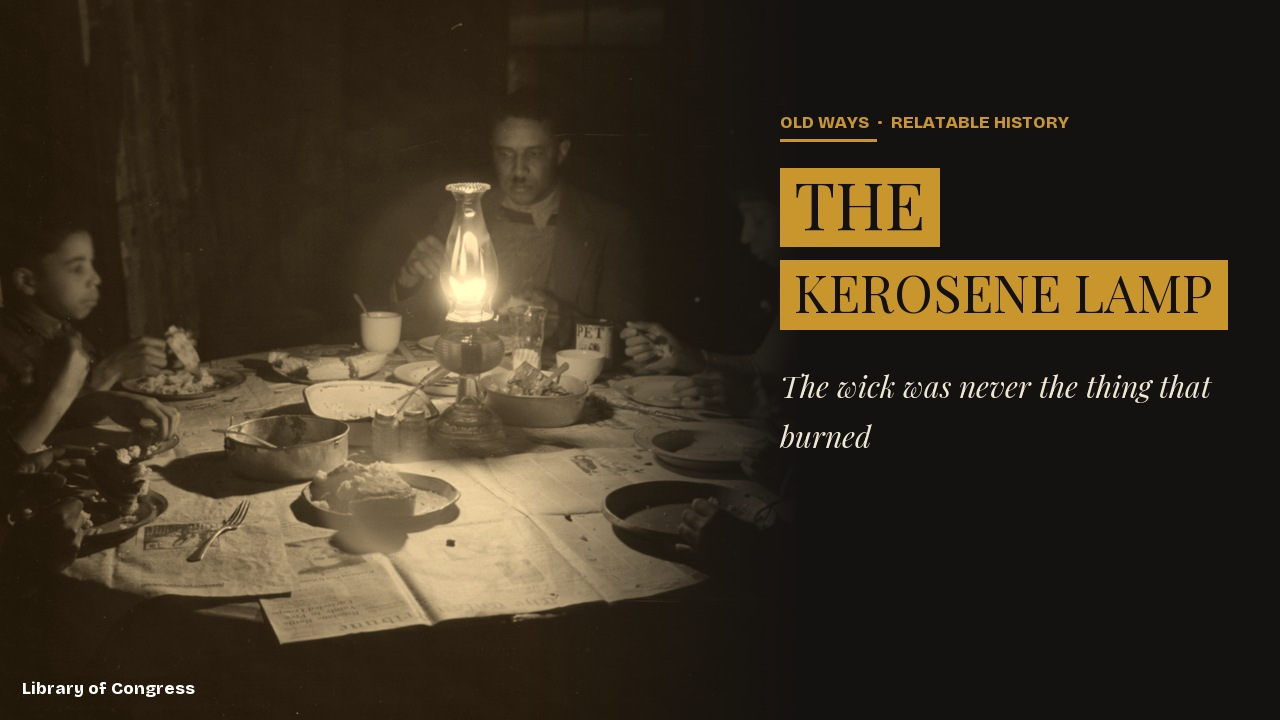
The wick inside a kerosene lamp never burns. It chars, slowly, at the tip, but the thing that actually produces light is vapor rising off the top of it. The wick’s only job is to be a piece of woven cotton tape that pulls oil up out of a reservoir by capillary action, the same way a paper towel pulls water up out of a spill. Get that backwards, as almost everyone eventually does, and the lamp still seems to work right up until it doesn’t.
For roughly ninety years, from the early 1850s until the power lines finally reached the American countryside, that small piece of chemistry was the difference between a house that went dark at sundown and one that didn’t. It was invented, more or less simultaneously, by two men who never met, on two different continents, chasing the same problem from opposite directions. And for decades, the fuel that made it work was sold by refiners who knew, and mostly didn’t care, that a cheaper mix meant a lamp that could flash into fire in a customer’s dining room.
This is the mechanism, the invention race, and the part of the story that a lamp collector’s shelf doesn’t usually mention: how dangerous the ordinary household object actually was, for a very long time, and why.
Two men reinvented light within a few years of each other, an ocean apart
The Nova Scotia geologist Abraham Gesner had been experimenting since around 1846 with distilling a burnable oil out of coal and bituminous rock, work that grew out of his surveys of New Brunswick’s mineral deposits. By 1853 he had perfected a lamp oil he called kerosene, from the Greek for wax, and in June 1854 he was granted three United States patents covering the refining process. A factory went up on Long Island under his supervision, and kerosene became a standard American lighting fuel almost immediately.
At almost exactly the same moment, in the city then called Lwów in Austrian Galicia (now Lviv, Ukraine), a pharmacist named Ignacy Łukasiewicz was running the same race from the other direction. Working with a colleague, Jan Zeh, at Piotr Mikolasch’s pharmacy, he distilled his own kerosene and had a local tinsmith build a lamp designed to burn it cleanly. The new lamps first lit the pharmacy’s own window. Then, on the night of July 31, 1853, they were carried into a hospital on Lyčaków Street in Lwów to light an emergency operation after dark — the first recorded surgery performed by kerosene light.
Neither man was working from the other’s notes. Gesner was working coal and asphaltite deposits in British North America; Łukasiewicz was working crude seep oil in the Carpathian foothills. That two chemists on opposite sides of the Atlantic solved the same problem within about a year of each other is less a coincidence than a sign of how badly the mid-nineteenth century wanted a cheap, bright, safe-ish light.
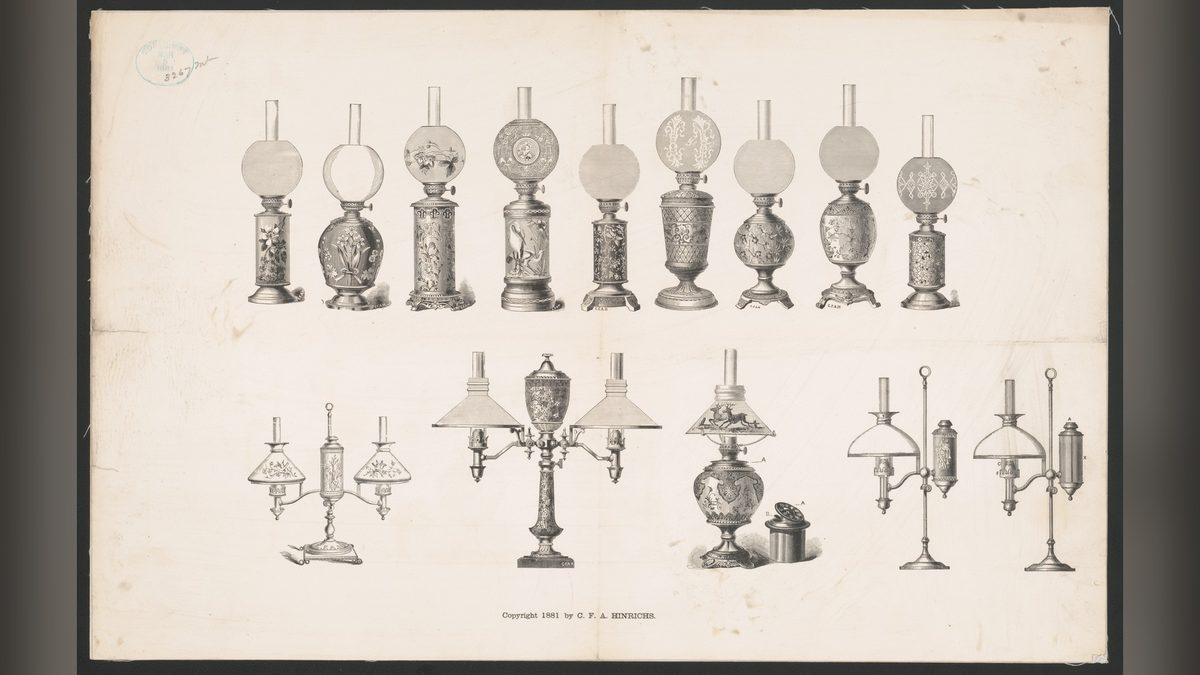
Whale oil had cornered good light, and geology broke the monopoly
Before kerosene, a genuinely bright, clean-burning household light meant sperm whale oil, and whaling had pushed its price to somewhere between roughly a dollar thirty and two dollars fifty a gallon through the 1850s, depending on the season and the size of the catch. Lard oil ran about ninety cents a gallon and smoked. The cheapest option, a coal-derived “coal oil,” cost around fifty cents but burned sooty and dim. Most Americans simply went to bed when the sun did, or made do with tallow candles.
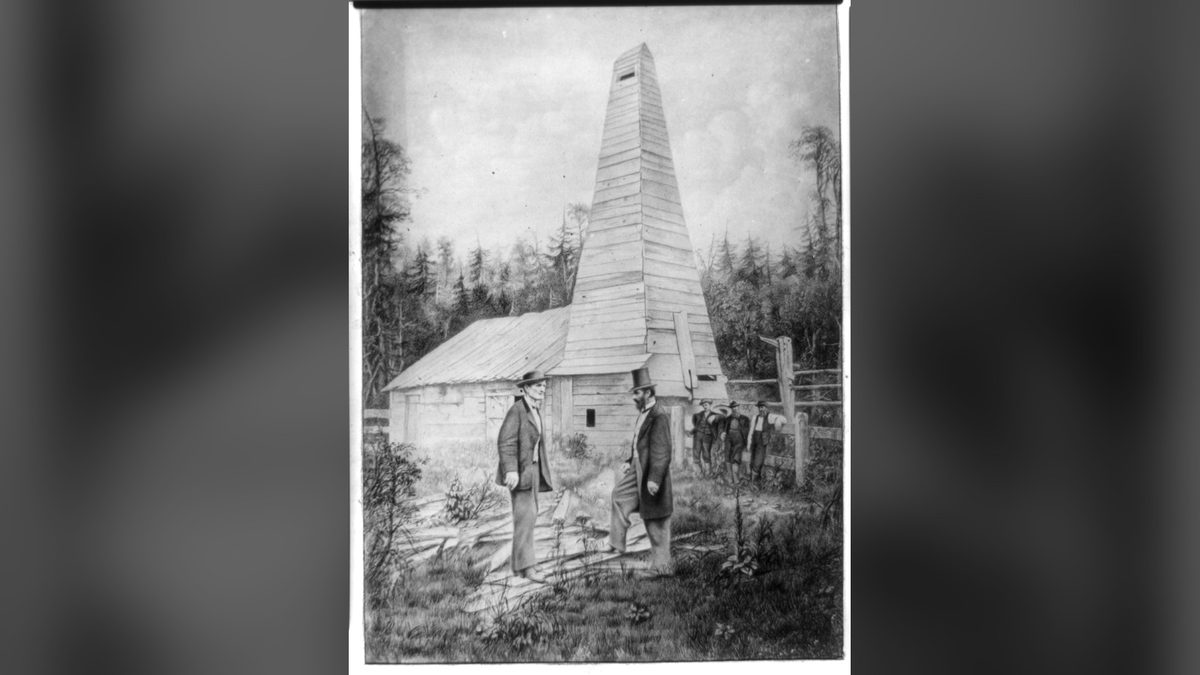
The event that actually broke whale oil’s monopoly on light wasn’t kerosene’s invention — it was Edwin Drake’s well at Titusville, Pennsylvania, which struck oil on August 27, 1859. Distilled crude from Drake’s well, and the wells that followed it, could be refined into kerosene for about the same fifty cents a gallon that coal oil had cost, except brighter and cleaner. Within a few years, kerosene lamps were burning in most American homes.
Kerosene’s rise is sometimes credited with “saving the whales,” but the timeline is messier than that. Whale oil was already losing ground to camphene, a cheap and popular but dangerously volatile turpentine-and-alcohol lamp fuel, well before Drake’s well. What actually killed camphene was a wartime tax: the Union’s 1862 excise tax on alcohol, intended to hit liquor, also caught the grain alcohol in camphene and made it far more expensive than kerosene almost overnight. Kerosene didn’t out-compete whale oil and camphene so much as inherit the field once one collapsed under its own price and the other got taxed out of existence.
The wick is a wick, not a fuse
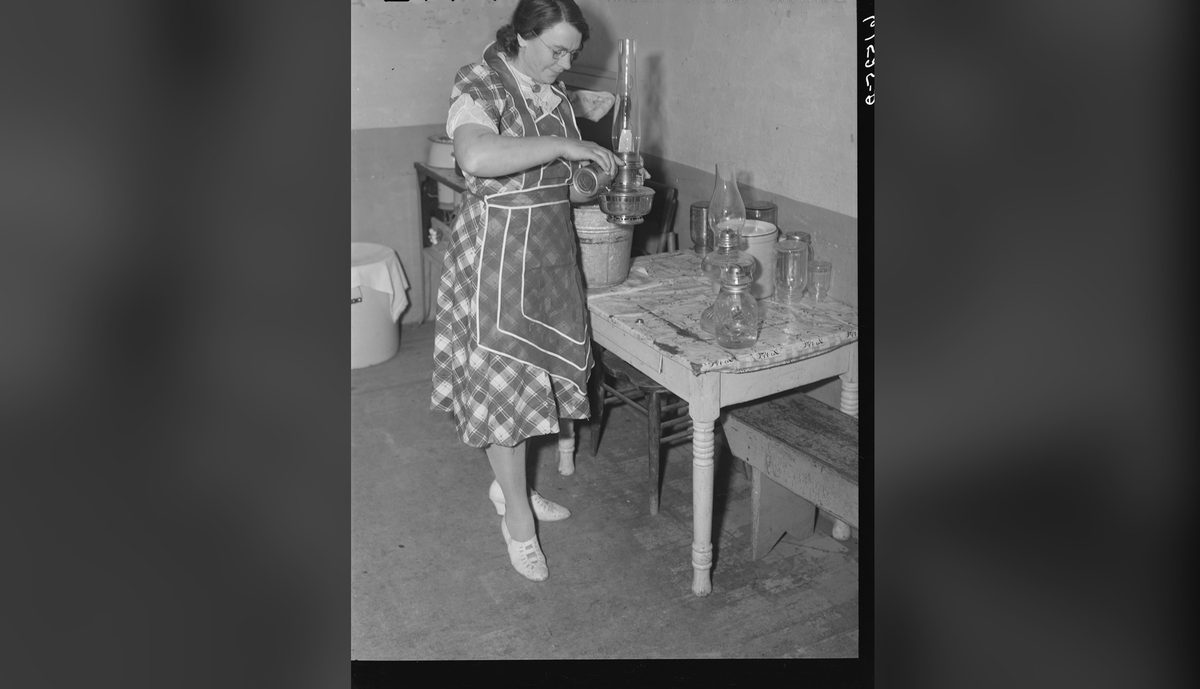
A working lamp has four parts: a glass or metal font holding the oil, a woven wick running up through a brass burner, the burner itself with a thumbwheel to raise or lower the wick, and a glass chimney standing over the flame. None of that is decorative. The wick draws oil upward by capillary action; the heat of the flame vaporizes the oil at the exposed tip; and it’s that vapor, not the cotton, that actually burns. The wick chars rather than consuming itself, which is why it has to be trimmed level, usually every morning, or the flame smokes and the char builds an uneven edge that throws the light sideways.
The chimney isn’t there to shield the flame from drafts, or not only that. Its real job is to create one: the column of glass forces a steady updraft past the flame, which is what lets a kerosene flame burn far brighter and cleaner than an unshielded candle or an open camphene wick. Filling the font, washing the soot off the chimney, and trimming the wick were a daily ritual in a lamp-lit household, not unlike the equally daily business of keeping a wood-fired cookstove fed, cleaned, and drawing properly.
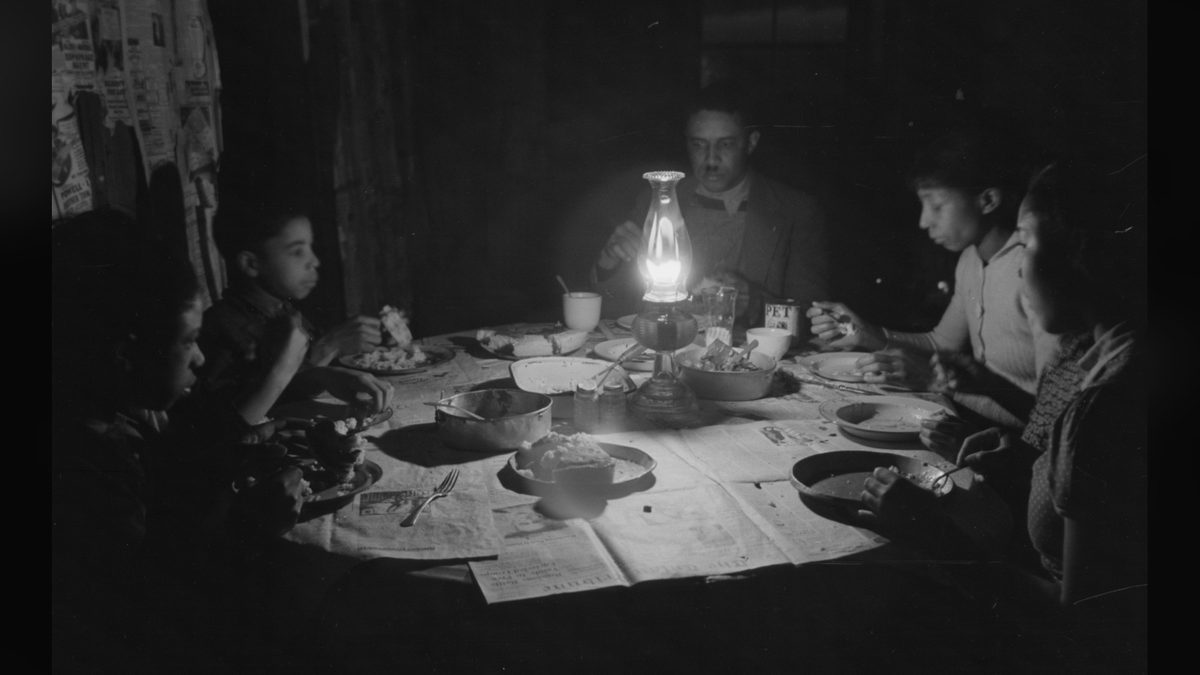
For decades, the fuel itself was the real danger
Well-refined kerosene is genuinely difficult to ignite at room temperature — a dropped match will simply go out in a cup of it. The danger was never the kerosene as designed. It was the kerosene as sold. Crude oil separates into lighter and heavier fractions during refining: gasoline and naphtha condense off first, at low temperatures, and kerosene comes later. In the 1860s those light fractions were cheap, sometimes close to worthless, and some refiners — not all, but enough — cut them back into their kerosene to stretch the batch. The mixture looked and poured like kerosene. Its flash point, the temperature at which it gives off ignitable vapor, was dramatically lower.
Michigan’s records make the human cost concrete. In May 1866, a sixteen-year-old named Maria Benham was fatally burned in Ann Arbor when the lamp she was extinguishing exploded in her hands. Her death was one of enough similar cases that Michigan passed its first kerosene inspection law in 1869, though it was a weak one, and by 1873 the state’s new Board of Health had assigned a Michigan Agricultural College chemistry professor, Robert Kedzie, to investigate. Kedzie built a standardized flash-point tester, sampled oil sold across the state, and found that fuel advertised at a 150-degree flash point was frequently testing far lower — one sample at just 90 degrees, low enough to give off flammable vapor on an ordinary warm day. He was blunter about it than a state chemist usually gets to be, writing that lamps filled with the worst adulterated “safety” oils being marketed to households should be labeled “Homicide Made Easy.”
The trade press estimated the scale in blunt terms too: the insurance paper Baltimore Underwriter put the 1875 national toll at over six thousand kerosene-related deaths, a period estimate that modern historians treat as rough rather than precise, but the direction of it isn’t in dispute. Michigan’s own fight wasn’t a straight line — in 1891 the legislature actually weakened its testing standard, switching from the stricter “closed cup” method Kedzie had championed to an “open cup” test that let more volatile fuel pass as safe, and lamp explosions in the state spiked that same year. It took decades of that back-and-forth before flash-point standards stuck for good; Michigan’s kerosene law today still traces straight back to Kedzie’s closed-cup method.
The best kerosene lamp ever built arrived just as its era was ending
In 1907, a Minneapolis businessman named Victor S. Johnson saw a German-made mantle burner, sold under the name Practicus, that used a round wick and an incandescent mantle to put out something like sixty candlepower of clean white light — several times what an ordinary flat-wick lamp could manage. Johnson incorporated the Mantle Lamp Company of America in Chicago in February 1908, trademarked the name Aladdin, and put the lamp on the market in early 1909. It sold extremely well, in part because it was so much brighter than every kerosene lamp that came before it that it made them look obsolete overnight.
What it couldn’t do was outrun the thing that actually was making kerosene lamps obsolete. Aladdin lamps sold strongly through the 1910s and 1920s, especially in rural areas that didn’t have power lines yet, but they were, in the end, the finest version of a technology whose replacement had already been invented. Even the best kerosene lamp on the market couldn’t compete with a light switch.
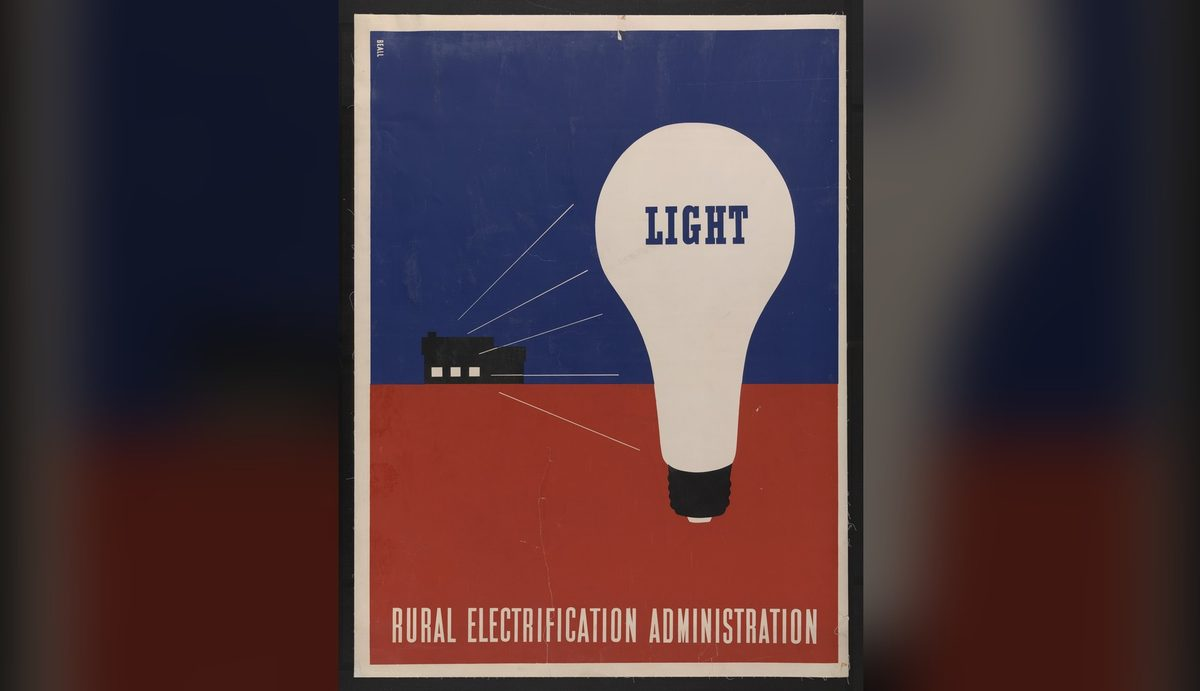
That replacement arrived slowly. When Franklin Roosevelt created the Rural Electrification Administration by executive order in May 1935, fewer than eleven farms in a hundred in the United States had central-station electric power — private utilities had long since decided that stringing wire to scattered farmhouses wasn’t worth the investment. The REA financed farmer-owned cooperatives instead of power companies, and the change was fast once it started: by the end of 1938, roughly 350 cooperatives across 45 states were already delivering power to about 1.5 million farms, and by the mid-1950s rural electrification was essentially complete. The kerosene lamp, the icehouse, and a whole category of hand-tended homestead technology went out more or less together, on the same wire.
What’s easy to miss, looking back from a house with switches on every wall, is how much daily skill and daily risk that one small object carried for ninety years. Trimming a wick level, judging a flame by its color, knowing which brand of “coal oil” not to buy from which peddler — all of it was ordinary household competence in 1890, and all of it is gone now, along with the fuel that occasionally burned the wrong person’s house down because someone further up the supply chain decided a lower flash point was an acceptable cost of doing business.
Watch the full history
The video version covers the same ninety years in about five minutes, from whale oil’s last years through the wick, the chimney, and the Rural Electrification Administration.

Related reading
- The Coal Scuttle Helmet: Why British Troops Named It That
- Water Bath vs Pressure Canning: Why the 240-Degree Difference Exists
- Inside the Pneumatic Tube Networks That Once Ran a City’s Mail
- How the Wood Cookstove Ran the American Kitchen for a Century
- How the Farm Windmill Pumped Water on the Great Plains
Shop
Book on this subject: Aladdin: The Magic Name in Lamps by J. W. Courter .
Works cited
- Courter, J. W. Aladdin: The Magic Name in Lamps. Rev. ed. Kevil, KY: J. W. Courter, 1997.
- Cumming, L. M., R. F. Miller, and D. N. Buhay. “Abraham Gesner.” The Canadian Encyclopedia. Historica Canada, published Feb. 7, 2013; last edited March 4, 2015. Link.
- Bejrowski, Piotr. “Ignacy Łukasiewicz: Inventor of the Kerosene Lamp and Founder of the Oil Industry.” Polish History, Museum of Polish History. Link.
- Wells, Bruce A., and Karen L. Wells. “Camphene to Kerosene Lamps.” American Oil & Gas Historical Society, last updated March 2, 2026. Link.
- Malone, Laurence J. “Rural Electrification Administration.” EH.Net Encyclopedia, edited by Robert Whaples, Economic History Association, March 16, 2008.
- Bien, Laura. “In the Archives: Lit by Kerosene.” The Ann Arbor Chronicle, June 6, 2012. Link.
- Carter-Lome, Maxine. “Aladdin Lamps: A History of Innovation and Design.” Journal of Antiques and Collectibles.
- Jang, Minseok. “Kerosene Is King: Kerosene Consumers and the Antitrust Movement against Standard Oil, 1859–1911.” The Journal of the Gilded Age and Progressive Era (Cambridge University Press). Link.