
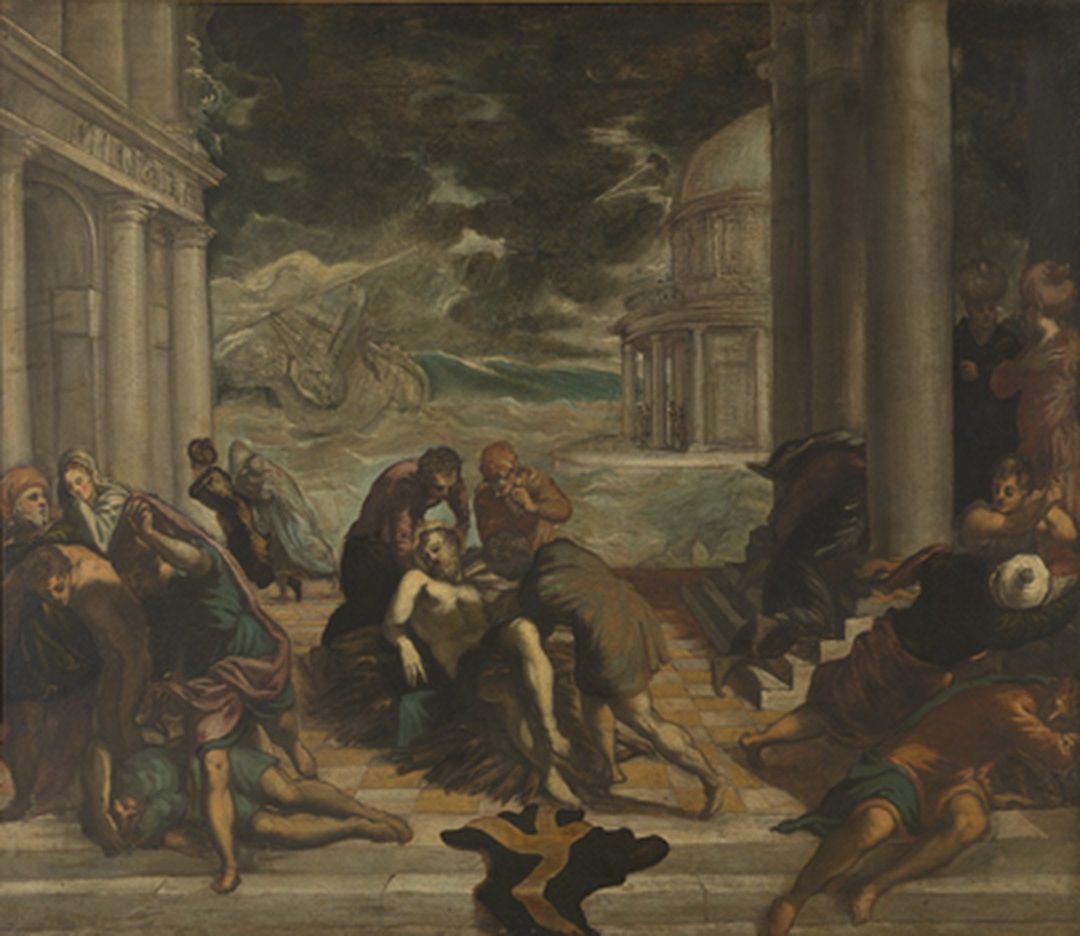
In 828 CE, two Venetian merchants named Buono da Malamocco and Rustico da Torcello sailed into Alexandria and committed an act of medieval relic theft that a city would later build its identity around: they located the tomb of the evangelist Mark and removed his body. Alexandria was under Muslim rule and the local custodians of the shrine were wary of losing it, so the extraction was not a purchase. The two men swapped Mark’s remains for those of a lesser saint, Claudia, packed the real body in a basket, and covered it with cuts of pork to keep customs officials from searching the cargo too closely. Later writers added that Mark himself intervened, warning the sailors in their sleep about a dangerous stretch of coastline ahead.
Venice did not bury the story. The city built it into its civic identity. Within eight years it had raised a shrine for the relics; the building that eventually replaced it, the Basilica di San Marco, still stands on the same spot, and Mark’s winged-lion emblem still marks the territory the Venetian Republic once ruled. A theft, openly acknowledged, became the origin story of a state.
What makes the episode strange by modern standards is not that it happened — medieval Europe is full of body-snatching. What is strange is that nobody involved seems to have treated it as something to be ashamed of. There was a name for this, a body of theology built to support it, and an entire category of object — the reliquary — engineered to hold the proceeds.
Furta sacra gave the theft a theology
Historians call the pattern furta sacra, Latin for “sacred theft,” a term popularized by the historian Patrick Geary in his 1978 study of the practice, Furta Sacra: Thefts of Relics in the Central Middle Ages. Geary collected dozens of medieval accounts — called translationes, or “translation” narratives — written specifically to describe how a community had come to possess the body of a saint it had not previously owned. Almost all of them follow the same structure: the relic is in danger or neglected where it is; a monk or merchant removes it, often at personal risk; and the saint, through a dream, a miracle, or an unexplained lightening of the coffin’s weight, signals approval.
The logic did real theological work. In the medieval worldview, saints were not passive remains — they were understood to retain will and agency after death, continuing to act through their relics. A saint who did not want to be moved could, in principle, make the body immovable, strike down the thief, or otherwise intervene. If none of that happened, and the theft succeeded, the silence was read as consent. The Mark legend’s storm-warning detail is a version of exactly this: the saint protects the men who are carrying him. A translation account was not reporting a theft so much as building a legal and spiritual case that no theft had occurred — the same instinct that, in a different religious tradition entirely, turned the lost Ark of the Covenant into one of history’s most durable disappearances.
Canon law had a category for profiting from the sacred — and medieval relic theft tested its edges
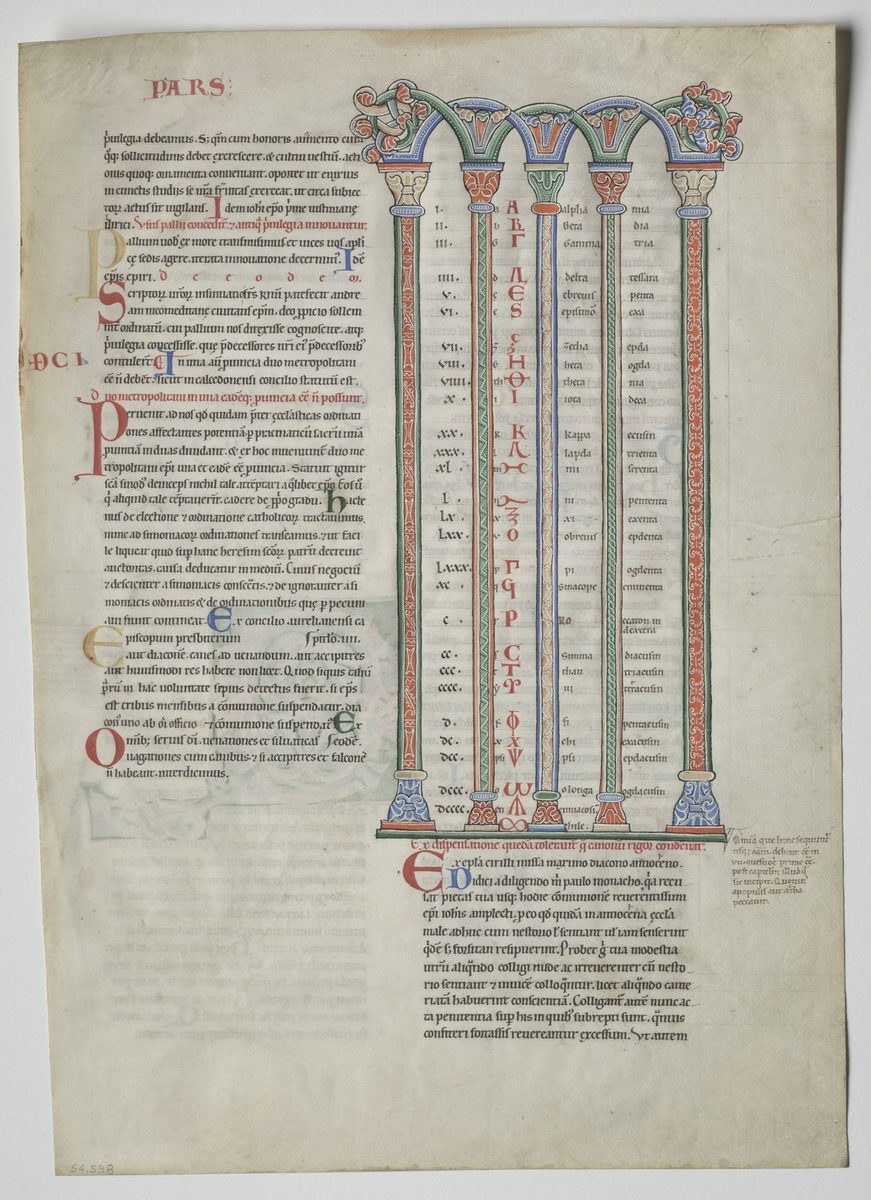
This theology did not operate in a vacuum. By the twelfth century, the Church had a working body of canon law governing exactly this kind of question, codified above all in the Decretum of Gratian, a monk working in Bologna around 1130–1140. A surviving leaf from a copy of the Decretum made at the Abbey of Pontigny in Burgundy — the same abbey where Thomas Becket later took refuge and reportedly studied canon law — opens with a case about simony, defined on the page as profiting from sacred things. Simony was already a serious offense; the sale of a church office, a sacrament, or anything deemed holy for money could be grounds for excommunication.
A relic sat right on that line. Whole communities competed for them and went to real lengths to acquire them, but a relic could not be openly bought and sold without risking the simony charge. Translation narratives solved this by framing acquisition as something other than a transaction: a gift, a rescue, an act of devotion, or, in the furta sacra pattern, a theft the saint had sanctioned. What rarely survives in these accounts is the money that, in practice, often changed hands anyway — a pattern historians have had to reconstruct from sources outside the pious narratives themselves.
A reliquary was part sacred object, part legal document
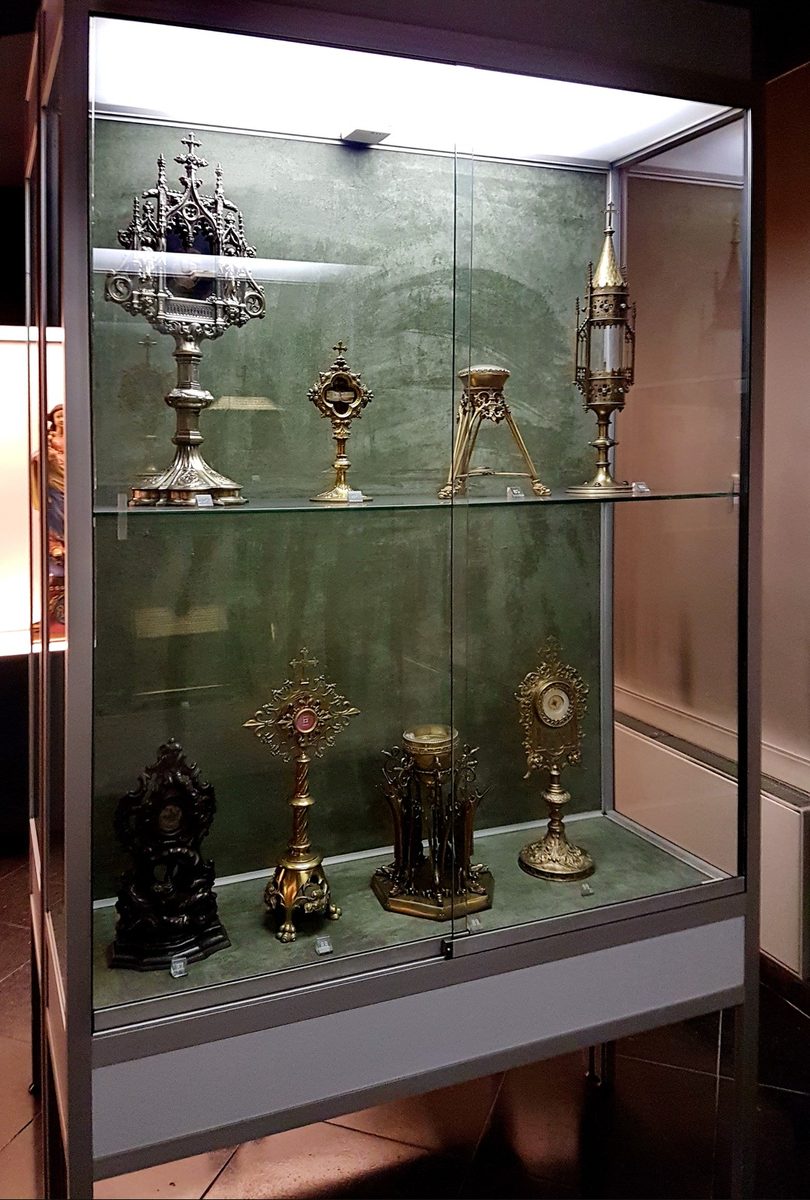
The container mattered as much as the contents. A reliquary was built to do several jobs at once: protect a fragile, often fragmentary set of remains; make the relic visible and processable in public ritual; and assert, through its materials and inscriptions, exactly what it held and where that claim came from.
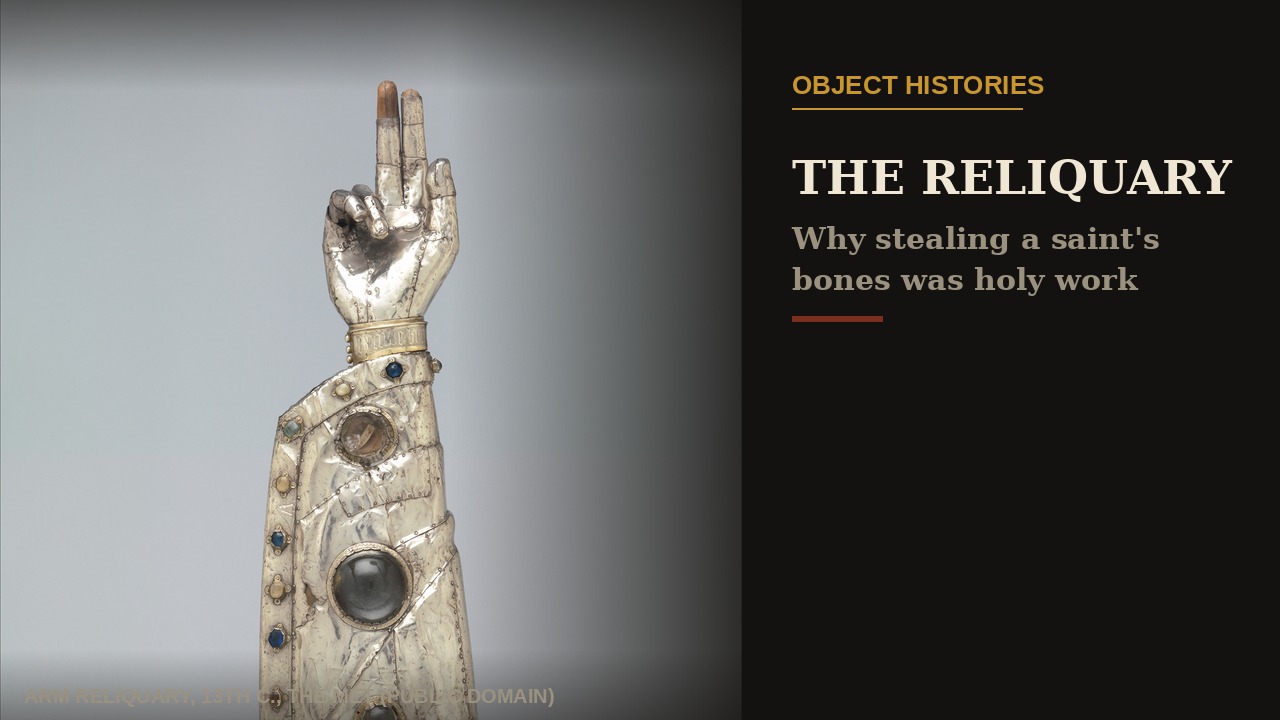
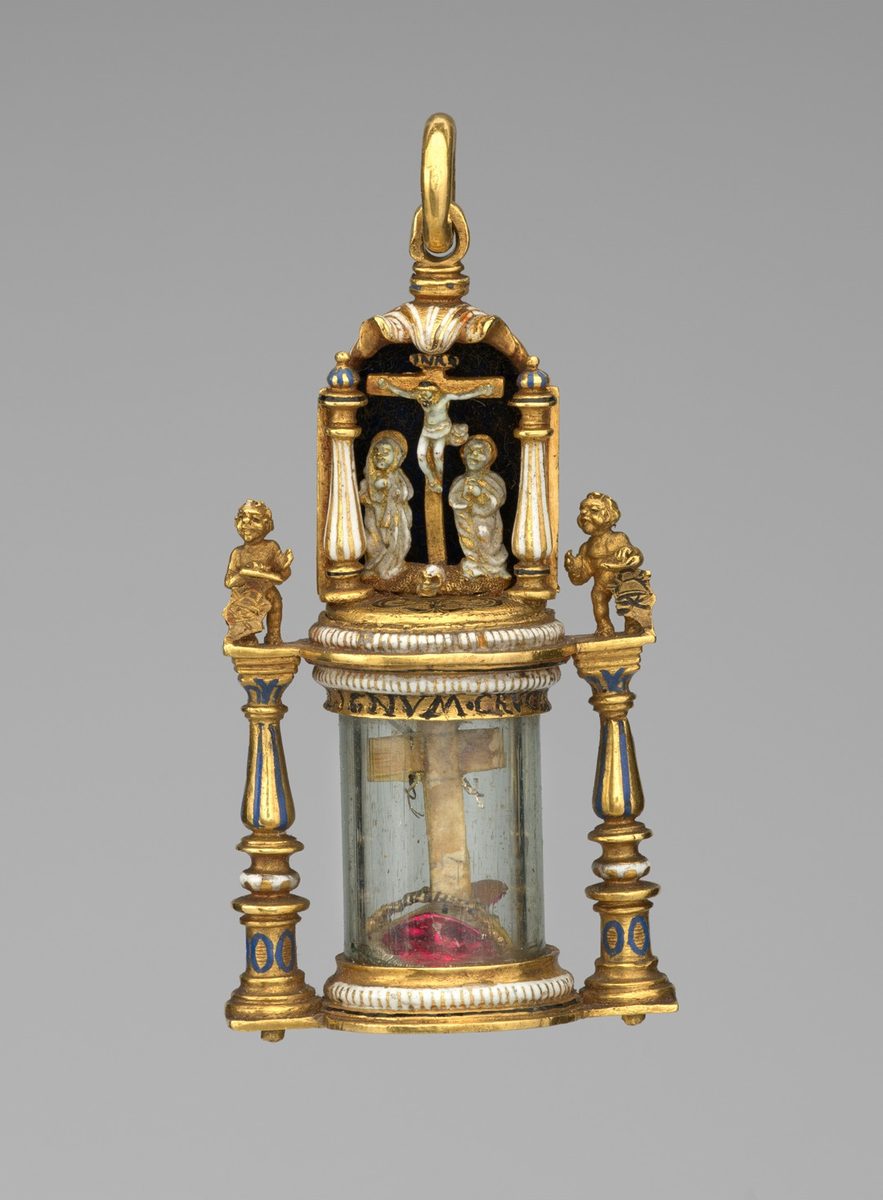
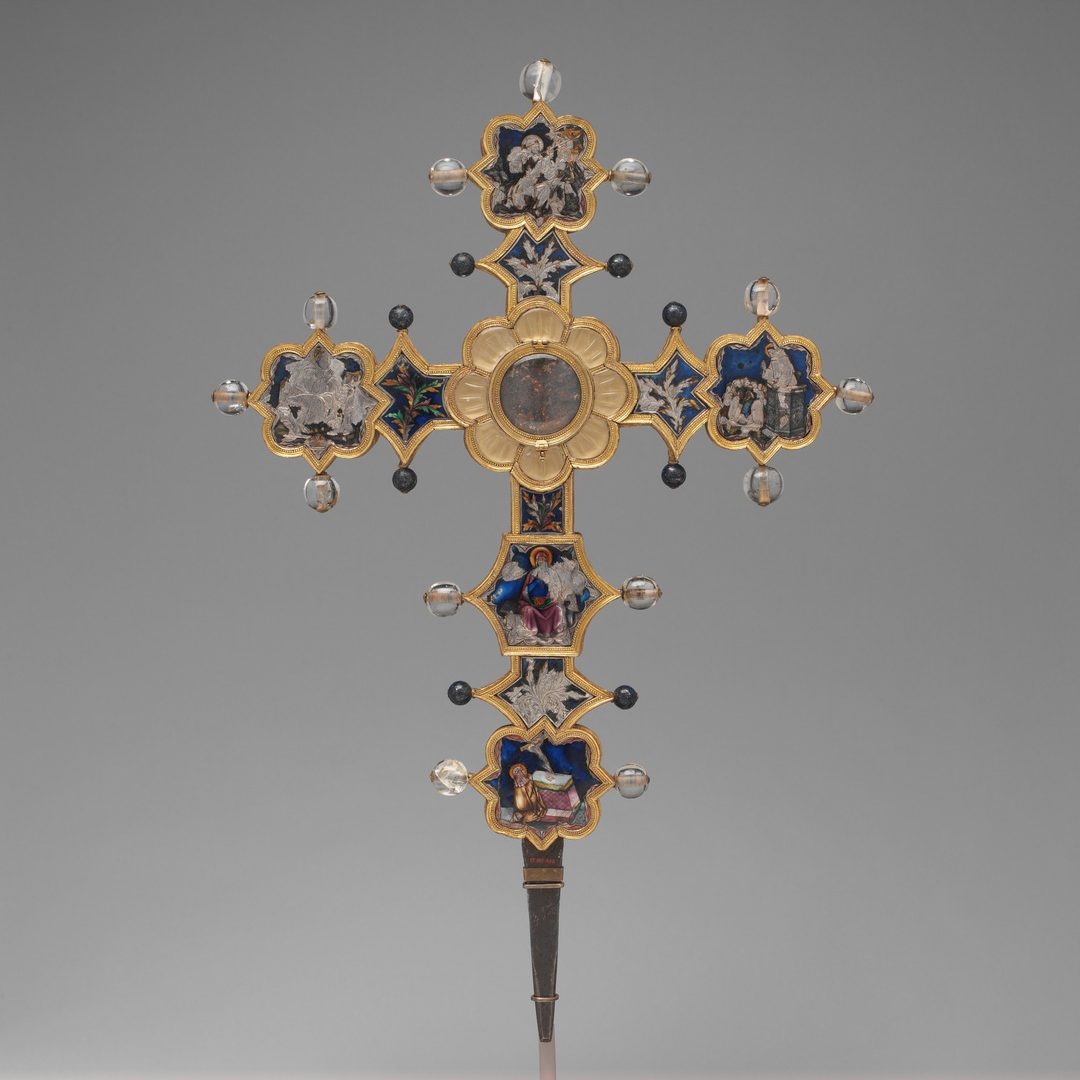
The Metropolitan Museum of Art’s thirteenth-century silver-gilt arm reliquary, shaped as an arm raised in blessing and set with rock-crystal cabochons, shows how literally this worked. Behind one of the crystal windows is a parchment tag identifying the relic inside, and an engraved cuff at the wrist does the same — this particular example held bone attributed to Saint Fiacre. The museum notes that arm reliquaries doubled as instruments of priestly authority: they were kept at the altar for veneration, then physically carried through the congregation during processions, so the object’s status as both holy and documented moved with it. A jeweled reliquary cross from the same collection did the same work in a different shape, its facets each keyed to a specific named relic, so the object functioned as an inventory as much as a shrine.
Owning the right bones was worth more than the bones themselves
None of this would have mattered if relics had been spiritually valuable but practically inert. They were not. A verified, prestigious relic reliably drew pilgrims, and pilgrims brought money, land grants, and political leverage with them. The historian Elizabeth Wiedenheft, writing for the Economic History Society, has described medieval relics as “inalienable commodities” — objects that could be acquired, sometimes through purchase or exchange, but whose value depended entirely on staying put once a community had them. A relic’s worth came from a combination of the saint’s reputation and the miracles credited to it specifically, and it was frequently deployed to settle disputes over land and status, not just to draw worshippers.
The pattern repeats across medieval England in cases far better documented than Mark’s: the body of Cuthbert anchored Durham’s wealth for centuries; Æthelthryth’s relics did the same for Ely; the promotion of Edmund’s cult built Bury St Edmunds into a major pilgrimage center; Thomas Becket’s tomb at Canterbury, after his murder in 1170, turned the cathedral into one of the most lucrative pilgrimage destinations in Europe almost overnight. A monastery that acquired an important body did not simply enshrine it quietly. Communities toured new relics through the surrounding region, housed them in reliquaries built to impress, and staged public translations attended by bishops and nobles, because the political return depended on everyone knowing the relic was there.
The Fourth Crusade turned medieval relic theft into a windfall
If individual thefts moved single bodies, the Fourth Crusade moved an entire city’s worth of holy material at once. Crusader forces diverted from their original target and sacked Constantinople in 1204, and the Latin Empire that western European nobles then installed in the Byzantine capital held, among the spoils, one of the largest concentrations of relics in the Christian world.
The fate of the Crown of Thorns traces the pipeline from conquest to cathedral in unusual detail. By the late 1230s the Latin Empire was broke, and its barons mortgaged the crown to Venetian creditors against a loan of 13,134 hyperpers; a single Venetian, Nicholas Querini, eventually consolidated the debt and held custody of the relic, with the right to keep it outright if the loan went unpaid. King Louis IX of France redeemed it before that deadline, in 1238, and brought it to Paris. He went on to acquire further relics of the Passion, including a fragment of the True Cross, from his cousin Baldwin II, the Latin emperor of Constantinople, and built an entire church, the Sainte-Chapelle, to house them. A relic that had started the century inside a Byzantine imperial treasury ended it as the centerpiece of a purpose-built French royal chapel — financed, along the way, by a Venetian moneylender’s loan.
Supply eventually outran the number of real saints
A trade this active, running for centuries across a continent with no verification system beyond reputation and paperwork, was always going to produce duplicates. John the Baptist’s head is the clearest case: churches in at least four cities have claimed to hold it. The Umayyad Mosque in Damascus, built on the site of an older church dedicated to the saint, holds a tradition that the head was sealed into one of its columns when the mosque was constructed in the early eighth century. A reliquary in Munich’s Residenz Museum, from a collection assembled under Duke Wilhelm V of Bavaria after the pope authorized him to acquire relics in 1577, is also said to hold it. The Roman basilica of San Silvestro in Capite has displayed the crown of the skull since at least the late twelfth century. And Amiens Cathedral in France holds a head brought back from Constantinople in 1206, in the years immediately after the Fourth Crusade, by a priest named Walon de Sarton — the same conquest that would later put the Crown of Thorns on the market.
Each claim came with its own evidence: a wound above the right eyebrow at Amiens was pointed to as matching an account of the saint’s execution; Damascus and Rome each had centuries of continuous tradition behind them. None of it could settle the question, and as National Geographic noted in a 2023 survey of the competing claims, there is no genetic material from John the Baptist to test any of the relics against. It is possible that none of the surviving heads is genuine. What the dispute reveals is less about one saint’s remains and more about how the system worked: reputation, documentation, and ritual display together made a relic real to its community, whether or not the underlying object could have withstood scrutiny — the same gap between ritual legitimacy and hard proof that, centuries later, made it a criminal act to blow a shofar at Jerusalem’s Western Wall.
The Reformation called the entire system a fraud
By the sixteenth century, that gap between claim and evidence had become impossible to ignore, and it became one of the Reformation’s sharpest lines of attack. John Calvin’s 1543 pamphlet, commonly known in English as A Treatise on Relics, is the fullest surviving version of the argument. Calvin’s method was not outrage; it was cataloguing. He walked through relic collections across Catholic Europe in a flat, deadpan inventory — phials of Christ’s blood, locks of the Virgin Mary’s hair, the bones of apostles — and let the sheer redundancy make his case. His best-known example was blunt arithmetic: he counted fourteen separate churches claiming to hold a nail from the cross, when the Gospels describe only three or four being used at the crucifixion. Multiple churches, he noted, also claimed to possess Christ’s foreskin, and rival churches disputed ownership of the same relics outright, including a cross said to have miraculously appeared to the emperor Constantine.
The tract was popular enough to see at least ten editions across several languages within the century, and the theology faculty in Paris added it to its list of banned books the same year it appeared. It did not end the practice — not even the mundane end of the spectrum, where an ordinary household object like the table fork could still be treated as faintly sinful on religious grounds a century later. The Catholic Church’s own Council of Trent, meeting in the following decades, formally reaffirmed the veneration of relics as legitimate, setting up a doctrinal line that separated Protestant and Catholic Europe for generations. Calvin had not disproven furta sacra’s underlying logic so much as refused to accept its premise — that an object’s holiness could be established by narrative and ritual alone.
Watch the full history
The video traces one theft — Mark’s — from Alexandria to the Venetian lagoon. The article above is the wider system that theft belonged to.

What furta sacra ultimately describes is not a loophole in medieval law so much as medieval Europe’s working answer to a problem every religious culture eventually has to solve: how do you make the sacred portable, verifiable, and useful, all at the same time, when the only evidence anyone has is a story and a box of bones? The doctrine let communities acquire exactly the kind of object — a saint’s body — that was too valuable to buy outright and too important to leave in place, by reframing acquisition as a drama in which the saint was always the one making the decision.
That framework built real things. It built Durham and Ely and Bury St Edmunds into pilgrimage economies. It built the Sainte-Chapelle around a crown redeemed from a Venetian pawn debt. It built, piece by piece, the entire material culture of the reliquary — objects engineered to be simultaneously beautiful, legible as legal claims, and durable enough to carry a community’s prestige for a thousand years. And it built Venice itself a founding myth sturdy enough that a theft is still, by the city’s own account, the reason Mark’s winged lion appears on everything from its flag to its cornerstones, the same way a deliberately hidden burial site, centuries later and on the other side of the world, would come to define the legend around the tomb of Genghis Khan.
Mark’s sarcophagus is still there, under the high altar of the Basilica di San Marco, mostly out of public view. Whether what is inside it is actually a first-century Egyptian martyr is not a question furta sacra was ever built to answer. It was built to make the question beside the point.
Related reading
- What Actually Happened to the Ark of the Covenant? — another sacred object whose disappearance became its own legend.
- Why Blowing a Shofar at the Western Wall Was a Crime — a religious object that went from ritual to criminal case.
- The Tomb of Genghis Khan: A Decision Not a Mystery — concealment, not theft, as a way of protecting a sacred body.
- Why the Fork Was Once Considered Sinful — how an everyday object picked up a reputation for sin.
Shop the styles/items featured in this video:
- Holy Bones, Holy Dust: How Relics Shaped the History of Medieval Europe
- Shrines, Relics, and Saints: Christian Sanctuaries from Late Antiquity Through the Middle Ages
Works cited
- Geary, Patrick J. Furta Sacra: Thefts of Relics in the Central Middle Ages. Rev. ed. Princeton University Press, 1990.
- “The Relics of St Mark.” The Fitzwilliam Museum, University of Cambridge. Link.
- De Jager, Eben. “How Did the Remains of St. Mark End Up in Venice?” TheCollector. Link.
- “Single Leaf from a Decretum by Gratian.” The Cleveland Museum of Art. Link.
- Wolff, Robert Lee. “The Latin Empire of Constantinople, 1204–1261.” In A History of the Crusades, Vol. II: The Later Crusades, 1189–1311, edited by Kenneth M. Setton, Robert Lee Wolff, and Harry W. Hazard. University of Wisconsin Press, 1969. Link.
- “King Louis IX Carrying the Crown of Thorns.” The Metropolitan Museum of Art, Heilbrunn Timeline of Art History.
- “Arm Reliquary.” The Metropolitan Museum of Art, Collection.
- Sartore, Melissa. “Why Are There Four Heads of John the Baptist?” National Geographic, September 12, 2023. Link.
- Calvin, John. A Treatise on Relics. 1543. Link.
- “Jean Calvin, A Treatise about Relics (1543).” Musée protestant. Link.
- Wiedenheft, Elizabeth. “Bodies as Commodities: The Medieval Trade in Christian Saints’ Relics.” Economic History Society, October 12, 2017. Link.