
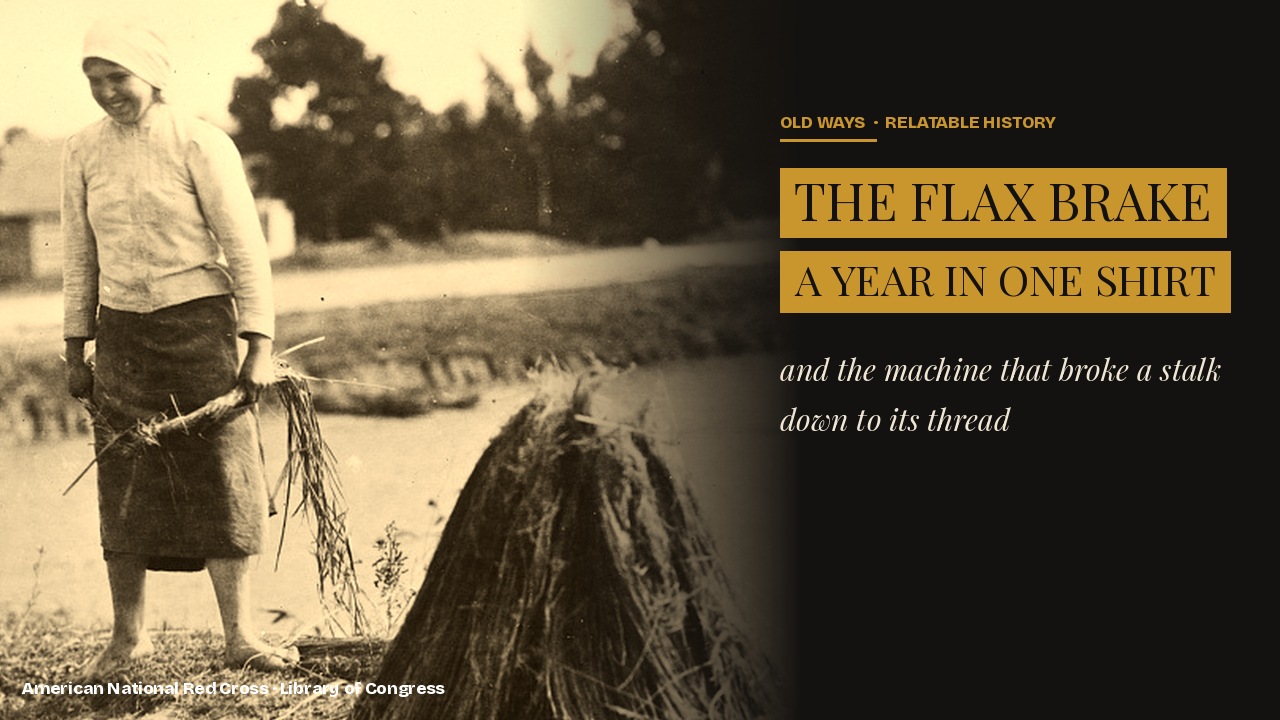

Cotton got a gin and, within a generation, a power loom. Wool got the spinning jenny and the water frame, and an entire argument among economic historians about why Britain mechanized spinning first. Flax got a hinged wooden blade that a farmer swung by hand, and in the United States, that is essentially what it kept for as long as anyone still grew the crop.
The video walks through how a household actually turned flax into linen, start to finish. This article asks the question the household process doesn’t answer on its own: why didn’t that work ever move into an American factory the way spinning wool or cotton did? The short version is that it did move into a factory — just not in America. It built an entire industrial city on the other side of the Atlantic instead, while the flax brake stayed exactly what it had always been, a hand tool in a barn, until American farm families simply stopped using it.
A Process That Resisted Being Sped Up
Donna C. Parker’s 2007 survey of flax’s use in America, published through Western Kentucky University’s TopSCHOLAR repository, describes the whole chain from stalk to thread in a single, pointed phrase: a “labor-intensive and highly-skilled process not suited to mechanization.” That line is doing more work than it looks like. Cotton’s bottleneck was removing seeds from raw boll, a repetitive mechanical task that a geared cylinder could do as fast as a crank turned. Flax’s bottleneck was nothing like that simple. Before a single thread could be spun, the fiber had to be separated from a woody stem it was never meant to let go of, and every method anyone had found for doing that depended on judgment, patience, or both.
The One Place the Brake Got Bigger
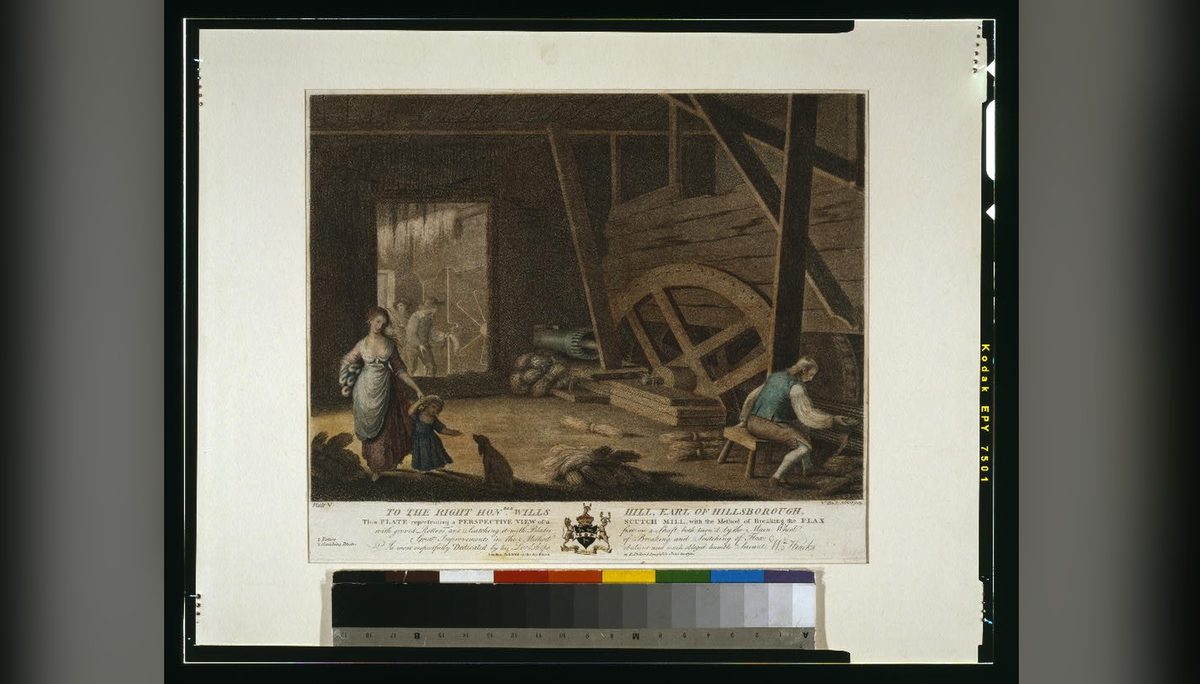
It isn’t quite true that nobody ever tried to scale the brake up. Writing in Hand Papermaking magazine, the book artist Suzanne Sawyer describes a “double brake” design built with two full sets of blades, a coarser set the fiber passed through first and a finer set after, and notes that one contemporary flax worker, Helmut Becker, prefers a brake built with three blades on top and five on the bottom over the simpler versions most farms actually owned. Sawyer also describes the water-powered scutch mills that once stood in flax-growing regions of Flanders, where workers along the River Leie retted their flax directly in the river because its water suited both retting and bleaching, then kept scutching sheds standing beside their own houses well into the 1870s for exactly this work. A bigger brake and a water wheel could do the breaking and scutching faster. What they could not do was skip the step that came immediately before either one.
Retting Was Biology, Not Engineering
That earlier step was retting, and it is where the limits of mechanizing flax become clearest. According to the University of Wisconsin–Madison Division of Extension’s research summary on flax, retting is fundamentally “a microbial process that depends upon the degradation of pectins” — the glue-like compound binding the fiber to the woody core has to be broken down by bacteria or fungi, not cut, crushed, or combed loose by any blade. Water-retting submerged the stalks and let anaerobic bacteria do that work; dew-retting spread them in a field instead and let fungi do a slower, patchier version of the same job. Either way, the extension’s research makes clear that this part of the process ran on its own biological clock, not a mechanical one. A spinner’s wheel could be built to turn faster. A vat of rotting flax could not be told to rot faster, which is a large part of why mechanizing retting lagged every other step in the chain by decades, in both America and Europe. The two retting methods also traded one kind of unpredictability for another: water-retting ran faster and gave a lighter, more even color, while dew-retting took longer and left a darker, less uniform fiber that depended on whatever rain actually fell that season. Neither method gave a farmer anything to adjust. A fiber that had to rot correctly before anything else about it could be improved was never going to be the one an inventor picked first, and for most of flax’s history, it wasn’t.
Where Flax Did Get Its Factory
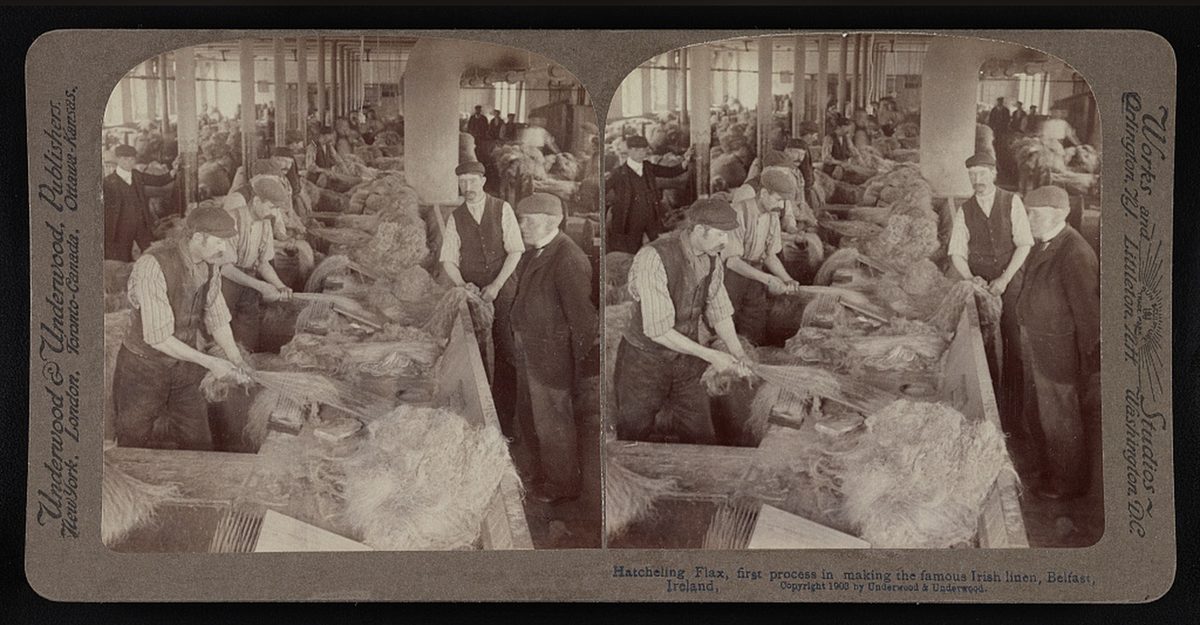
What flax needed, in the end, wasn’t a bigger brake. It was a way to spin the fiber by machine at all, and that solution arrived specifically in Ulster. According to the Irish Linen Centre & Lisburn Museum, a workable “wet spinning process” for flax came into use around 1824, and steam-driven power looms came to dominate the industry from 1860 onward. The museum’s account traces the mill-building that followed in close detail: the Quaker manufacturer Samuel Richardson built a spinning mill on the River Lagan at Lisburn in 1840, on a site that had previously held a vitriol works used for bleaching; after a fire, Joseph Richardson rebuilt it as the Island Spinning Company in 1867, a mill that employed roughly 1,100 people weaving and twisting thread by 1900 and didn’t close until 1983. John Barbour had set up an even earlier thread mill at Lisburn back in 1784. By the industry’s height in the late 19th century, Ulster’s mills were pulling in so much flax that much of the raw fiber had to be imported from Belgium and Russia just to keep the spinning frames fed.
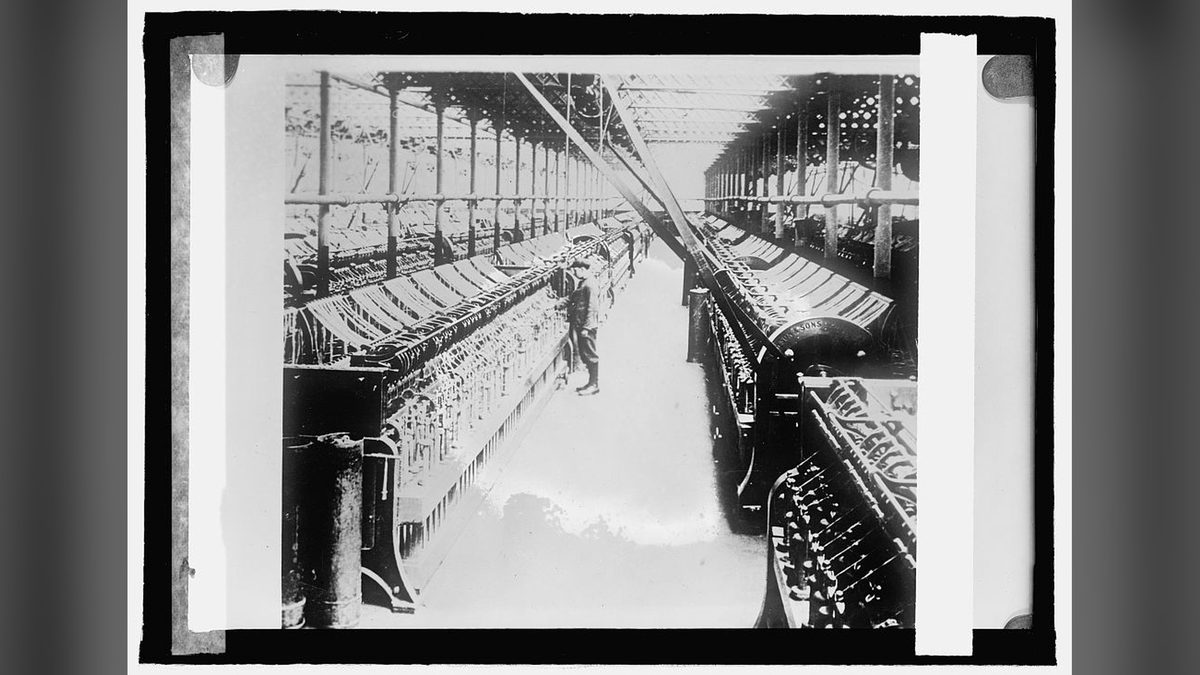
None of that infrastructure existed on the American side of the Atlantic. What America had instead was millions of individual households, each running its own miniature version of the same process on its own schedule, with no equivalent of a Lagan Valley mill district anywhere in reach.
Why Flax Never Became an American Industry
Historian Michelle Mormul’s entry on flax and linen for The Encyclopedia of Greater Philadelphia, published through Rutgers University–Camden’s Mid-Atlantic Regional Center for the Humanities, looks at exactly this gap in one of colonial America’s most promising linen-growing regions, the Delaware Valley, and finds a simple economic answer rather than a technical one. Local flax production, she writes, “could never fill the Delaware Valley’s needs,” and the region’s various attempts at building real linen factories mostly “failed because they lacked funding and labor was too expensive.” The households kept right on growing flax and spinning it by hand on a small, artisanal scale well into the late nineteenth century, while the actual commercial linen Philadelphians bought — for shirting, table linen, sailcloth, and grain bags — mostly kept coming from Ireland and England anyway, imported rather than milled at home. The American colonies and then the young United States, in other words, never lacked flax growers. They lacked investors willing to bet that an American flax mill could out-earn a flax patch out back and a linen importer down at the docks.
What Finally Ended It

The fiber that actually displaced flax in America wasn’t machine-spun linen at all. It was cotton, and the turning point has an exact date: Eli Whitney patented the cotton gin in 1793, a geared cylinder that pulled raw cotton fiber through wire teeth set too narrow for its seeds to pass through, according to Encyclopædia Britannica. Cotton’s bottleneck, unlike flax’s, really was the kind of repetitive mechanical task a machine could do faster than a person, and the gin broke it wide open. Mechanized cotton cloth undercut a household’s own homespun linen on price without that cloth ever having to come from a flax mill at all, in America or anywhere else. The flax brake didn’t lose a competition to a rival machine built for the same job. It lost to a cheaper substitute that made the entire question of mechanizing flax beside the point, everywhere except Ulster, which had found its own paying export market, dressing shirts, sheets, and tablecloths, far beyond anything a single American farm patch had ever needed to supply.
None of this makes the flax brake a failure. A tool that stayed in continuous, functional use on American farms for roughly two and a half centuries without needing to change its basic design is about as successful as a hand tool gets. What it never became is the seed of an American industry, and that had nothing to do with the tool itself. Spinning could be sped up by a machine because spinning is motion. Retting could not be sped up by a machine because retting is decay, running on bacteria’s schedule rather than an inventor’s. Ulster built a city’s worth of mills around that same stubborn fact once it found a way past it. American flax growers, with cheaper cloth arriving by wagon and later by rail, mostly just quit first.
Watch the full history
The video covers the household process itself — pulling, retting, breaking, scutching, hackling, spinning, and weaving a single linen shirt from a handful of seed — in just under nine minutes.

Related reading
- The Spinning Wheel’s Economics Were Worse Than You Think
- How Rag Rug Making Worked, From Rags to Wages
- The Cotton Bag Sewing Contest That Outlived the Great Depression
- Inside the 19th-Century Ice Harvesting Industry’s Boom and Bust
Shop
- The Big Book of Flax, by Christian and Johannes Zinzendorf — a hands-on reference for every step from field to finished linen.
Works cited
- Parker, Donna C. “Use of Flax in America.” SCL Faculty and Staff Publications, Western Kentucky University TopSCHOLAR, 2007. Link.
- Sawyer, Suzanne. “The Flax Brake: Then and Now.” Hand Papermaking, vol. 27, no. 1, Summer 2012. Link.
- “Flax Research in the U.S.” University of Wisconsin–Madison Division of Extension, Crops & Soils. Link.
- “The Story of Irish Linen: Flax to Fabric.” Irish Linen Centre & Lisburn Museum, via Google Arts & Culture. Link.
- Mormul, Michelle. “Flaxseed and Linen.” The Encyclopedia of Greater Philadelphia, Mid-Atlantic Regional Center for the Humanities, Rutgers University–Camden. Link.
- “Cotton Gin.” Encyclopædia Britannica.