
When a family bought a sewing machine in the years just after the Civil War, a startling share of what they paid had nothing to do with manufacturing it. A patent-licensing fee of twenty-five dollars — by itself almost half of what a basic machine cost — went straight to a rival patent holder the maker had quite possibly been suing a few years earlier. That absurdity was the product of a decade of lawsuits historians call the Sewing Machine War, and it came within a hair of keeping the machine too expensive for an ordinary household ever to own outright — which is exactly why the sewing machine installment plan had to exist in the first place.
The war ended in 1856, not in a courtroom but at a negotiating table, in an agreement now remembered, when it is remembered at all, as the first patent pool in American industrial history. Settling it did more than stop the lawsuits. It is also the reason the machine that eventually reached rural America was not simply a better tool — it was sold through a financing method nobody had tried before, one that would go on to put pianos, furniture and, eventually, automobiles into American homes the same way.
A patent pool had to rescue the machine from its own inventors
The modern sewing machine traces to a single patent: No. 4,750, issued to Elias Howe Jr. on September 10, 1846. Howe’s machine used a curved, grooved, eye-pointed needle on a vibrating arm, with a second thread carried by a shuttle to lock each stitch from underneath — the lockstitch. Howe’s claim to that specific combination, needle and shuttle together, held up in court, which meant that anyone building a machine on the same principle owed him money.
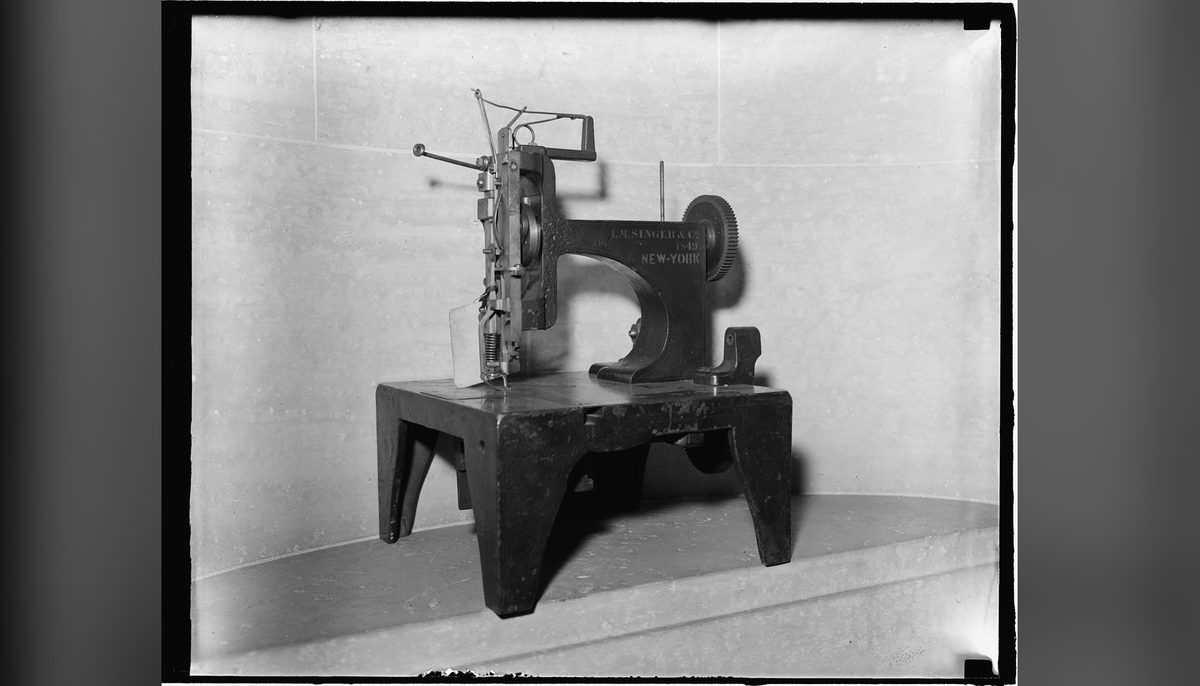
Almost everyone building a machine was, eventually, doing exactly that. Isaac Singer’s own machine, patented in 1851, added a vertical needle working over a horizontal table; Wheeler and Wilson patented a four-motion feed that advanced the cloth automatically. Both improvements were real, and both infringed on pieces of what other inventors already held. By the mid-1850s, the industry’s biggest names were suing each other in overlapping combinations, spending on lawyers what they might have spent on manufacturing. Singer himself was an unlikely figure to end up a household name in the dispute — a former touring actor with a flair for showmanship, described by Smithsonian curator Peter Liebhold as more of a “scalawag” than a businessman, and by most counts the father of around two dozen children across several concurrent households.
Orlando Potter, a lawyer and the president of Grover and Baker, proposed the fix: rather than keep litigating, Howe, Singer, Wheeler and Wilson, and Grover and Baker would pool their patents — nine in total, built around the lockstitch, the four-motion feed and Singer’s vertical-needle arrangement — and license the bundle to any manufacturer for a flat per-machine fee, split among the four. It worked. Historian Grace Rogers Cooper, writing for the Smithsonian, called the result “believed to be the first ‘trust’ of any prominence” in American industry. At least two dozen other manufacturers took licenses rather than fight, the fee itself fell from twenty-five dollars a machine to five within about a decade, and the pool’s basic patents simply ran out in the mid-1870s, by which point sewing machines were ordinary enough that nobody much noticed.
The sewing machine installment plan existed because the machine didn’t come cheap
Settling the patent war made a machine cheaper to manufacture. It did nothing about the fact that most families simply did not have that kind of money sitting around. A complete Wheeler and Wilson machine, cabinet included, sold for $125 in 1853; an earlier model from a smaller maker, Morey and Johnson, was priced at $135 with the patent right bundled in the year before that, while a bare mechanism without a cabinet could run closer to $35. Even at the low end, that was not pocket money for a farm household, and it was the sort of sum people did not borrow for in the 1850s — there was no consumer lending industry yet built to handle it.
The man who solved that problem was not an engineer. Edward Clark, the lawyer who had partnered with Isaac Singer to found I. M. Singer and Company, proposed what Cooper’s Smithsonian history calls the hire-purchase plan: a small sum down, with the rest paid off in small weekly or monthly installments. “Into the American economy,” Cooper writes, “thus came the now-familiar installment buying.”
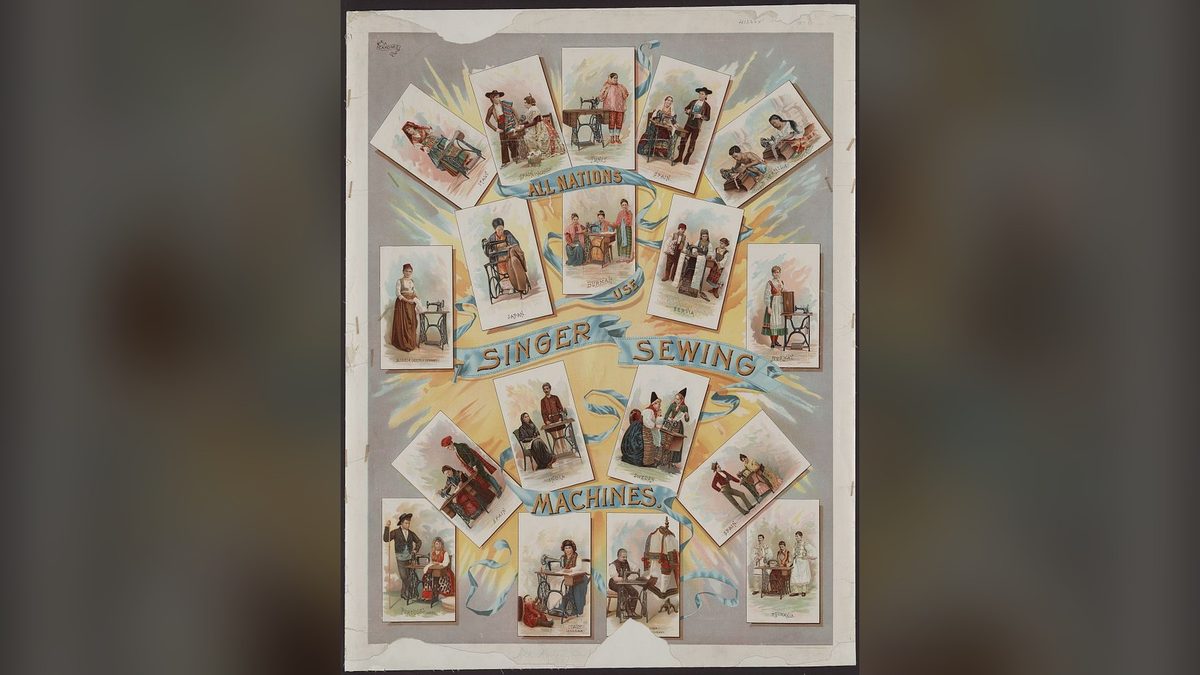
Clark paired the plan with an entire sales apparatus built to support it. Door-to-door canvassers worked a territory on commission, collecting weekly payments in person and leaving a machine behind as the debt was worked off. Company showrooms, meanwhile, staged demonstrations for walk-in customers — Cooper notes the machines were shown off “by pretty young women,” a fact that says as much about 1850s retail as it does about the machine itself. Old machines were accepted as trade-ins to push upgrades, and agents returning on later rounds sold needles, oil and belts, turning a single sale into years of repeat business.
Clark eventually eased Singer himself out of day-to-day management of the company he had co-founded, and in 1863 their partnership dissolved into the Singer Manufacturing Company. By most historical accounts, that reorganization under Clark’s sales strategy, not Singer’s mechanical tinkering, is what turned a patent-pool survivor into the dominant name in the industry. The sewing machine installment plan did not just sell sewing machines. It became the template American retailers reached for every time they needed to sell something expensive to someone without much cash on hand.
The one part of the machine that really was Singer’s own idea
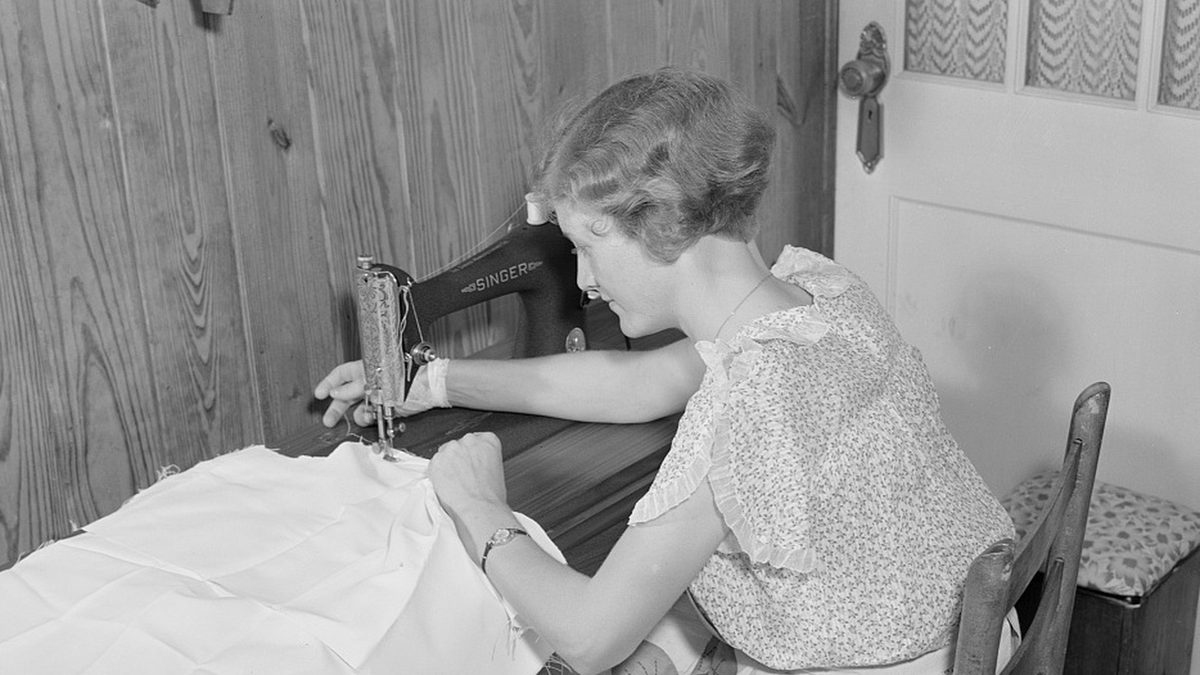
Given how much of the sewing machine’s story is other people’s patents, it is worth being precise about what Singer actually contributed. It was not the lockstitch, which was Howe’s. It was not the automatic feed, which was Wheeler and Wilson’s. It was the treadle itself — specifically, the rocking, two-direction motion that let an operator drive the machine with one foot while both hands stayed free for the cloth.
Cooper’s account is specific on this point: Singer “put the pivot of the treadle toward its center, about where the instep of the foot would rest,” which “produced the heel-and-toe action treadle” that became standard across the industry. “Singer also added a flywheel to smooth out the treadle action,” evening out the jerkiness of a foot that was, after all, only pushing a pedal back and forth rather than turning a crank. It is a small mechanical idea, and it is also the one piece of the standard treadle machine that does not trace back to a lawsuit — the rest of the machine’s running tally of patent royalties was a kind of arithmetic manufacturers had to keep as carefully as a merchant working a counting frame, bead by bead.
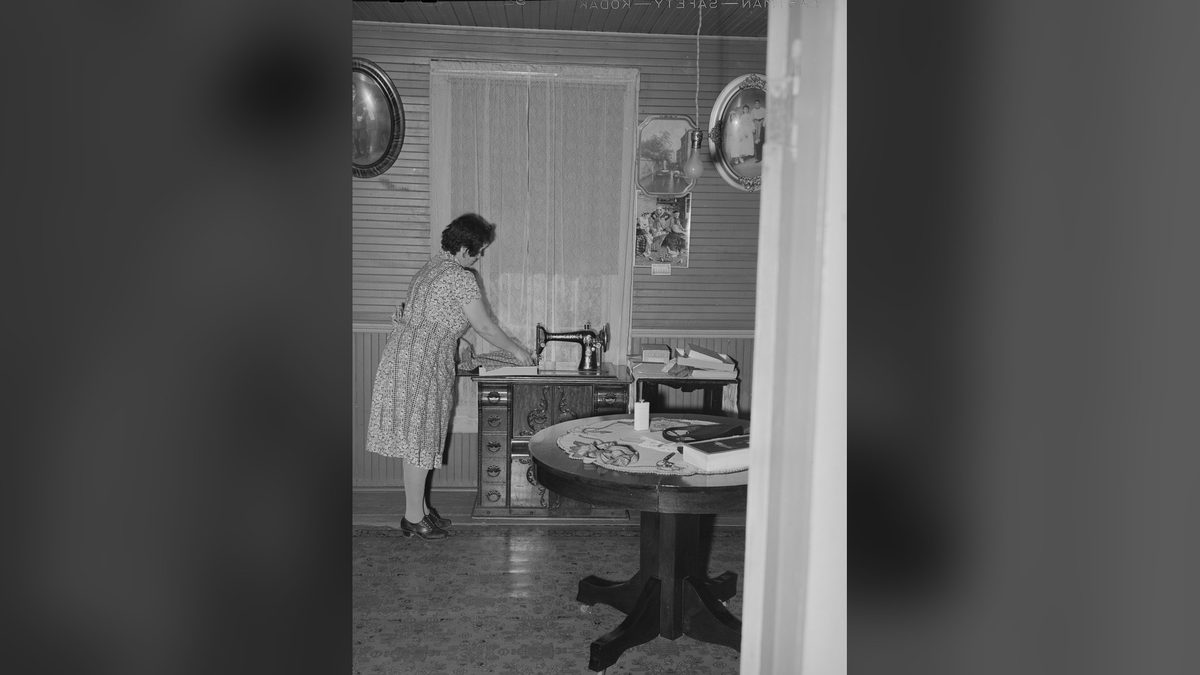
Factories got the machine first, and that changed what it meant at home
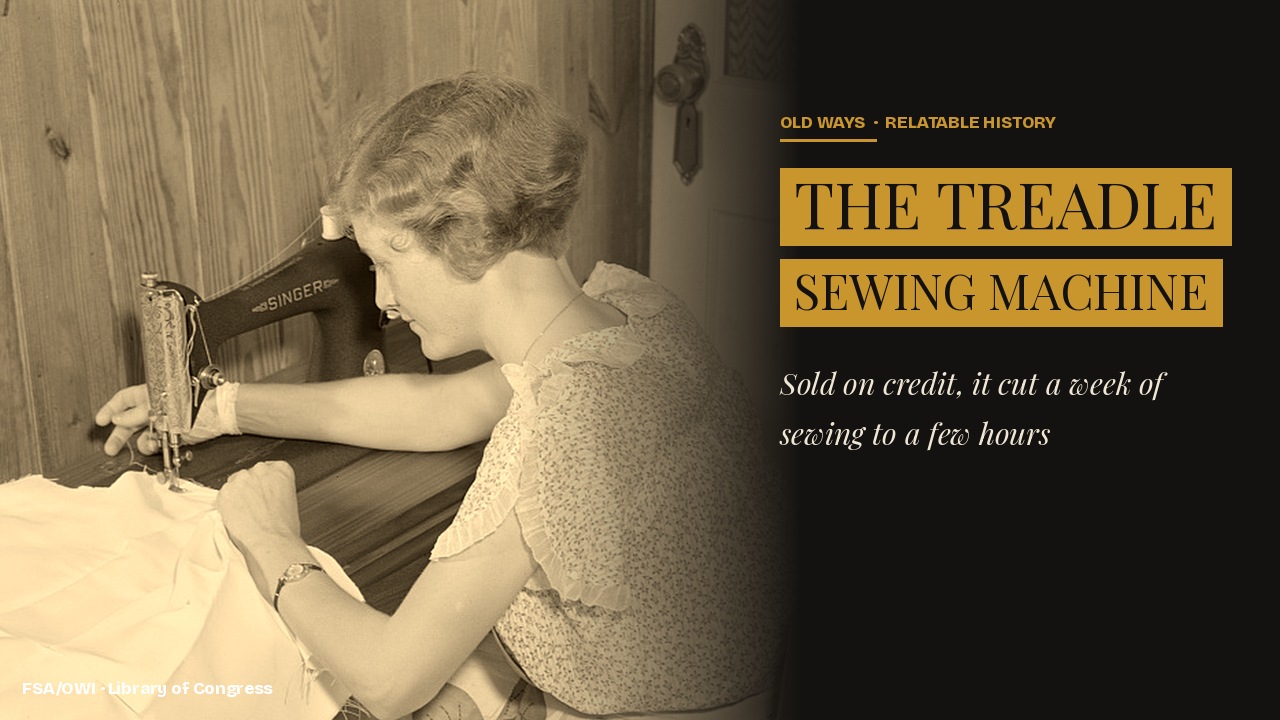
It is tempting to picture the sewing machine spreading from farmhouse to farmhouse, but clothing manufacturers adopted it first, in the 1850s, years before it was common or affordable enough for home use. By the time a treadle machine was a realistic purchase for a working family, the ready-to-wear clothing industry was already forming around machines in factories, and by the early 1900s that industry offered men’s, women’s and children’s clothing off the shelf, according to curator Jeanine Head Miller of The Henry Ford museum. The home machine and the factory machine were, in effect, racing each other to make hand-sewing obsolete, and between them they mostly succeeded — finishing off the same kind of hour-by-hour household arithmetic that had already made spinning your own thread look like a bad bargain by comparison.
What that race actually saved in time is well documented, with only minor disagreement on the exact figure. Miller’s museum puts a hand-sewn man’s shirt at roughly fourteen hours of labor against about one hour on a machine. A 1996 lecture to the International Sewing Machine Collectors’ Society, drawing on earlier trade estimates, gives a closer figure: fourteen and a half hours by hand against one and a quarter by machine. The two sources were compiled decades apart from different material, and they land within half an hour of each other — which is about as close as two independent estimates of unpaid household labor from the 1850s are ever going to get.
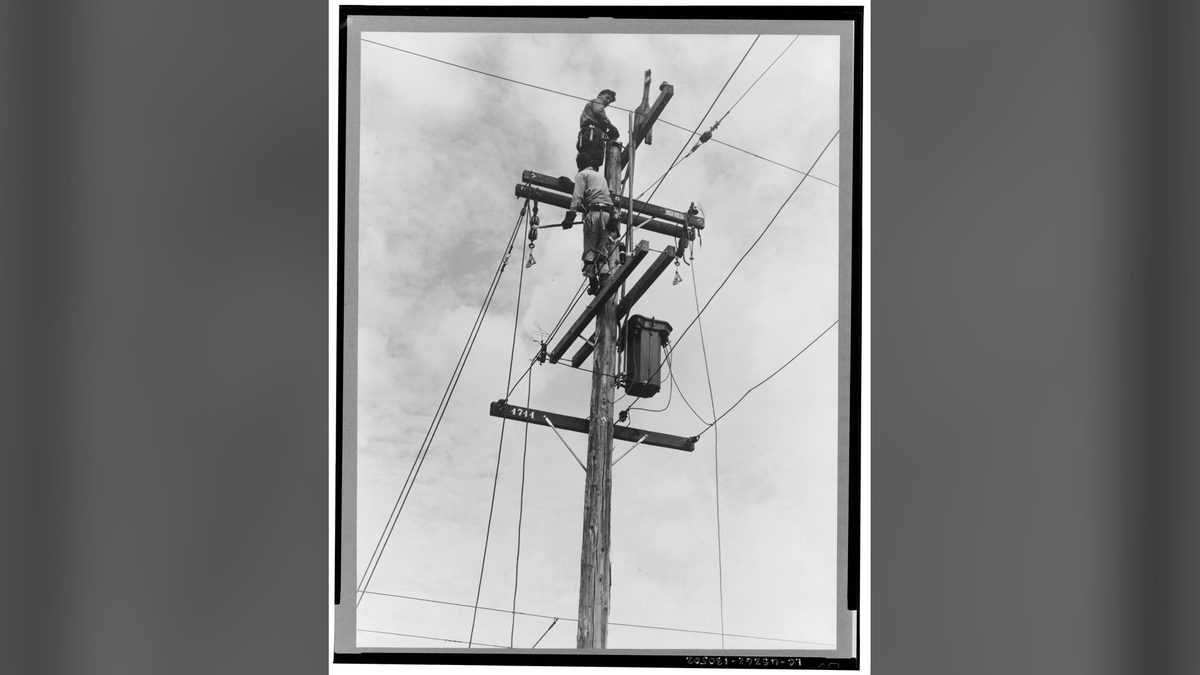
The power grid took longer to arrive than the machine already had
The treadle needed nothing from a wall outlet, which mattered more than it might sound, because the outlet took generations to show up. As of 1930, roughly one farm in ten in the United States had electricity at all; private utilities considered rural lines a bad investment, with construction costs that could run close to two thousand dollars a mile for a scattered customer base, according to an economic history published by the Federal Reserve Bank of Richmond. Those were the same households that, a few decades earlier, had still been rendering their own tallow for light instead of buying it, for exactly the same reason: no infrastructure existed yet to make the store-bought version worth the cash.
President Franklin Roosevelt created the Rural Electrification Administration by executive order in May 1935, with a hundred million dollars set aside for loans; Congress made the agency permanent with the Rural Electrification Act the following year. Rather than build lines itself, the REA lent money to new, member-owned electric cooperatives at two to three percent interest, and its own engineering standards and bulk purchasing pushed construction costs down to under eight hundred twenty-five dollars a mile by the end of the 1930s. By the close of the Second World War, roughly half of American farms had power; it took most of two more decades for the rest to catch up, and the loan program’s default rate, remarkably, stayed under one percent the whole time. A treadle machine bought by a young bride in the 1910s could easily still be the only sewing machine in a house where her own daughter was raising children decades later, simply because the wires had not arrived yet.
A small number of American households still run the original machine on purpose
In May 2020, with manufactured masks suddenly scarce, women in an Amish community in New Wilmington, Pennsylvania, sewed cloth masks using — in the words of a report at the time — four foot-powered antique sewing machines set up in one home, with several families working in shifts. An organizer said a mask could be finished in well under five minutes, entirely without electricity. The community involved keeps an unusually traditional position even among Amish groups, deliberately declining the grid that reaches almost every other American home.
That is not nostalgia. It is the same machine solving the same problem it solved in 1870: getting a needle through cloth quickly, using only a foot, in a house that has made a considered decision not to depend on a power line. Nothing about the treadle’s design needed to be preserved or revived to make that possible. It simply never stopped working.
Watch the full history
The video walks through the treadle’s mechanics and that same fourteen-hour shirt in about seven minutes; the lawsuits, the canvassers and the decades-long wait for the power grid are the parts there wasn’t room for there.

Related reading
- The Spinning Wheel’s Economics Were Worse Than You Think
- How Tallow Candles Were Made, and Why Candle Day Was Dreaded
- How an Abacus Actually Works, Bead by Bead
- How Scrimshaw Was Made, From Whale’s Tooth to Keepsake
Shop the styles/items featured in this video
Works cited
- Cooper, Grace Rogers. The Invention of the Sewing Machine. United States National Museum Bulletin 254. Smithsonian Institution, 1968. Link.
- Lampe, Ryan, and Petra Moser. “Do Patent Pools Encourage Innovation? Evidence from the Nineteenth-Century Sewing Machine Industry.” The Journal of Economic History 70, no. 4 (2010): 898–920. Link.
- Smithsonian National Museum of American History. “1846 – Elias Howe Jr.’s Sewing Machine Patent Model.” Collection record. (Live at si.edu; blocks automated verification from this machine, cited as print.)
- Palmer, Alex. “How Singer Won the Sewing Machine War.” Smithsonian Magazine, July 14, 2015. (Blocks automated verification from this machine, cited as print.)
- Miller, Jeanine Head. “The Changing Nature of Sewing.” The Henry Ford, September 1, 2021. Link.
- Gregory, Martin. “What Can We Learn from the Sewing Machine?” Lecture, ISMACS ’96. ISMACS News, issue 52. International Sewing Machine Collectors’ Society. Link.
- Sablik, Tim. “Electrifying Rural America.” Econ Focus, First Quarter 2020. Federal Reserve Bank of Richmond. Link.
- Rural Electrification Act of 1936, Public Law 74-605, 49 Stat. 1363. United States Department of Agriculture Rural Utilities Service archive.
- Wesner, Erik. “Amish Women Sew a Mask in 5 Minutes — With Foot-Powered Antique Machines.” Amish America, May 4, 2020. Link.
It is worth asking the same question the video closes on, from the other direction. If the power went out tonight for good, could your household clothe itself with a needle and thread alone? In 1870, the honest answer for most families was barely, and only because a whole week already bent around it. In a handful of Amish and Mennonite homes today, the answer is still yes — on machines built to the same cast-iron answer that was already old news when the power lines finally showed up.