
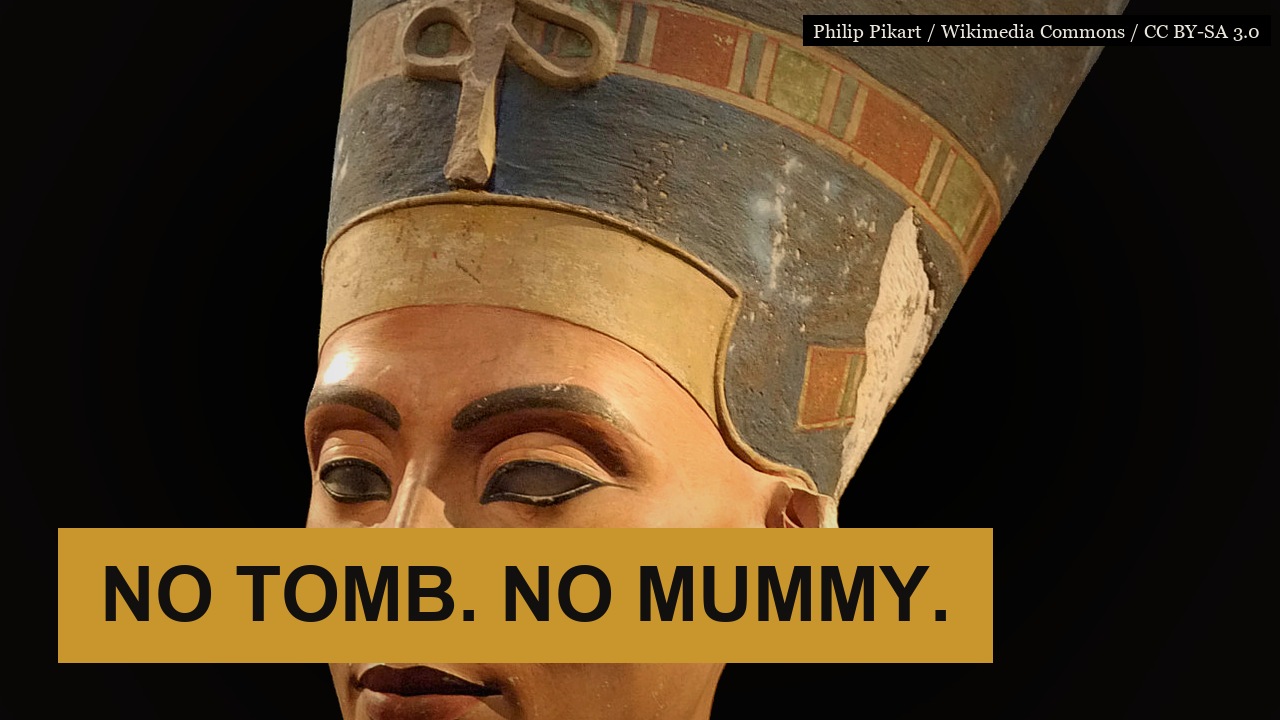
Five serious investigations, spread across more than a century and using everything from a shovel to ground-penetrating radar, have each claimed to be closing in on the tomb of Nefertiti. Every one of them has since been withdrawn, contradicted, or left to expire quietly without an answer. The most reproduced face in ancient Egyptian art belongs to the one queen whose grave nobody has ever been able to point to.
That is a strange gap for someone this well documented. Nefertiti has titles, portraits, a dated inscription proving exactly how long she lived, and a bust that millions of people walk past in Berlin every year. What she does not have is a coffin, a canopic jar, or a body anyone can defend in a peer-reviewed journal. Egyptology has spent well over a hundred years ruling out candidates for her burial without ever ruling one in.
What follows is the full run of attempts, roughly in the order they happened: the science that closed off the oldest theory about where she went, the burial that shows how completely a royal body can be erased, and the radar surveys of Tutankhamun’s tomb that keep reaching different verdicts about the same wall.
She Held a King’s Titles, and Once, a King’s Pose
Nefertiti became great royal wife to Akhenaten in the mid-fourteenth century BC, during the reign that Egyptologists still argue about more than almost any other. Akhenaten shut down the state cults of Egypt’s traditional gods, declared the sun disc, the Aten, the only deity worth a temple, and abandoned Thebes for a new capital built from nothing on virgin desert at Akhetaten, the site now called Amarna. Nefertiti’s position inside that project was not ceremonial. Her titles — Lady of the Two Lands, Mistress of Upper and Lower Egypt — belong, almost word for word, to the vocabulary of kingship rather than queenship.
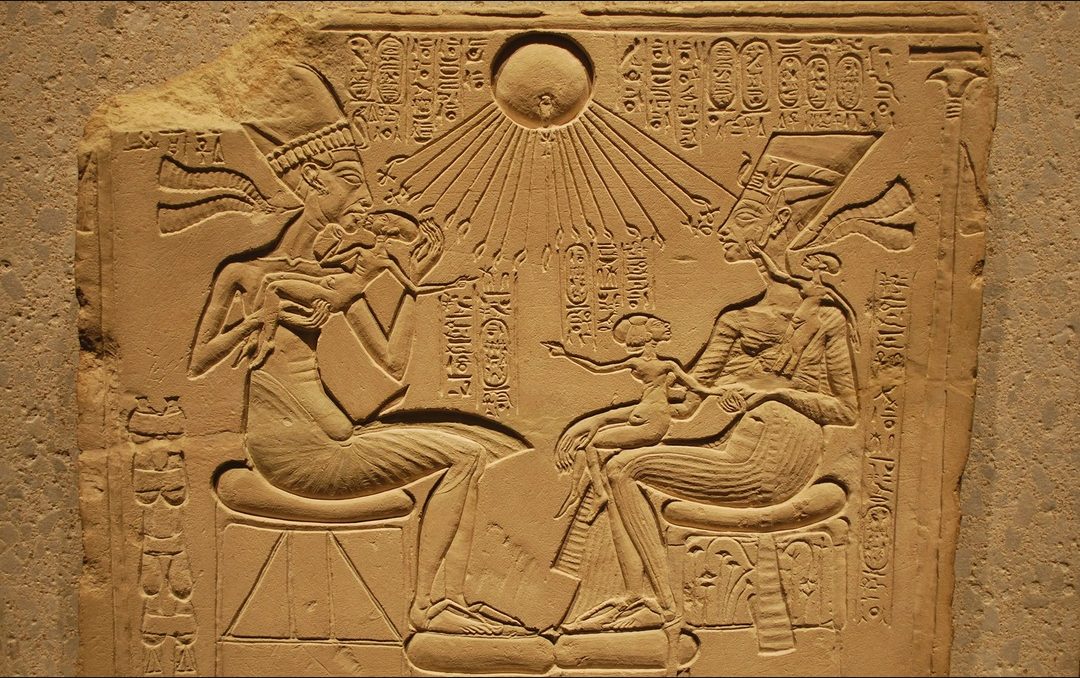
The art backs up the titles. In the Amarna reliefs Nefertiti is carved at the same height as Akhenaten, a scale almost no other Egyptian royal wife was given against her husband. In at least one surviving scene she is shown raising a weapon over a bound captive — iconography reserved, in every other context, for a reigning king smiting an enemy of the state. Whatever her formal status turns out to have been, the people decorating her monuments were not treating her as background.
That ambiguity about where queen ends and king begins is not a modern reading. It is baked into the last years of her documented life, and it is the reason her eventual burial is so hard to predict in advance: a king’s tomb and a queen’s tomb were different builds, in different places, and nobody now agrees which one she would have been given.
The Discovery Came With Its Own Quiet Cover-Up
The face everyone recognises was dug up on 6 December 1912, when Ludwig Borchardt’s German excavation cleared house P47.2 at Amarna and found, in room 19, a workshop belonging to a sculptor named Thutmose. The limestone-and-stucco bust inside — just under fifty centimetres tall, with a rock-crystal right eye set in beeswax and a left eye that was never inlaid at all — was a model, not grave goods. Borchardt wrote in his diary that the piece was “absolutely exceptional” and that description was “useless, must be seen.”
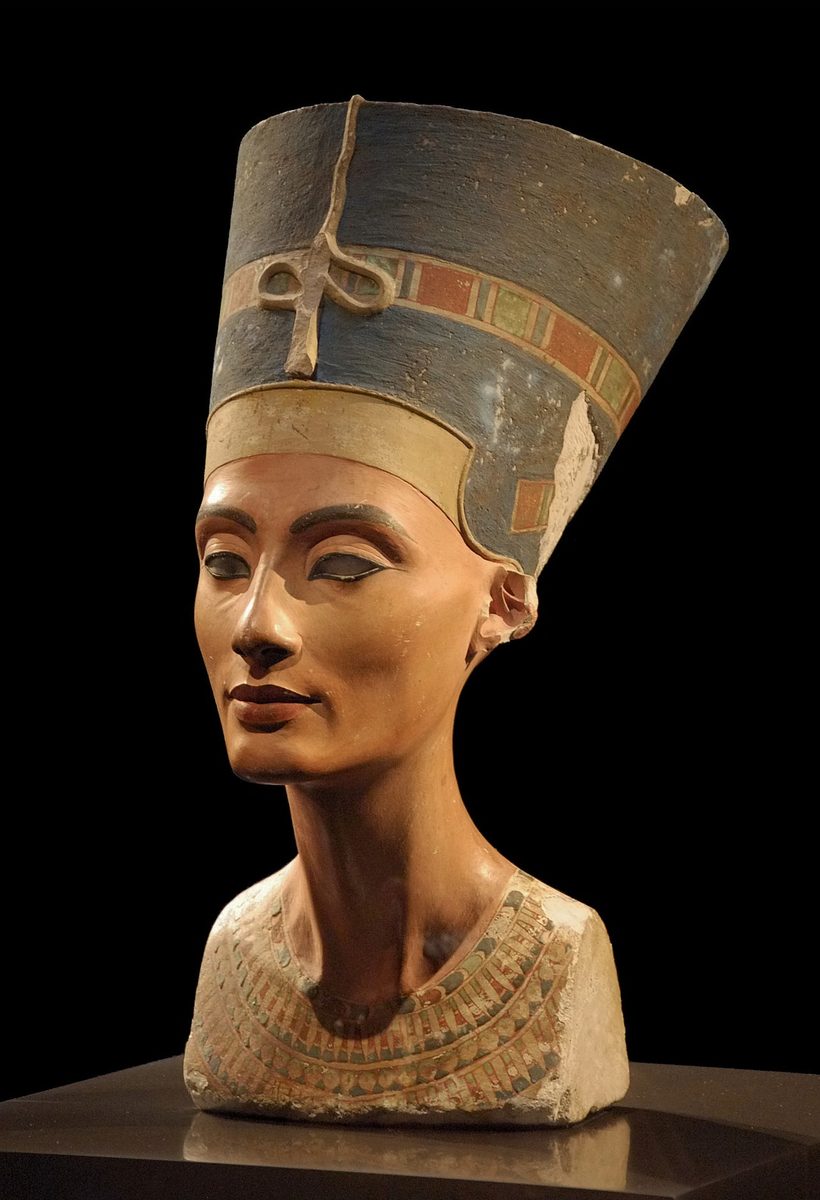
How it left Egypt is still argued over. Excavated finds at the time were divided between Cairo and the foreign mission under mudawala rules, with Egypt entitled to keep anything exceptional. Egyptian officials, including former antiquities minister Zahi Hawass, maintain that Borchardt’s team undervalued the bust to the inspectors who signed off on the division — German reporting from 2009 on the original paperwork quotes Borchardt’s own notes that he “wanted to save the bust for us” — and that it left the country as a result of that misrepresentation rather than a fair division of finds. Hawass has called the outcome a bust that “left Egypt illegally.” Germany’s position, repeated by its cultural institutions whenever the demand resurfaces, is that the 1913 division was conducted under the legal rules of the period and that the bust was simply Berlin’s rightful share. The financier James Simon, who paid for the excavation, donated the piece to the Berlin state museums in 1920; it has been on public display, with brief exceptions, since 1923, and Egypt’s campaign for its return has neither succeeded nor stopped.
One Inscription Closed a Theory That Had Stood for Decades
For most of the twentieth century, the working assumption was that Nefertiti fell from favour and vanished from the record around Akhenaten’s twelfth regnal year, when her name stops appearing in the usual places. Entire theories of disgrace, banishment, or a falling-out with her husband were built to explain that silence.
In 2012 the Egyptologist Athena van der Perre published a limestone quarry inscription from Dayr Abu Hinnis, a site that supplied stone for Akhetaten’s construction, dated by its own text to Akhenaten’s sixteenth regnal year. It names Nefertiti as great royal wife and refers to her as living. That single graffito is the last securely dated mention of her, and it quietly erased a decade of disgrace-and-exile scholarship built on a gap that no longer existed: Akhenaten died in his seventeenth year, so Nefertiti was demonstrably still queen with roughly twelve months left on the clock, not years earlier.
The inscription opened a different, harder question. Somewhere in that final stretch, a co-ruler appears in the record under the name Ankhkheperure-Neferneferuaten, carrying the epithet “effective for her husband” — grammatically feminine, meaning the figure is either Nefertiti herself or her daughter Meritaten. Egyptologists including Aidan Dodson, James Allen and Nozomu Kawai, alongside van der Perre, have argued the balance of evidence points to Nefertiti ruling briefly in her own right. It is not a settled question, and it matters enormously for the search: a woman buried as a reigning king does not get a queen’s tomb.
A Tomb Was Started For Her, and Then Abandoned
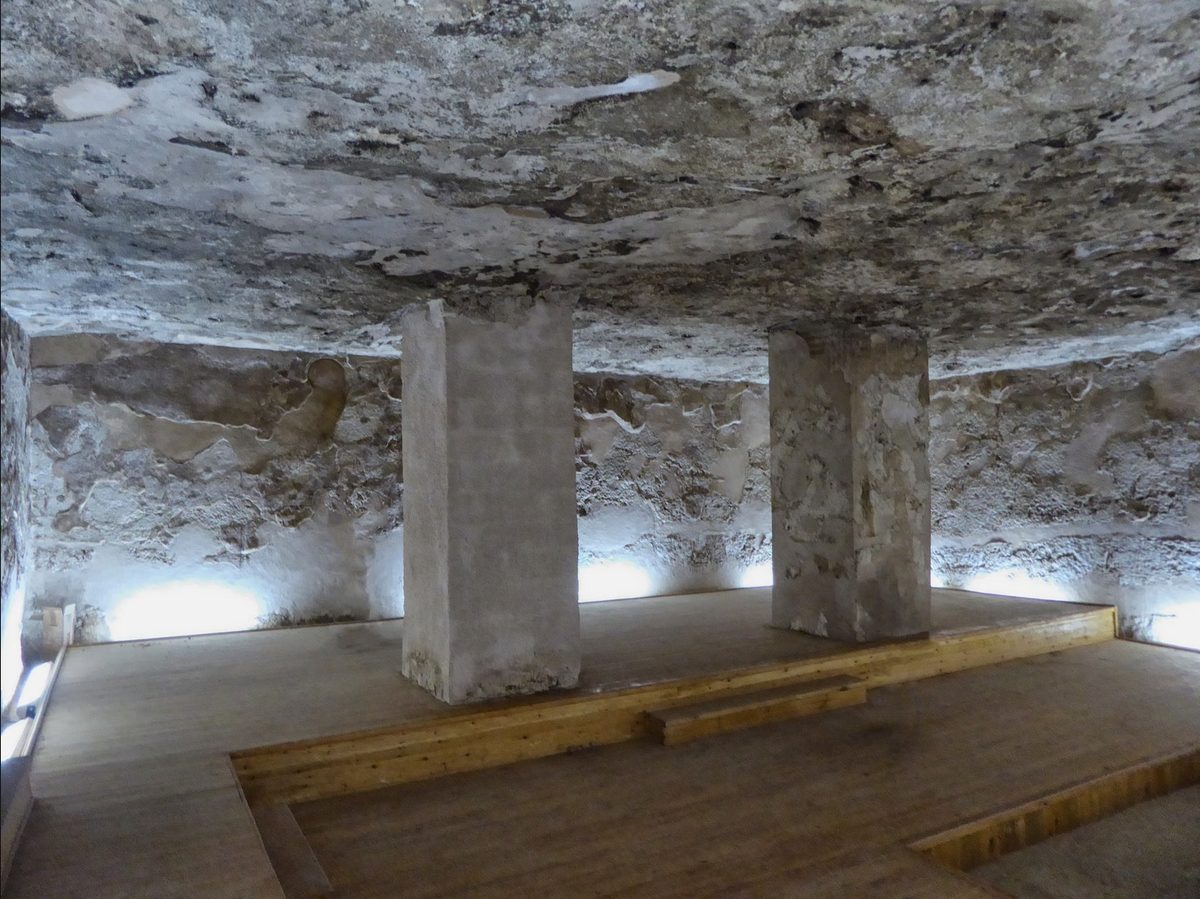
Something was, in fact, being prepared. The royal tomb cut into the cliffs at Amarna has a suite of side chambers branching off its main corridor that appears to have been intended for Nefertiti, and the rooms were never finished. Akhenaten seems to have died first and been given the completed section instead. One shabti figure — a servant statuette buried to work for the deceased in the afterlife — survives bearing her name, which is the clearest physical proof that someone, at some point, was actively equipping a burial for her. A second Amarna tomb, numbered 29, is sometimes proposed as hers instead; it has no finished burial chamber at all.
Neither tomb got the chance to be used as planned, because the city itself did not survive Akhenaten. Within a few years of his death the royal court moved back to Thebes, Akhetaton was abandoned and largely dismantled for building stone, and his name and image were chiselled off monuments across Egypt in a campaign of erasure that also swept up Nefertiti’s. Royal burials from the city were moved, which means whatever had been prepared for her either travelled several hundred miles to the Valley of the Kings or was broken up where it stood. Nobody has recovered enough of either process to say which — the same dead end that swallowed an entire Persian army in the Egyptian desert, centuries later, with just as little left to show for it.
One Royal Burial Shows How Completely a Body Can Be Erased
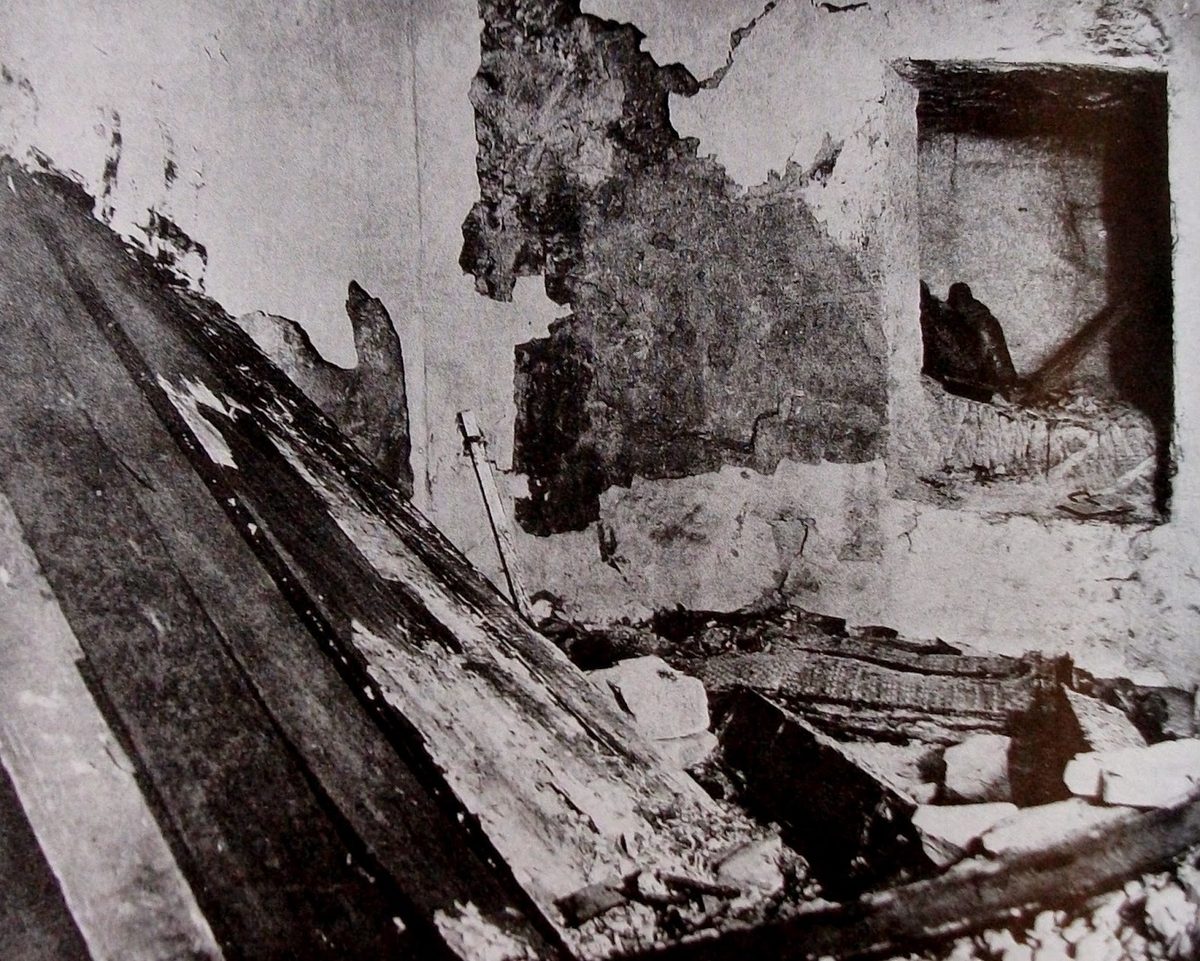
There is a case study in exactly how thoroughly an Amarna-period royal burial can be disguised, and it is a discouraging one. On 6 January 1907, Theodore Davis and Edward Ayrton opened a small, flooded chamber in the Valley of the Kings, now catalogued KV55. Inside was a coffin with its face smashed off and its royal cartouches physically cut away; four inscribed clay bricks on the floor, of which only two could still be read, both naming Akhenaten; a set of canopic jars originally carved for a lesser wife named Kiya and then reworked; and a gilded wooden shrine built for Queen Tiye’s own funeral equipment. Nothing in the room agreed with anything else in the room.
More than a century of forensic and archaeological argument has not settled whose body that coffin held. The best current forensic reading, from the 2010 JAMA study discussed below, identifies the KV55 male as Tutankhamun’s father — without resolving whether that man is Akhenaten himself or his shadowy, barely attested successor Smenkhkare. Someone went to deliberate, specific trouble to make an Amarna royal burial unidentifiable, more than three thousand years ago, and by any reasonable measure they succeeded. That is the strongest argument available that a tomb built for Nefertiti could already have been found, stripped of everything that would say so.
Two Mummy Identifications Didn’t Survive the Laboratory
In 1898 Victor Loret opened the tomb of Amenhotep II, KV35, and found a side room holding three unwrapped bodies dumped on the floor in antiquity, stripped of grave goods: an older woman, a younger woman, and a boy. On 9 June 2003 the Egyptologist Joann Fletcher, then of the University of York, announced in a Discovery Channel press release that the younger woman might be Nefertiti. Her case rested on a double-pierced ear matching royal portraiture, a bent right arm that could once have held a sceptre, a “Nubian”-style wig found near the body, and rib damage one specialist read as a possible pre-death wound.
The rebuttal was immediate and specific. Zahi Hawass called the identification “pure fiction” and barred Fletcher from further fieldwork in Egypt. The Egyptologist Barbara Mertz dismissed it in print as “balderdash” and called the arm evidence “methodologically unsound”; Susan James disputed the wig’s association with the body and the ear evidence; Aidan Dodson pointed out that royal ear-piercing in art is not attested for the relevant reigns at all. The claim did not survive the week, let alone the decade.
Seven years later, the same body was tested properly. A CT and DNA study led by Hawass, published in JAMA in 2010, identified the older KV35 woman as Queen Tiye and the younger woman as Tutankhamun’s biological mother — and a daughter of Amenhotep III and Tiye. Nefertiti is attested nowhere in the record as a king’s daughter — the same kind of ancient-DNA testing that has settled identity disputes in burials as far away as the Tarim Basin. On the genetic evidence, she is ruled out as a match for the Younger Lady, closing the one mummy identification that had ever gained mainstream attention.
Three Radar Surveys of One Tomb, Three Different Verdicts
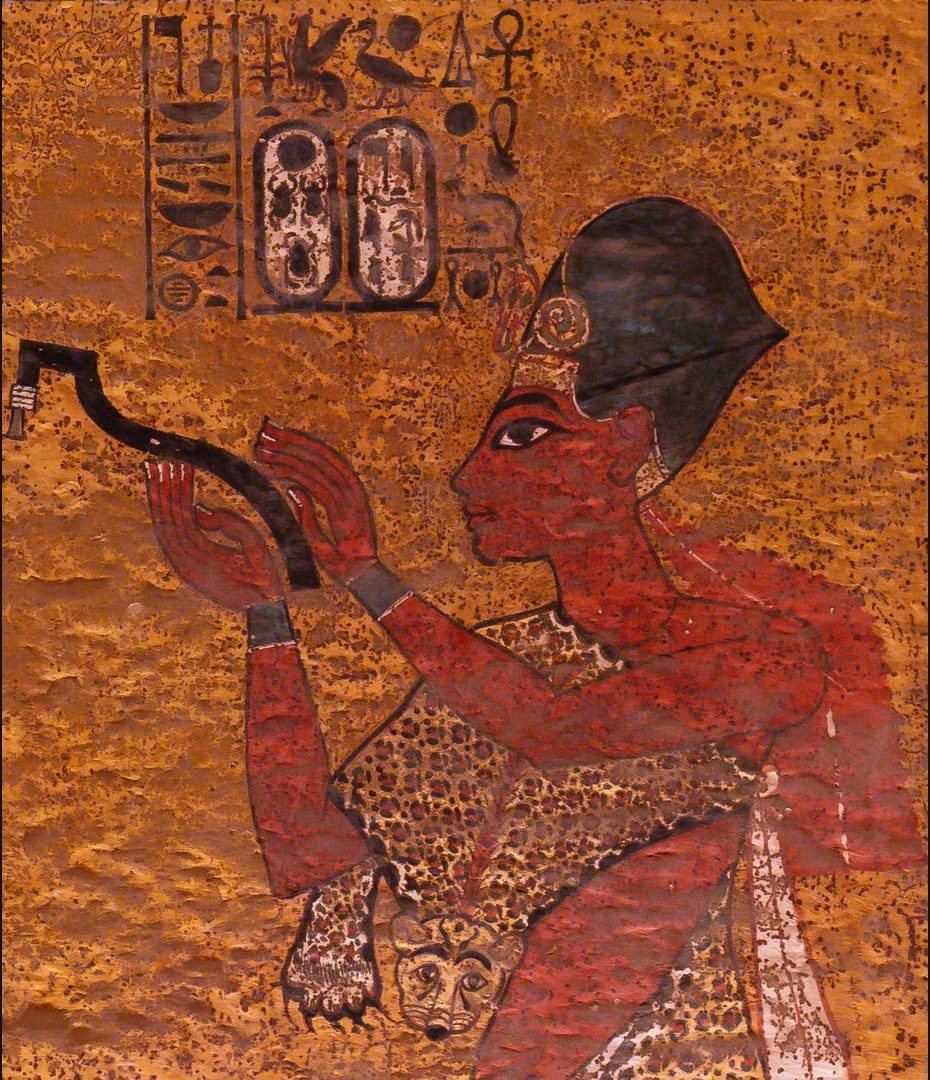
The search then turned to the single most examined room in Egypt. In 2015 Nicholas Reeves was studying ultra-high-resolution scans of Tutankhamun’s burial chamber, made by the digital restoration studio Factum Arte for a facsimile, when he identified faint linear traces in the painted plaster as two bricked-up doorways: one leading to a storeroom, one continuing north. His self-published paper argued that KV62 was built as a corridor-style tomb intended for a queen, and that Tutankhamun had been buried inside the outer section of someone else’s monument — calling his own evaluation of the scans “beyond intriguing.” He read the famous north-wall scene, conventionally understood as Tutankhamun’s successor Ay performing the funerary rite for Tutankhamun, as the reverse: a youthful Tutankhamun performing that rite for Nefertiti.
What followed was four years of radar pointed at the same two walls, with results that never agreed twice. In late 2015 a single-antenna survey by Hirokatsu Watanabe was announced as having found a void, and Egypt’s antiquities minister publicly moved from sixty percent confidence to ninety — on data that was never formally published or repeated. In April 2016 a National Geographic-funded team ran broader multi-angle scans and found nothing. In 2018 and 2019, a team from the Politecnico di Torino led by Luigi Sambuelli and Francesco Porcelli ran three separate radar systems, calibrated against features already known to exist in the chamber, across a wide range of frequencies. Their published conclusion was unambiguous: “there are no hidden chambers immediately adjacent to the Tomb of Tutankhamun.” Egypt’s antiquities chief, Mostafa Waziri, accepted the result publicly the same year the fieldwork concluded.
Even that did not end it. Reeves and a geophysicist later reprocessed the 2016 and 2018 radar data and flagged a possible backfilled corridor at one end of the wall, well short of a confirmed chamber; a separate, unpublished survey reported a similar feature in 2020. Reeves has since issued further written supplements to his original paper without a new excavation to test any of it. Meanwhile, in 2022, Hawass pointed the search somewhere else again: KV21, a small tomb holding two badly degraded female bodies. Their DNA was too damaged for complete profiles. One, KV21A, may have mothered the two stillborn daughters buried with Tutankhamun. The other, KV21B, was roughly forty-five at death — an age that fits — but the usable DNA places her only generally within the eighteenth-dynasty royal line. She could be Nefertiti. She could be Nefertiti’s sister, Mutnodjmet. Hawass promised a final identification for October 2022, then for early 2024, then said in December 2024 he was confident it would come in 2025. As of the most recent public tracking of the claim, it still has not.
Watch the full history
The video version covers this same run of investigations, from the 1912 excavation to the radar inside Tutankhamun’s tomb, in just under nine minutes.

What remains, after five investigations and more than a century, is a strange kind of certainty about uncertainty. Excavation found a model bust and an unfinished tomb. Forensic genetics ruled out one named mummy. Three calibrated radar surveys ruled out one specific wall. None of those methods has ever produced a positive match — only a shrinking list of places she is not.
She is not the only prominent figure from the ancient world missing a grave: Alexander the Great’s tomb disappeared from the record in much the same way, a few centuries later. What survives of Nefertiti is her name, her titles, her face, a single shabti made in her name, and one dated inscription proving exactly how long she lived. What has never surfaced is a coffin, a canopic jar carved for her specifically, a finished tomb, or a body a laboratory will stand behind. So here is the same question the video leaves open: would investigators rather finally find the tomb, or find the proof?
Related reading
- Who Made the Gundestrup Cauldron? The Mystery Nobody Has Solved
- The Carnac Stones Are Older Than Stonehenge. Nobody Knows What They Were For.
- What the Tarim Mummies’ DNA Actually Revealed
- The Purpose of the Longyou Caves Is Still Not Settled
Works cited
- Hawass, Zahi A., Yehia Z. Gad, Somaia Ismail, et al. “Ancestry and Pathology in King Tutankhamun’s Family.” JAMA 303, no. 7 (2010): 638–647.
- Sambuelli, L., C. Comina, G. Catanzariti, F. Barsuglia, G. Morelli, and F. Porcelli. “The Third KV62 Radar Scan: Searching for Hidden Chambers Adjacent to Tutankhamun’s Tomb.” Journal of Cultural Heritage 39 (2019): 288–296. Link.
- Reeves, Nicholas. The Burial of Nefertiti? Amarna Royal Tombs Project, Valley of the Kings, Occasional Paper No. 1, 2015. Link.
- Van der Perre, Athena. “The Year 16 Graffito of Akhenaten in Dayr Abu Hinnis: A Contribution to the Study of the Later Years of Nefertiti.” Journal of Egyptian History 7 (2014): 67–108. Link.
- Staatliche Museen zu Berlin. “In the Light of Amarna: 100 Years of the Nefertiti Discovery.” Neues Museum exhibition record. Link.
- Ayyad, Ibrahim. “Egypt, Germany Spar over Claim That Nefertiti Bust Was Stolen.” Al-Monitor, October 2020. Link.
- Shaw, Anny. “Queen Nefertiti’s Burial Chamber Could Lie Behind King Tutankhamun’s Tomb.” The Art Newspaper, 11 August 2015. Link.
- Rose, Mark. Review of the claimed identification of Nefertiti’s mummy. Archaeology (Archaeological Institute of America), 16 September 2004. Link.
- Bodenhemier, Lou. “Four Years Later: An Update on the Supposed Discovery of Nefertiti’s Tomb.” ExplorersWeb, 9 January 2026. Link.