
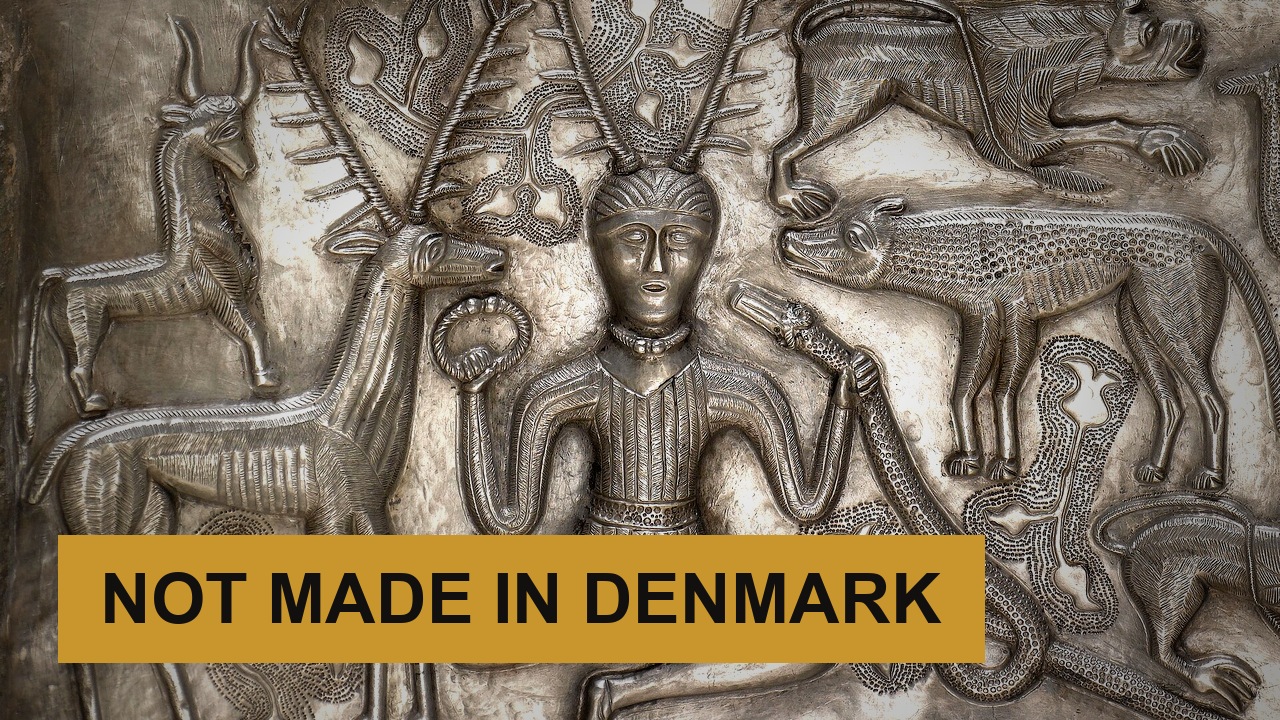
In 1891, peat cutters working a bog called Rævemosen in northern Jutland pulled up nearly nine kilograms of silver, hammered into gods, griffins, and elephants. Nobody in that part of Denmark had ever seen an elephant, let alone shaped one in silver, and nobody there worked metal this way. The cauldron had plainly come from somewhere else. More than a century of archaeology still hasn’t settled where.
What isn’t in dispute is what the peat cutters actually found: a bowl nearly 70 centimetres across, built from sheets of beaten and gilded silver, that had been deliberately taken apart before it went into the ground. Since then, scholars have argued over three connected questions — who made it, what its crowded pictures mean, and how a vessel built somewhere far to the south ended up buried in a Danish bog — and have reached a firm, settled answer on none of them.
The most persuasive case, built from the metal and the craftsmanship rather than the story the pictures seem to tell, points toward the Balkans and a trade in silver that almost nobody associates with Iron Age Denmark at all.
It Was Found Already Taken Apart
The find spot was a small bog near the hamlet of Gundestrup, in Aars parish in Himmerland, the broad inland region of northern Jutland. The cauldron was not lying whole. Its curved base had been used as a container for the rest of itself: the large silver plates that once lined its sides, along with fragments of its rim tubing, had been stacked down inside the bowl before burial.
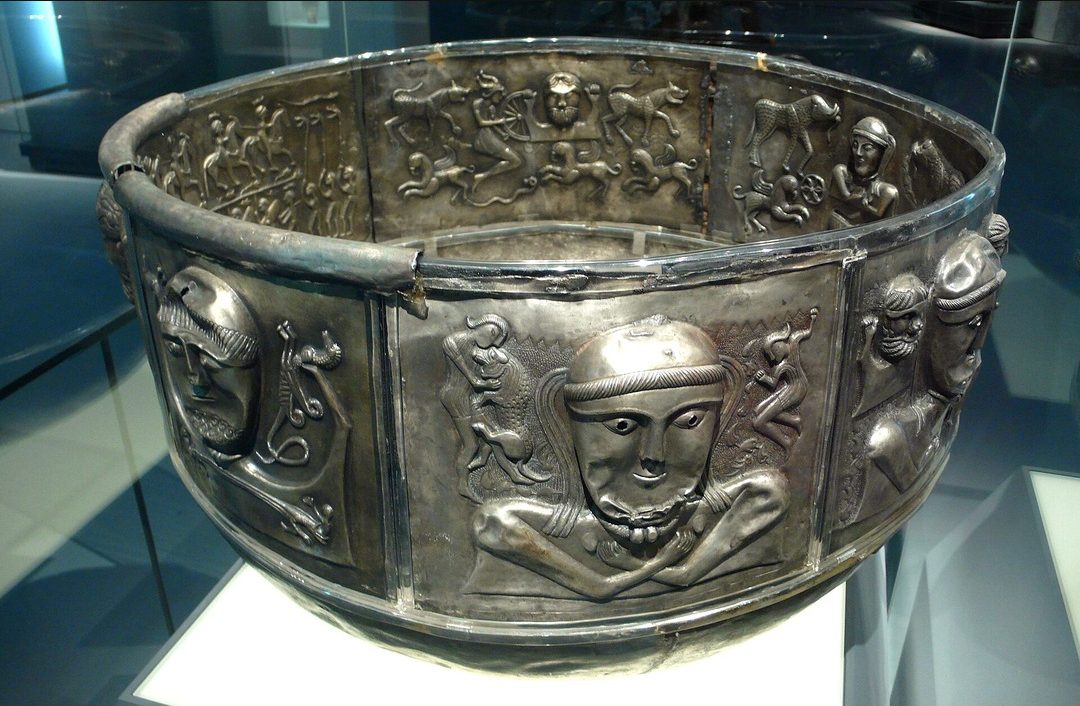
The National Museum of Denmark, which has held the cauldron ever since, treats this as a votive act rather than a loss or a hiding place for later recovery — an object this valuable, deliberately dismantled and sunk into standing water, looks like an offering that was never meant to be reclaimed. The pattern isn’t unique to Denmark: the Sanxingdui bronzes were deliberately broken before their own burial pits were closed, a continent away and well over a thousand years earlier, which suggests ritually destroying a valuable object before giving it up was not a one-off idea. Pollen and peat analysis done long after the find suggests the ground here was dry when the cauldron went in, with the bog growing up over it only afterward, which fits a burial made with some care rather than a panic.
Only seven of the short outer plates survive, and their combined width doesn’t quite run the full circumference the five longer inner plates would need to line. An eighth plate, the same shape as the other seven, is missing — lost before the burial, lost in the bog, or simply never recovered by the men who dug it up. Nobody has ever found it.
Nine Kilograms of Silver, Shaped by More Than One Hand
Assembled, the cauldron stands 42 centimetres high and spans 69 centimetres across, and at just under nine kilograms of silver it is the largest known surviving object of its kind from Iron Age Europe. What survives is a curved silver base, one round base plate stamped with a bull, five long rectangular interior plates, and the seven shorter exterior plates mentioned above.
Every figure on every plate was raised in repoussé — hammered out from the back of the sheet into high relief, with a pitch backing supporting the metal while the detail was worked from the front. The larger figures were then selectively gilded and given inlaid glass eyes, so that in low light the gods and animals on the cauldron would have caught the light while the backgrounds stayed dark.
It was not the work of one pair of hands. The plates differ enough in finish and in small stylistic habits — how a mane is textured, how a border is finished off — that most specialists who have examined the piece closely conclude a workshop of several silversmiths built it, dividing the plates between them rather than one master working alone from start to finish.
A Picture Book Jutland Couldn’t Read
The plates are so densely carved that a full inventory of their imagery runs for pages, but a few scenes carry most of the weight in the debate over what the cauldron is actually depicting.
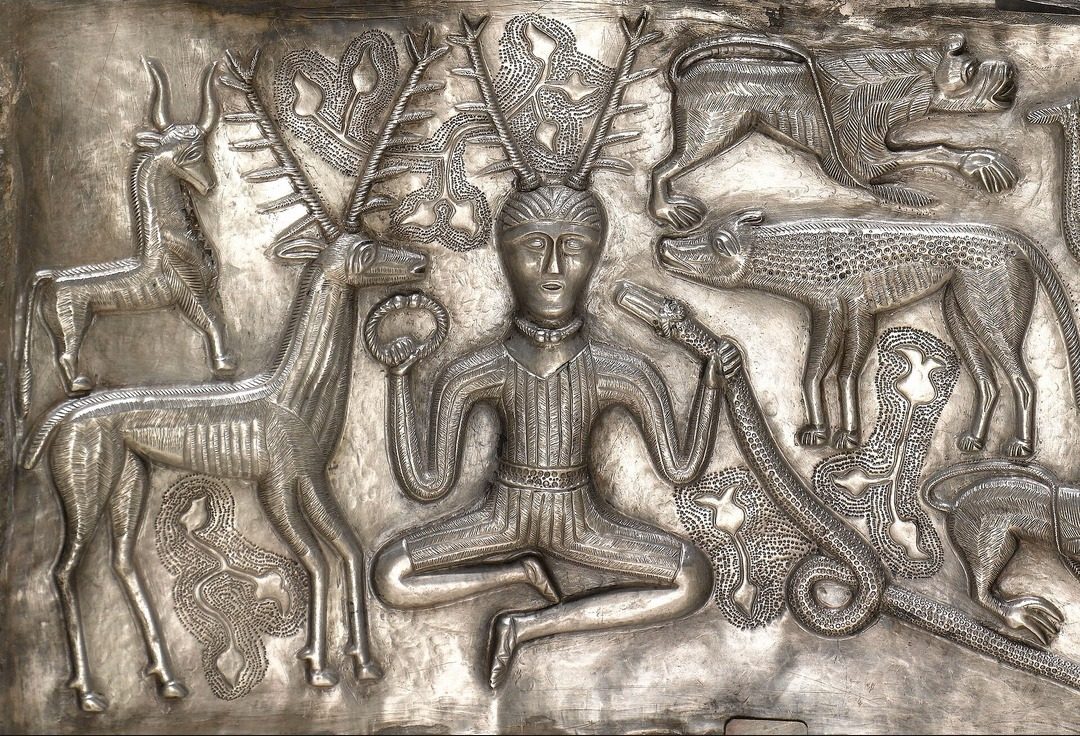
One interior plate shows a seated, antlered man, cross-legged, holding a torc in one hand and a horned serpent in the other, with a stag beside him carrying matching antlers. The figure is routinely nicknamed Cernunnos in popular writing, but that name comes from a different and much later monument entirely — the Pillar of the Boatmen, raised in Paris around the first century AD, more than a hundred years after this cauldron is thought to have been made. Nothing on the Gundestrup cauldron names the antlered figure at all.
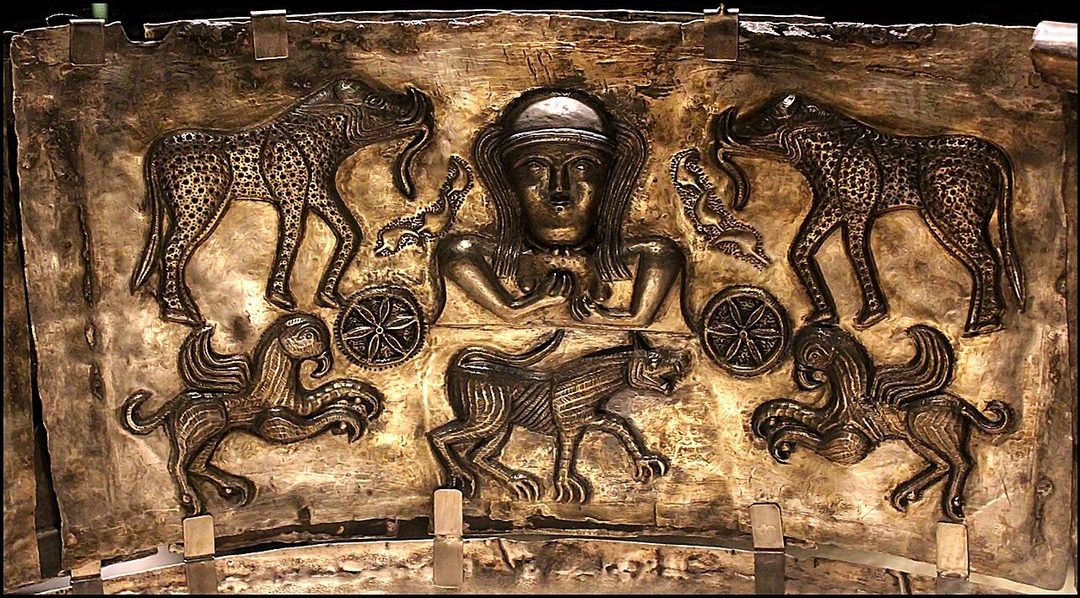
Another plate carries the detail that gives the whole object away as an import: a woman’s bust, wearing a torc, flanked by two spoked wheels, two griffins, and two elephants. Nobody working metal in Jutland around the turn of the millennium had ever encountered an elephant. Whoever designed this plate had, which places the design, if not necessarily the burial, a very long way south and east of where the cauldron was finally put in the ground.
A third interior plate shows a bearded man gripping a broken, spoked wheel, a much smaller figure in a horned helmet reaching for its rim, and griffins and hyena-like beasts crowding the space around them. Some scholars have guessed at a wheel-god, in the rough shape of the Gaulish deity Taranis described centuries later by the satirist Lucian, but the identification is a guess layered on a guess, not a reading anyone can confirm.
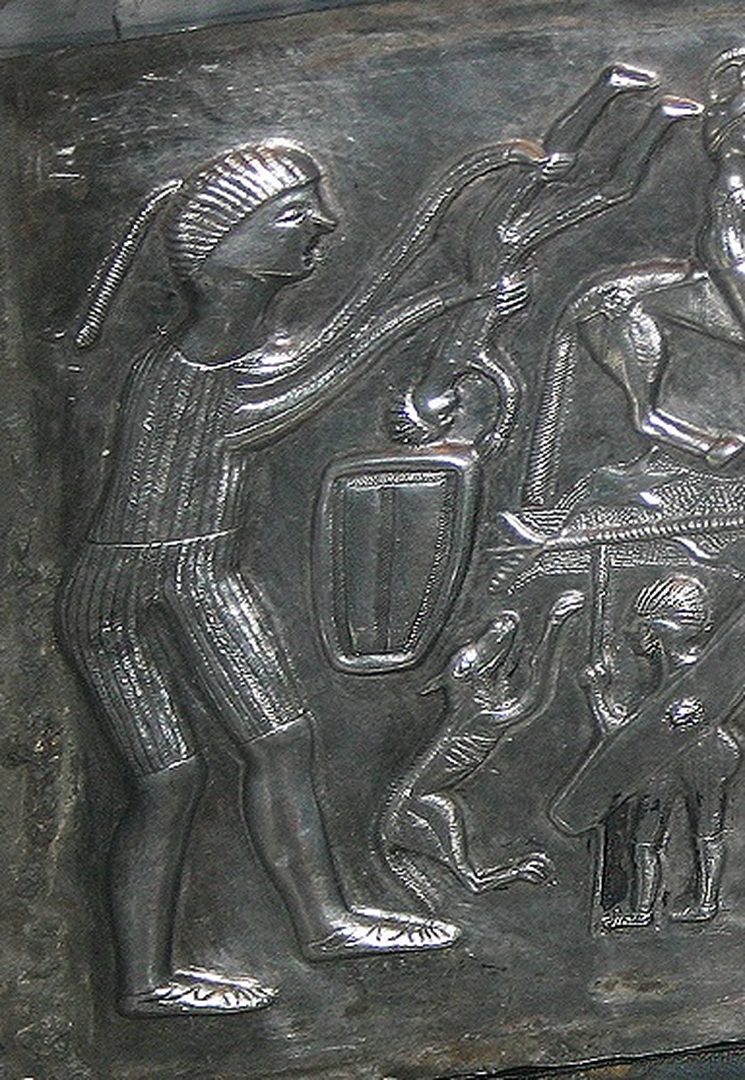
The most argued-over scene runs along one of the long interior plates: a file of spear-and-shield-carrying warriors marches behind several men blowing carnyxes — the long Celtic war-trumpets cast in the shape of animal heads — while at one end of the procession a figure drawn far larger than the rest holds a smaller man upside down over a vessel, apparently about to submerge him head-first. A tree stands above the scene; a line of mounted riders runs below it. Several scholars read this as a myth of death and renewal — warriors fallen in battle, dipped into the vessel, and returned to life to march again — though, as with most of the cauldron’s imagery, no inscription confirms it.
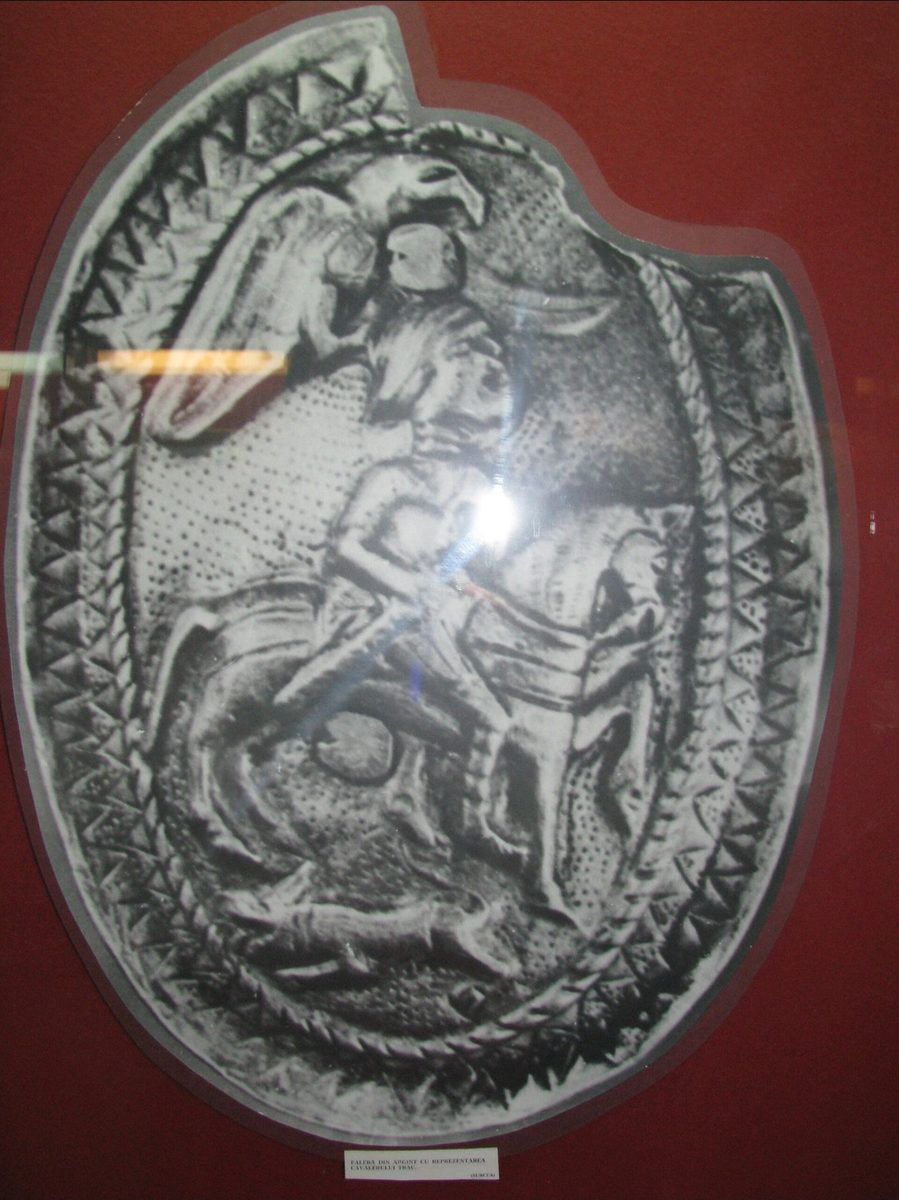
The base plate, stamped with a bull under attack from a sword-wielding figure and three dogs, one of them apparently already dead beneath the bull’s hooves, rounds out the best-preserved scenes. Across all of it, motifs borrowed wholesale from Greek and Near Eastern art — a boy riding a dolphin, scrolling ivy ornament, the griffins themselves — sit next to unmistakably Celtic material like the carnyxes and the torcs. No single, agreed story ties the plates together, and most specialists now doubt that one ever did.
Thracian Hands on Celtic Subjects
That mismatch — recognisably Celtic subject matter, built with a technique nobody can find in any known Celtic workshop — is the whole engine of the authorship debate. The sheet silver construction, the deep repoussé relief, and the fine punched surface decoration don’t resemble La Tène Celtic metalwork so much as they resemble Thracian silver vessels from what is now Bulgaria and Romania — the same kind of puzzle raised by the Ulfberht swords, where a manufacturing technique shows up somewhere nobody expected it to travel.
Archaeologists Anders Bergquist and Timothy Taylor made the technical case explicitly in 1987, pointing to close parallels with Thracian silver hoards such as the Rogozen treasure in north-west Bulgaria, and proposed that the Scordisci — a Celtic people settled on the lower Danube, neighbouring Thracian populations and their silversmiths — commissioned local Thracian craftsmen to build a vessel carrying Celtic imagery in a technique their own smiths didn’t practise.
That wasn’t the starting assumption. Ole Klindt-Jensen’s 1959 reassessment of the cauldron, published decades before the Thracian argument reframed the debate, worked from a Gallic and Celtic milieu as the default explanation, in keeping with how thoroughly Celtic the imagery reads at a glance. A later rival case, made by Garrett Olmsted, argues the opposite geography entirely: he reads stylistic parallels to Coriosolite coinage struck in Armorica, in what is now Brittany, as evidence the cauldron was built in north-west Gaul, with the seafaring Veneti people proposed as the makers or the traders who moved it.
The National Museum of Denmark’s own current position splits the difference rather than choosing a side: it describes the cauldron as most likely made somewhere Celtic and Thracian populations lived in close contact, probably in south-west Romania or north-west Bulgaria. That is a geographic compromise, not a resolution, and the museum says so directly: where, precisely, the cauldron was made remains an open question.
How a War Trophy Ends Up in a Bog
Even a confident answer to where the cauldron was built leaves the harder question untouched: how did it travel roughly a thousand kilometres to a bog in Jutland? The Bergquist-and-Taylor theory offers one route. The Cimbri, a people Roman writers repeatedly place in Jutland, are recorded fighting their way through the Balkans in the late second century BC, clashing with the Scordisci around 118 BC during a long migration before eventually turning back north and west. If the Scordisci owned the cauldron by then, a defeat at Cimbric hands is one plausible way it changed hands, making the journey home as plunder rather than trade goods.
Plunder is not the only option. A vessel this valuable could equally have moved north as a diplomatic gift to a powerful local chieftain, passed on again by inheritance or exchange over one or two further generations, with whatever story explained its origin fading with each hand it passed through. Both explanations are consistent with everything that’s actually been found; neither can be confirmed by it.
What the dismantling adds is a final, deliberate full stop. Whoever buried the cauldron in Rævemosen didn’t lose it and didn’t hide it to come back for later. They took it apart, stacked the pieces inside the bowl, and sank the whole arrangement into water that was, at the time, dry ground. The National Museum states plainly that it doesn’t know how the cauldron reached Denmark. That the people who buried it chose never to see it whole again is the one part of the story the object itself settles.
Watch the full history
The video version walks through the plates in sequence and lays out the Thracian-manufacture case in full.

Related reading
- Who Made the Gundestrup Cauldron? The Mystery Nobody Has Solved
- The Carnac Stones Are Older Than Stonehenge. Nobody Knows What They Were For.
- What the Tarim Mummies’ DNA Actually Revealed
- The Purpose of the Longyou Caves Is Still Not Settled
Works cited
- Bergquist, Anders K., and Timothy F. Taylor. “The Origin of the Gundestrup Cauldron.” Antiquity 61, no. 231 (1987): 10–24. Link.
- Klindt-Jensen, Ole. “The Gundestrup Bowl: A Reassessment.” Antiquity 33, no. 131 (1959): 161–169. Link.
- Olmsted, Garrett. The Gundestrup Cauldron: Its Archaeological Context, the Style and Iconography of Its Portrayed Motifs, and Their Narration of a Gaulish Version of the Táin Bó Cúailnge. Bonn: Rudolf Habelt Verlag, 1979.
- Taylor, Timothy. “The Gundestrup Cauldron.” Scientific American 266, no. 3 (March 1992): 84–89. Link.
- National Museum of Denmark. “The Gundestrup Cauldron.” Link.
- National Museum of Denmark. “The Dating and Origin of the Silver Cauldron.” Link.