
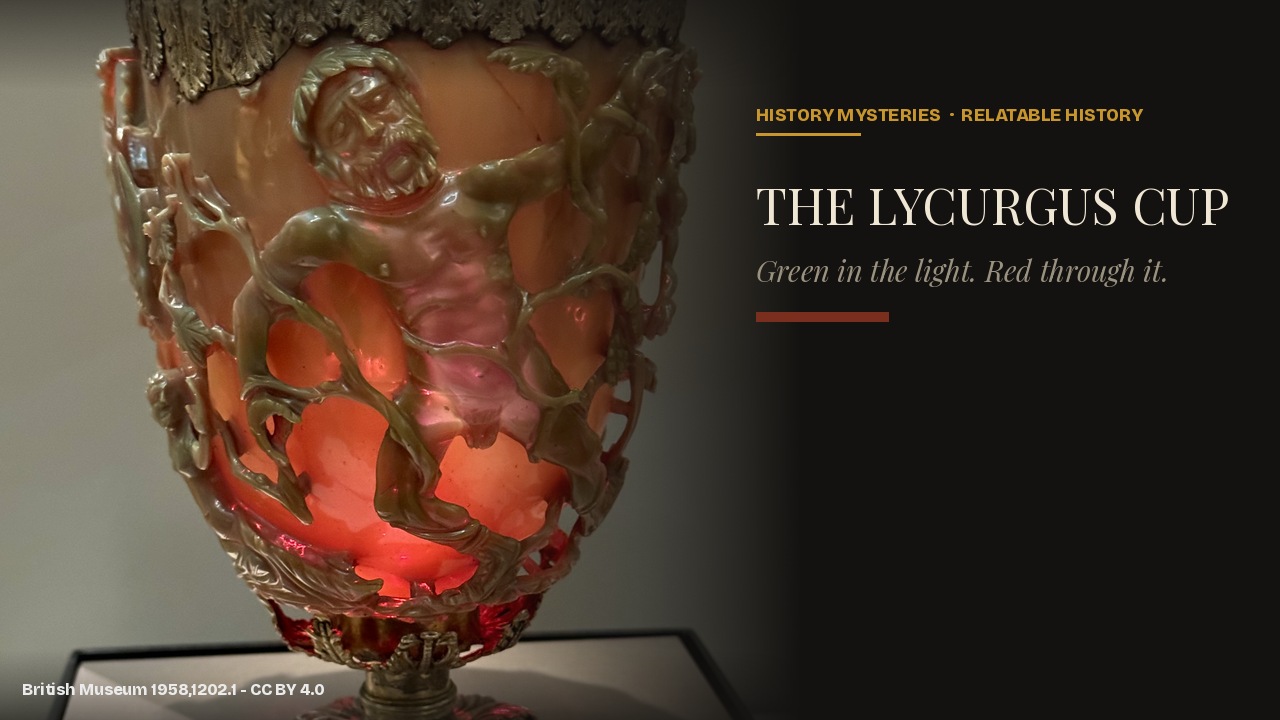
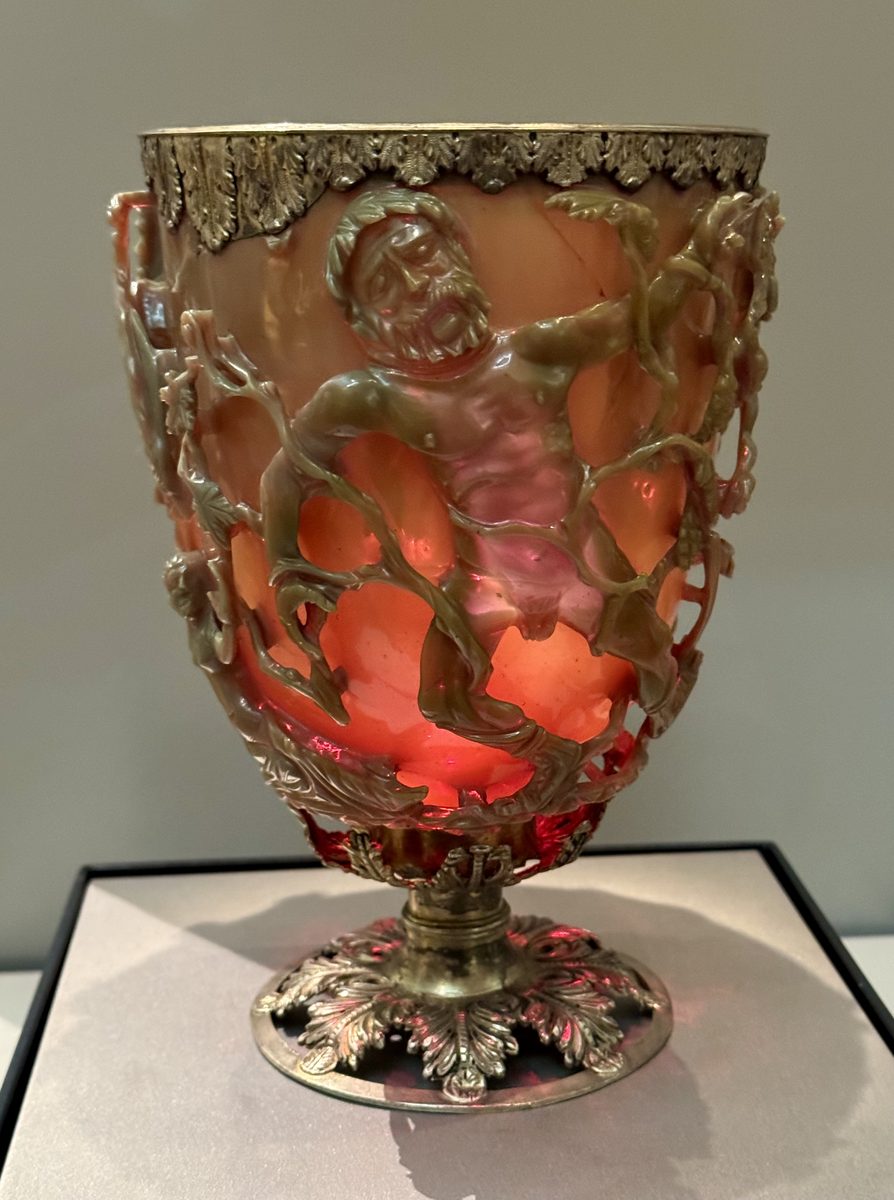
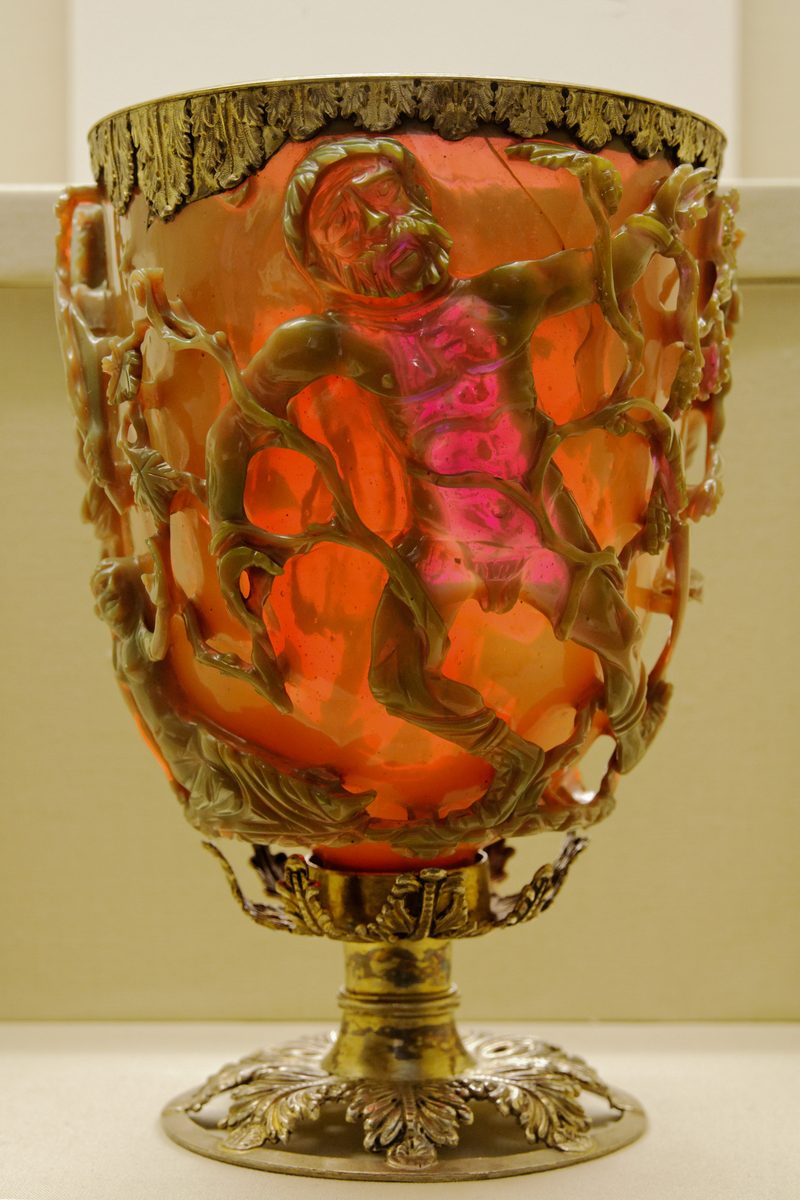
The British Museum keeps a fourth-century Roman drinking cup that does something no piece of ancient glass should be able to do. Lit from the front, it is a flat, slightly murky jade green. Put a light behind it instead, and the same object glows the color of red wine. The glass has not moved, and nothing has been swapped out. The only thing that changed is where the light is coming from.
For most of the time anyone has written about it, nobody could say why. The cup — known as the Lycurgus Cup, after the mythical king carved into its surface — sat in private collections and then in a museum case for more than a century before a 1990 laboratory study finally identified what was hiding inside the glass itself. That answer turned out to be one of the odder discoveries in the history of materials science: the Romans had, apparently without a word for it, built something close to a nanotechnology device.
What the chemistry cannot explain is almost everything else about the object — who made it, how the cage of glass figures was cut free of the cup wall beneath it, or why, for roughly a century of its documented existence, nobody in the scholarly world seems to have looked at it twice.
The color change comes from metal hidden in the glass, not from any mineral
The Lycurgus Cup is what specialists call a cage cup, or diatretum: a drinking vessel with an inner wall and an outer decorative lattice standing almost free of it, connected only by small bridges of glass. Roughly fifty cage cups are known to survive at all, most as fragments, and the Lycurgus Cup is the only complete one carved with a figural scene rather than a plain geometric net. At the British Museum it is catalogued as 1958,1202.1: 15.9 centimeters tall, 13.2 centimeters across at its widest, and 700 grams, with a silver-gilt rim band and a silver-gilt foot of open vine leaves added well after the glass itself was made.
Because color-changing glass this dramatic has no obvious parallel in the ancient world, some of the cup’s earlier observers assumed it could not be glass at all, and guessed instead at a carved semi-precious stone. It is, in fact, ordinary soda-lime Roman glass in every respect except one: scattered through it, invisible to the eye and to any microscope available before the twentieth century, is metal.
A 1990 electron microscope study finally explained the trick
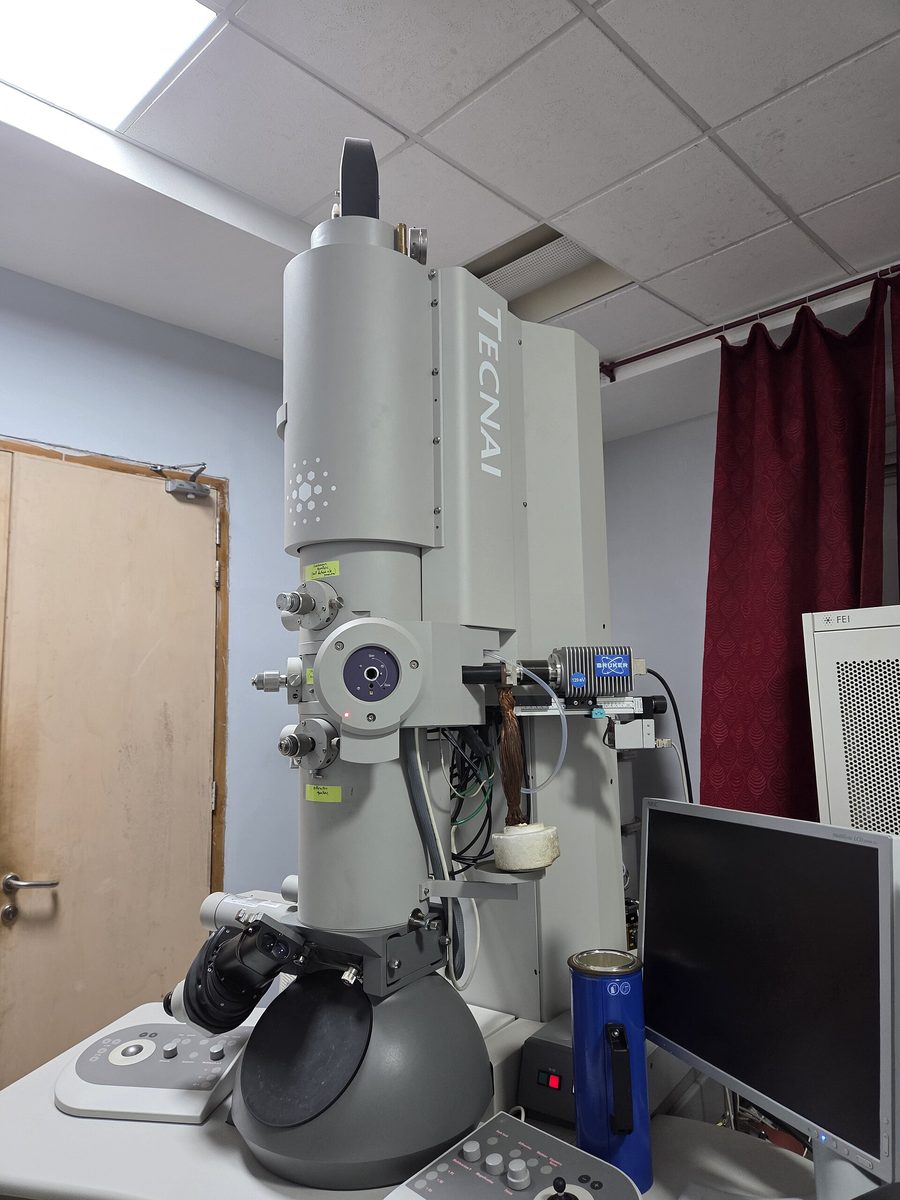
In 1990, the materials scientists D. J. Barber and Ian Freestone examined tiny fragments of the cup’s glass under a transmission electron microscope — an instrument that can resolve detail far below what visible light itself can show. What they found were particles of a silver-gold alloy roughly 70 nanometers across, woven through the glass at almost absurdly low concentration: on the order of 330 parts per million of silver and 40 parts per million of gold, estimated against a standard Roman glass flux.
Seventeen years later, a follow-up study by Freestone and three co-authors, published in the trade journal Gold Bulletin, worked out the physics in modern terms. Particles that size interact with visible light through a mechanism called surface plasmon resonance: the free electrons in the metal oscillate in step with the light’s wavelength, and particles of roughly this diameter scatter shorter, green wavelengths back toward the viewer while letting longer, red wavelengths pass straight through. Light the cup from the front and you see the scattered green. Light it from behind and you see the red that made it through. Nothing about the glass changes between the two; only which half of the light you are catching does.
It is a strikingly similar trick to the one later identified, independently, in the dating puzzle around the Great Pyramid’s hidden chamber, where a modern physics instrument — there, cosmic-ray muon detectors rather than an electron microscope — was what finally let researchers see something a visitor’s eye never could.
Nobody can prove whether the gold was put there on purpose
Knowing the mechanism does not settle the more interesting question: did a Roman glassworker understand what they were doing, or did they get lucky once and never repeat it?
The case for accident is the concentration itself. Forty parts per million of gold is not a recipe measurement; it is closer to a contamination level. Roman silver of the period routinely carried trace gold as an impurity from its ore, and a workshop that melted scrap silver, or reused a crucible that had previously held a metalworking batch, could easily have introduced exactly this kind of trace alloy into a glass melt without ever intending to. A handful of other Roman dichroic glass fragments are known besides the Lycurgus Cup, and they do not agree closely with one another on the exact shade each produces — the kind of inconsistency that fits an uncontrolled process rather than a guarded formula.
The case against pure accident is that this is an extraordinarily difficult effect to reproduce even once by chance, in an object important and expensive enough to be fitted with precious-metal mounts and carved with a mythological narrative that may have carried real political weight (more on that below). No ancient text describes how the glass was made, and no workshop record survives to settle it either way. The honest answer, repeated by nearly everyone who has studied the cup since 1990, is that the evidence runs out before the question does.
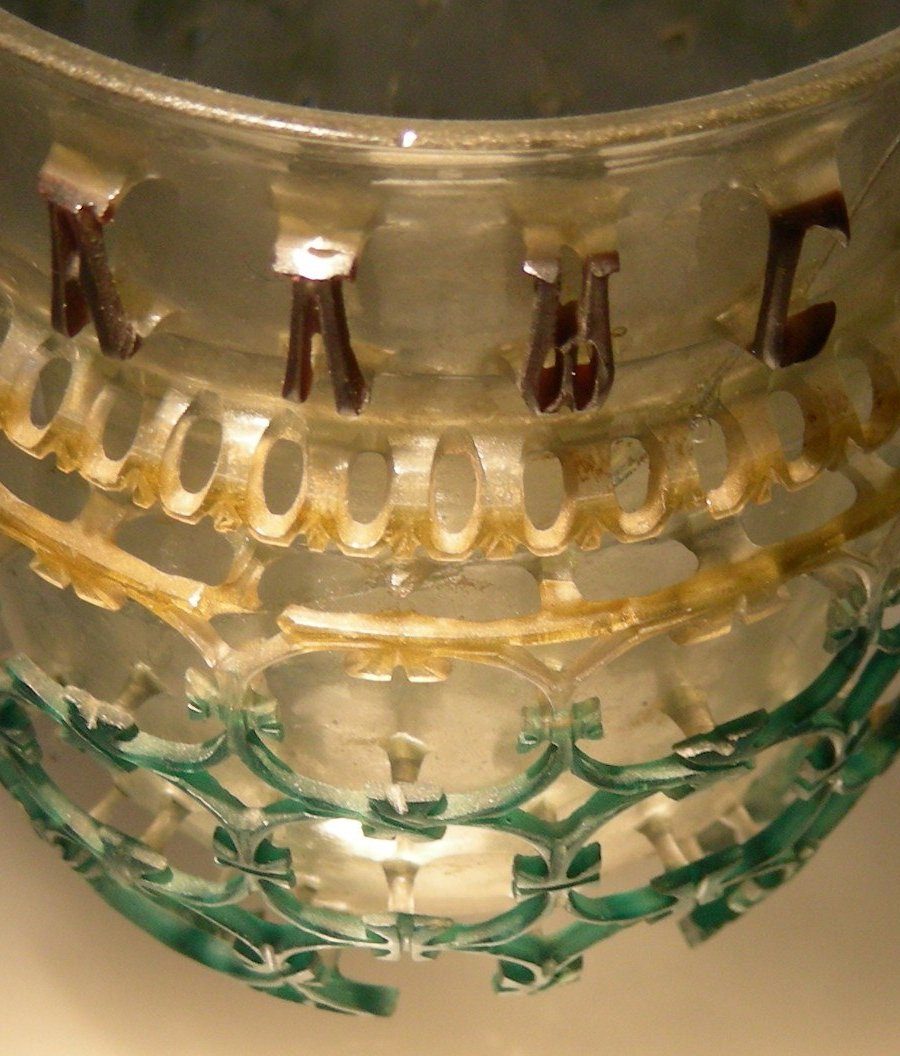
Cutting the cage free of the cup is a separate, still-unsolved problem
The color is not the only mystery. How the diatretum itself was physically made is a long-running argument among glass historians, almost entirely separate from the chemistry question.
The traditional account, going back to the nineteenth century, holds that a cage cup began as a single, unusually thick glass blank, which a second workshop then spent months grinding and cutting away — first roughing out the figures, then undercutting them until they stood nearly free of the wall, connected by only a few deliberately preserved struts. One mistake late in that process could destroy months of labor in an instant. D. B. Harden, one of the cup’s first serious students, noted that the glass behind the figures on the Lycurgus Cup had been hollowed out to keep the background color even in transmitted light — a step he described as an afterthought, as if the cutters discovered the need for it partway through the job rather than planning for it from the start.
The glass researcher Rosemarie Lierke challenged that account in a 1995 paper, arguing that cutting from one solid thick blank does not match features visible on several surviving cage cups. She proposed instead that the blanks were formed as a double-shelled vessel, shaped hot on a turning wheel, with the final cage cut from that pre-shaped form rather than from a solid mass — evidence, in her view, that a wheel-turning glass tradition had been revived in late antiquity. The debate has not been resolved in either direction: a cage-cup fragment from Corinth shows no sign of the joins her two-shell theory would predict, while other examples, including one in Cologne, have been cited on her side of the argument.

What modern labs have managed is a different kind of reproduction. In 2020, a Dutch research team led by Venkatesan Saggiomo embedded silver and gold nanoparticles in a 3D-printable polymer and printed a small cup that showed the same green-reflected, red-transmitted effect, at roughly a 90-to-10 ratio of silver to gold. It proved the chemistry can be deliberately engineered with today’s tools. It did nothing to explain how a Roman workshop, with no electron microscope and no theory of nanoparticles, managed the cutting — which remains exactly the kind of inherited, undocumented craft knowledge that shows up again and again in ancient technology, from the still-debated purpose behind why Karahan Tepe was deliberately buried to the equally unresolved carving methods behind other enigmatic worked-stone objects like the stone spheres of Costa Rica.
The scene carved into the glass may be making a political point
The cup is not decorated at random. It shows the death of Lycurgus, a mythical king of Thrace who attacked Ambrosia, a follower of the wine-god Dionysus, for interfering with his kingdom. Ambrosia is transformed into a vine, which grows up around the king and strangles him while a satyr prepares to hurl a rock and Dionysus himself looks on, taunting Lycurgus with his staff. Several Roman floor mosaics — at Piazza Armerina in Sicily, at Antioch, and elsewhere — show the same myth, so the image itself was not unusual. What is unusual is putting it on an object that performs its own small transformation every time it is moved from daylight to lamplight.
Some historians have connected the choice of scene to a specific political moment: the emperor Constantine’s defeat of his rival Licinius in 324, read as a tyrant brought down much as Lycurgus was. Others point instead to the cup’s likely use at a Bacchic feast, where the color shift from green to red would have echoed grapes ripening on the vine in front of the diners’ eyes. A passage in the Historia Augusta — a late Roman text whose reliability historians have long treated with suspicion — even describes dichroic cups being used at banquets, though it is attached to a supposed letter from Hadrian that most scholars doubt is genuine. None of these readings excludes the others, and none is provable from the object alone.
A cup that vanished from scholarship for roughly a century
The Lycurgus Cup’s paper trail is almost as patchy as its manufacturing record. The earliest known printed mention of it dates to 1845, when a French writer described seeing it in Paris in the hands of a Monsieur Dubois. No earlier owner, no find spot, and no excavation record of any kind has ever surfaced; the cup simply appears in the documentary record already in private hands. Its silver-gilt rim and foot, by most assessments, were added around the year 1800, possibly reusing metalwork taken from church treasuries during the upheavals of the French Revolution, though that specific link is a reasonable guess rather than a documented fact.
Shortly after the 1845 mention, the cup passed to the Rothschild banking family. Lionel de Rothschild owned it by 1857, when the German art historian Gustav Friedrich Waagen inspected it and recorded his verdict as barbaric and debased — a judgment aimed at least partly at the added mounts rather than the ancient glass underneath them. Lionel lent the cup for public display twice in this period, and then it largely dropped out of scholarly literature for close to a century; a major early-twentieth-century survey of ancient glass could not even arrange to examine it.
The cup resurfaced for serious study only around 1950, when researchers worked from a fresh set of photographs. D. B. Harden and Jocelyn Toynbee published the first thorough scholarly treatment in 1959, running to more than thirty pages in the journal Archaeologia. A year earlier, in 1958, Victor Rothschild had sold the cup to the British Museum for £20,000, of which £2,000 was contributed by what is now the Art Fund. Museum conservators removed the cup’s foot that same year for study and did not reattach it until 1973. The glass itself remains cracked to this day, which is the reason its metal rim has never since been taken off.
Watch the full history
The video version covers the color-change discovery and the unresolved cutting debate in just over eight minutes.
httpv://www.youtube.com/watch?v=_i–qEWWCsA
Related reading
- Scientists Know Exactly When the Sky Went Dark in 536 AD. They Still Don’t Know Why. — a very different ancient mystery that modern instruments, not ancient texts, finally cracked
- The Nebra Sky Disc Dating Dispute, Explained — another case of a scientific measurement on an old object turning into its own long-running dispute
- What Happened to Rome’s Lost Ninth Legion? — a Late Roman disappearance with just as thin a documentary trail as the cup’s own early history
- Why No One Has Ever Deciphered the Indus Valley Script — an ancient artifact whose meaning several independent teams still cannot agree on
No consumer book exists specifically about the Lycurgus Cup, and no faithful replica of it is currently sold, so this article carries no shop section.
Works cited
- Harden, D. B., and Jocelyn M. C. Toynbee. “The Rothschild Lycurgus Cup.” Archaeologia 97 (1959): 179–212. Link.
- Barber, D. J., and I. C. Freestone. “An Investigation of the Origin of the Colour of the Lycurgus Cup by Analytical Transmission Electron Microscopy.” Archaeometry 32, no. 1 (1990): 33–45.
- Freestone, Ian, Nigel Meeks, Margaret Sax, and Catherine Higgitt. “The Lycurgus Cup — A Roman Nanotechnology.” Gold Bulletin 40 (2007): 270–277. Link.
- Lierke, Rosemarie. “One More Time — The Making of the Diatreta Cups.” Glass Science and Technology 68 (1995): 195–204. Link.
- Scott, Gerry D. “A Study of the Lycurgus Cup.” Journal of Glass Studies 37 (1995): 51–64.
- Whitehouse, David. Cage Cups: Late Roman Luxury Glasses. Corning, NY: Corning Museum of Glass, 2015.
- Kool, Lonneke, Floris Dekker, Anne Bunschoten, Glen J. Smales, Brian R. Pauw, Aldrik H. Velders, and Venkatesan Saggiomo. “Gold and Silver Dichroic Nanocomposite in the Quest for 3D Printing the Lycurgus Cup.” Beilstein Journal of Nanotechnology 11 (2020): 16–23. Link.
- Elsner, Jaś. “The Lycurgus Cup.” In New Light on Old Glass: Recent Research on Byzantine Mosaics and Glass, edited by Chris Entwistle and Liz James. British Museum Research Publication 179. London: British Museum Press, 2013.
- British Museum. “Cup; 1958,1202.1” (collection record).