
How much firewood heated a farmhouse through a single nineteenth-century winter? By the most common historical estimate, an ordinary farmhouse with no coal furnace and no oil tank burned somewhere between ten and fifteen cords of wood every winter. Corded four feet high and four feet deep, that much wood would run forty to sixty feet down a farmyard — and every log in it had already been cut, hauled, split, and left outside to dry for the better part of a year before anyone let it near a stove.
That single rule — never burn what you only just cut — is the entire reason the woodshed existed, and it turned something as ordinary as a woodpile into a yearlong logistics problem. Misjudge the timing and a household could run out of usable fuel in the coldest week of the year, with nothing left to burn but wet, hissing green wood. Misjudge the volume in the other direction and a family had spent an entire autumn’s labor on more cords than the house would ever need.
What follows is the part of that story the numbers tell on their own: how much heat a cord of wood actually holds, where the shed itself came from architecturally, the one documented New England woodshed detailed enough to outlast the building it belonged to, and why historians still can’t fully agree on what a winter’s firewood was worth.
How Much Firewood Heated a Farmhouse, in Hard Numbers
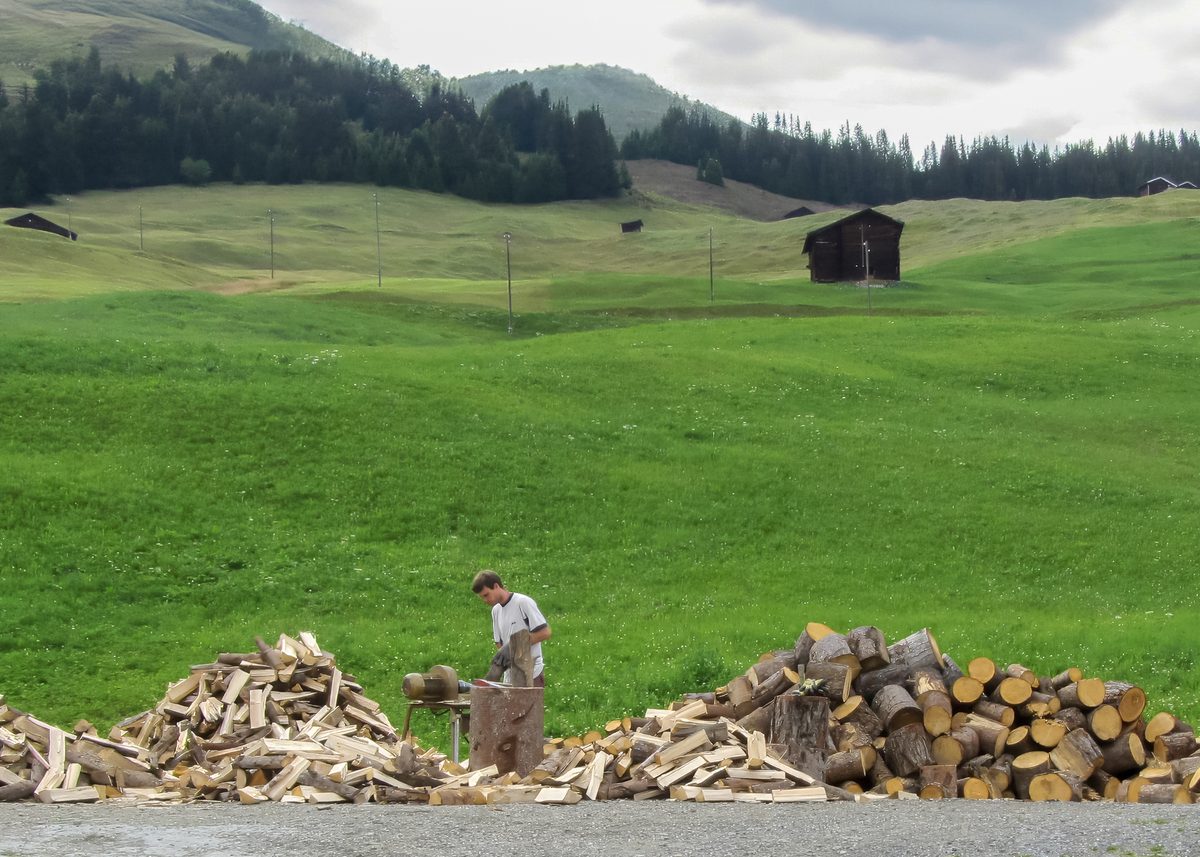
A cord of well-seasoned hardwood — stacked logs filling the 128 cubic feet the firewood trade has used as its standard measure for centuries — holds a specific, if contested, amount of heat. The University of Missouri Extension’s current wood-fuel guide puts it at roughly 11.4 million available BTUs per cord of air-dried hardwood at around 20 percent moisture, burned at an ordinary stove’s efficiency; converted into a fuel most readers can picture, that works out to the heat value of about 108 gallons of home heating oil. Other extension bulletins and household guides quote somewhat different totals for the same cord, because the number moves with the species burned, how dry “seasoned” actually means in practice, and how efficiently a given firebox converts fuel to usable heat. There isn’t one official figure so much as a consistent neighborhood of them.
Burn the same log before it has finished drying and that heat value collapses, because a freshly felled log can be as much as half water by weight. A large share of the fire’s own output then goes into boiling that water off before the wood can burn hot at all, which is why green wood smokes, hisses, and burns cool and dirty instead of clean. The steam it throws off condenses partway up a flue that a seasoned fire would otherwise keep hot enough to stay dry, leaving behind the tar and soot — creosote — that causes most chimney fires. None of this was folklore to a farm family; it was the entire argument for spending a summer’s labor stacking wood outdoors to dry rather than simply cutting it and burning it as needed.
A Building Designed to Be Walked Through, Not Just Into
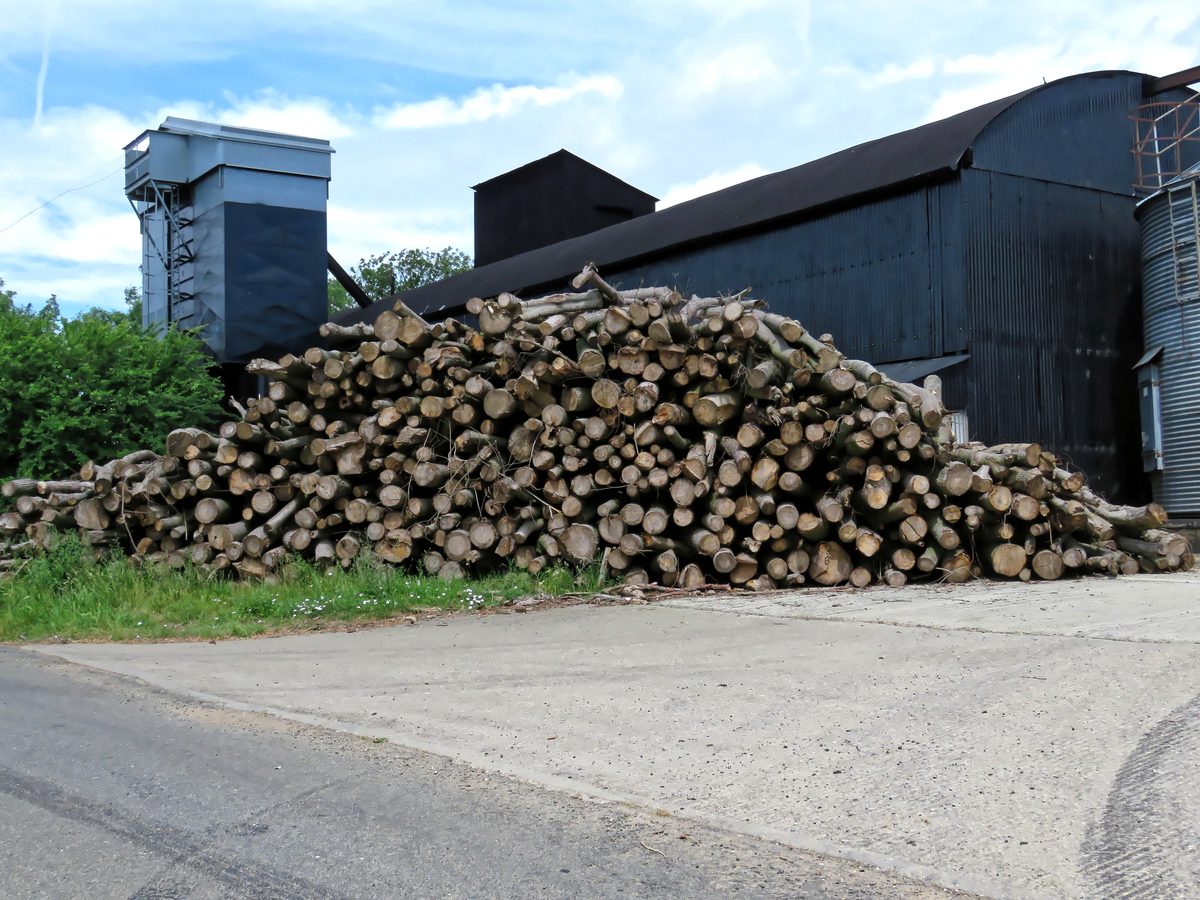
Where the shed stood mattered almost as much as what was kept in it. The architectural historian Thomas Hubka’s study of New England farmhouses, Big House, Little House, Back House, Barn, documents a regional building pattern in which a farm’s woodshed was rarely a stand-alone structure at all — it was one link in a chain of connected buildings running from the kitchen, through the woodshed, to the barn, so a family could move between house and livestock without stepping outside into a blizzard. One end of the shed was frequently left open on purpose, wide enough for an ox sled or a loaded wagon to drive straight through and dump a winter’s haul of logs without anyone shoveling a path first.
The shed held more than fuel. At least one documented farmhouse describes a brick arch built into a woodshed wall, holding a cast-iron kettle used for laundry, for scalding hogs at hog-killing day, and for rendering lard — the same outbuilding doing triple duty as the farm’s overflow kitchen for jobs too big, too smoky, or too smelly for the one indoors. None of this architecture needed to be attractive. Boards were typically left rough-sawn and unpainted, with deliberate gaps between them, because a shed sealed tight enough to block the wind would also have sealed in the moisture a stack of curing firewood was supposed to be losing.
The One Woodshed Detailed Enough to Outlast Argument
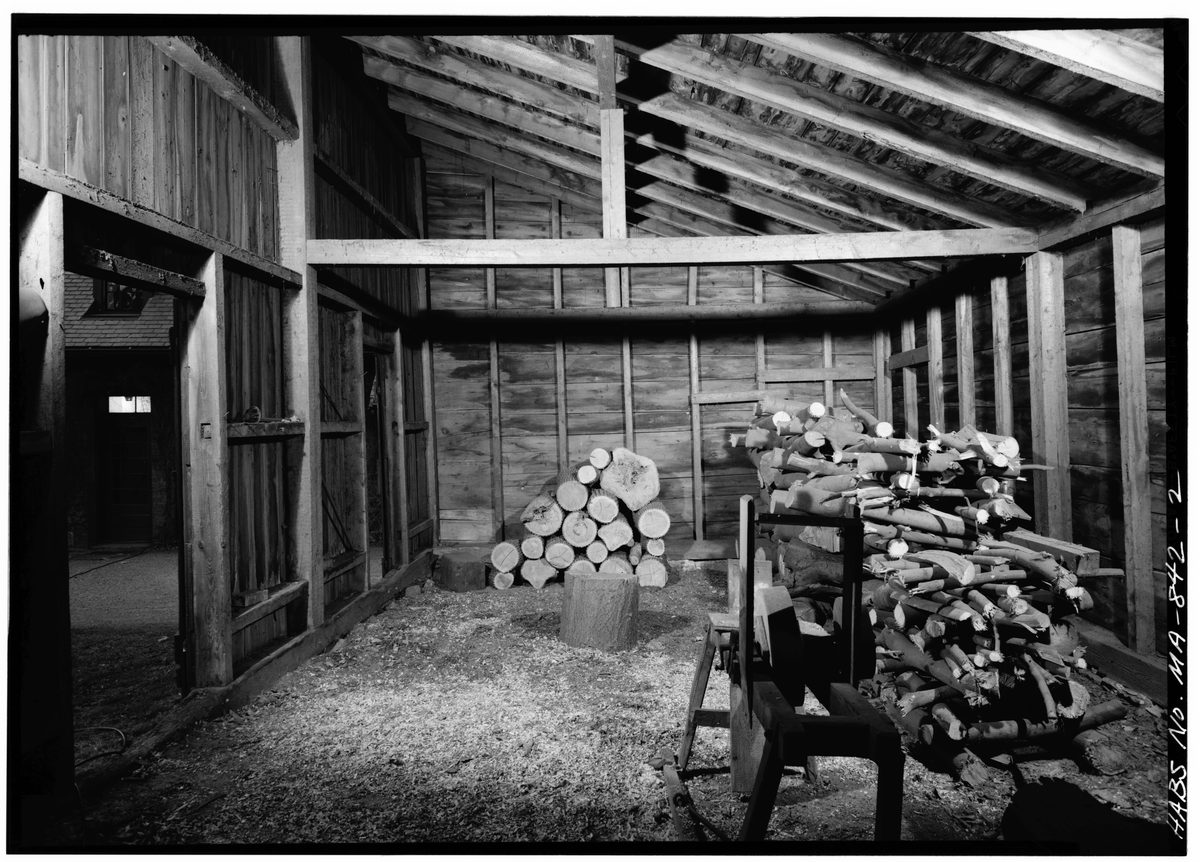
Most nineteenth-century woodsheds left no paper trail at all — they were plain outbuildings nobody thought worth recording, and most were eventually torn down or quietly repurposed into garages once nobody needed them. One exception survives in unusually exact documentary detail: the woodshed at the Adams family’s homestead in Quincy, Massachusetts, the house where both John Adams and John Quincy Adams lived, recorded by the Library of Congress as HABS No. MA-615. Historic American Buildings Survey teams — the Depression-era federal program that sent out-of-work architects out to measure and photograph historic American buildings starting in 1933 — gave the property’s woodshed two sheets entirely to itself, a general exterior view and a photographed interior, among the 38 images and 28 measured drawings the survey produced for the homestead as a whole.
That level of attention is unusual for a building this ordinary, and it means a shed that functioned exactly like the thousands of anonymous ones scattered across rural New England now exists in enough photographic and measured detail that its framing, proportions, and interior arrangement can be reconstructed from the public record, long after most of its neighbors were demolished without anyone writing them down first.
What Historians Still Argue About Is the Price
How central wood actually was to the American economy, and what a cord of it cost in a given year, turn out to be two of the more contested numbers in American economic history. A 2025 working paper by the economist Nicholas Z. Muller, built from a dataset of more than 6,000 historical price quotations stretching from 1700 to 2010, estimates that the total value of firewood produced in the United States rose from roughly 18 percent of GDP to nearly 30 percent of GDP by the 1830s — a startling share for a single fuel, reflecting how much of the early American economy ran on wood before coal and oil took over, not home heating alone. By the 1880s, Muller finds, that share had collapsed to under 5 percent.
Even the price of a single cord is disputed. Muller’s own data put the national average for 1840 at around four dollars a cord. An influential 1868 estimate by the statistician Ezra Seaman put the same year’s price at roughly half that, about two dollars — a gap that later economic historians who built on Seaman’s figures, including Robert Gallman’s widely used 1960 estimates of nineteenth-century commodity output, inherited without resolving. When Muller matched his own price quotations against the years used in a separate, commonly cited price index that Dorothy Brady compiled in 1966, his quotations averaged nearly five dollars a cord against Brady’s own figure of about $2.25 — a statistically significant, roughly twofold gap between two records of the same commodity in the same years. Real prices in the urban Northeast, meanwhile, climbed by something like 1.6 percent a year between 1800 and 1860, with Boston’s buyers facing the steepest rise of any major market. None of this is a rounding error; it means a firewood-price chart built from a textbook written in 1960 can run twice as high, or twice as low, as one built from the primary sources themselves.
Who Actually Cut, Split, and Carried It
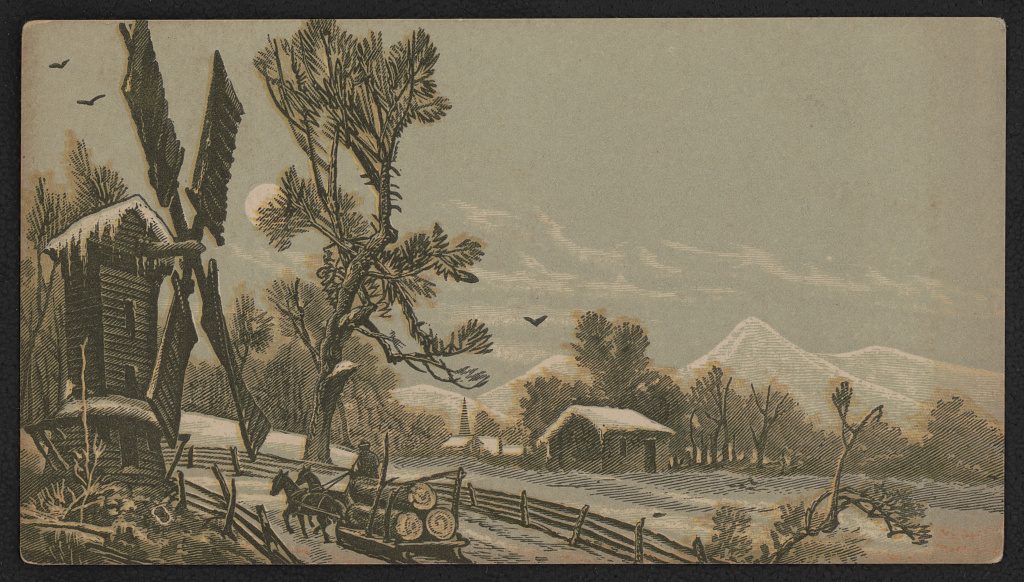
Before any of that wood dried in a shed, somebody had felled it, usually in the dead of winter, when frozen ground and snow let a loaded sled glide where a wagon wheel would have sunk. For most of the nineteenth century the tool of choice was still the axe; the two-person crosscut saw that now seems like the obvious symbol of old-time logging only became a common tool on ordinary farms in the final quarter of the 1800s. Splitting came next, by hand, with a splitting axe and iron wedges driven by a heavy wooden sledge.
Children did a disproportionate share of the ongoing work, and one of the better documented accounts of it comes from Henry A. Shute’s The Real Diary of a Real Boy, a published 1902 memoir of his 1860s boyhood in Exeter, New Hampshire. Shute doesn’t describe the chore as drudgery so much as a running hazard: in one February entry he records being sentenced by his father and a neighbor, a Mrs. Lewis, to “saw and split a cord of wood” as punishment — a sentence serious enough that more boys were recruited to help finish the job over several more days. A separate June entry is shorter and plainer: “i forgot to split my kindlings tonite.” Between the two entries sits the entire adult anxiety about an empty woodbox, inherited by a boy who mostly just treated it as one more thing to forget.
What Finally Made the Shed Unnecessary
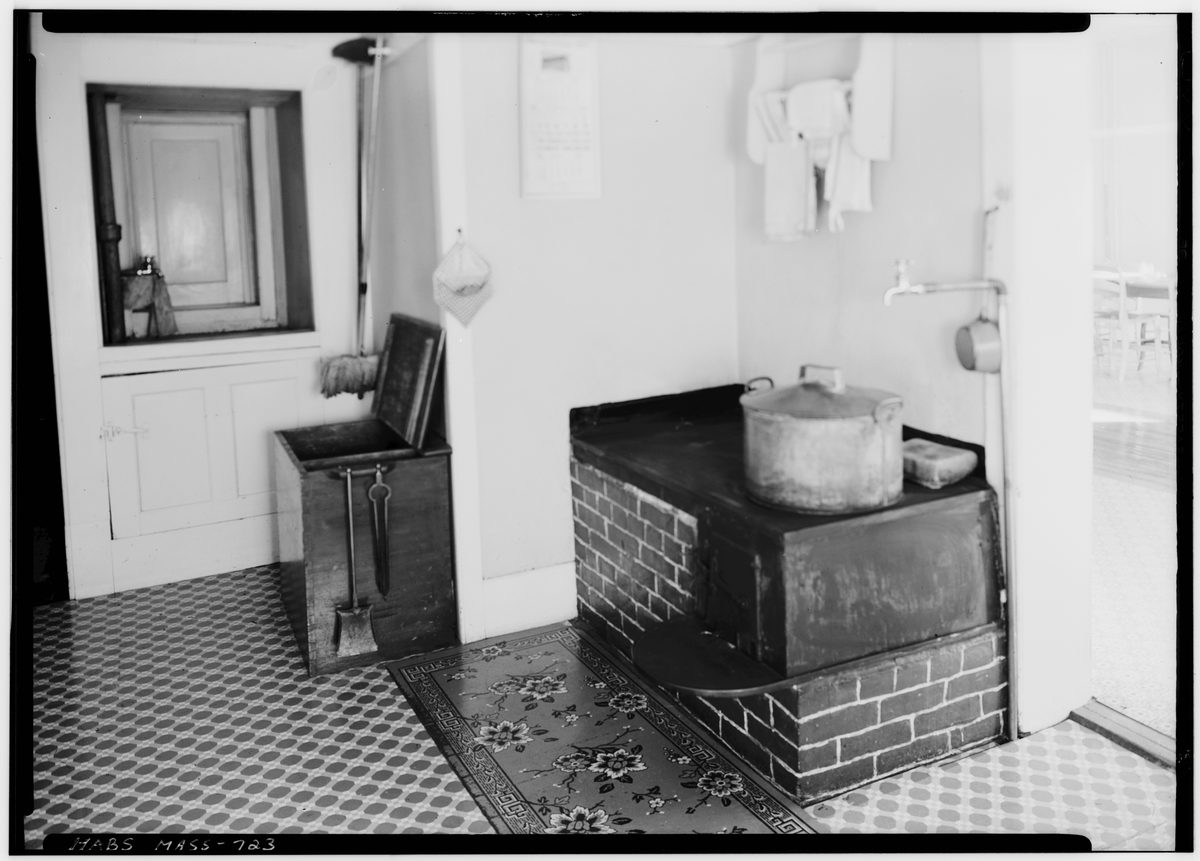
Woodsheds became standard fixtures roughly as cast-iron stoves replaced open hearths across rural America, mostly between the 1830s and the 1870s — a domestic shift the historian Priscilla Brewer traces in detail in From Fireplace to Cookstove, her study of how the cast-iron stove changed, and was changed by, nineteenth-century household life. The incentive was straightforward: a stove held and radiated heat far more efficiently than an open fire, which meant a farm burning ten to fifteen cords a year could do with a stove what an open hearth alone had needed thirty or forty cords to accomplish. (Whether the stove most Americans picture under that story actually originated with Benjamin Franklin is its own, separate argument.) Once a household depended on a stove for its only heat, it also depended, for the first time, on a dry, finished fuel supply sitting ready months in advance — which is what made the shed worth building in the first place.
What emptied the sheds back out wasn’t a better stove. It was the wire. The federal Rural Electrification Administration, whose surviving records the National Archives catalogs as Record Group 221, pushed hard into the countryside starting in 1935, and the oil and propane furnaces that followed it after the Second World War meant a farmhouse no longer needed a full year’s seasoned fuel standing by the back door. A thermostat did overnight what a teenager with an axe had done for a hundred years.
Watch the full history
The video version covers what the shed actually was, how a building with no heat of its own kept a year’s fuel dry, and how long farms depended on it, in about eight minutes.

Most woodsheds met one of two fates once the wire reached them: quiet demolition, or a second life as a garage or a tool shed, their brick kettle-arches bricked over or torn out. What’s left standing is mostly the paperwork — survey sheets, extension bulletins, a diary entry about a boy’s punishment, a disputed price index — rather than the buildings themselves.
That’s worth sitting with for a moment. A woodshed was, in effect, a yearlong energy-storage system built from nothing more than a roof, gapped board walls, and careful timing — the same basic problem every household heating system has to solve, just solved with an axe and a calendar instead of a thermostat and a pipeline. So: how many cords of wood do you think it took to heat a farmhouse through one whole winter?
Related reading
- How Icehouses Worked Before Refrigeration: The Physics, the Industry, and the People Who Cut the Ice
- The 2,000-Year History of the Cold Frame
- How Outdoor Bread Ovens Worked, and Where Owning One Was Against the Law
- Inside the 19th-Century Ice Harvesting Industry’s Boom and Bust
Works cited
- Hubka, Thomas C. Big House, Little House, Back House, Barn: The Connected Farm Buildings of New England. University Press of New England, 1984.
- Historic American Buildings Survey. Adams Mansion, 135 Adams Street, Quincy, Norfolk County, Massachusetts. HABS No. MA-615. Library of Congress, Prints and Photographs Division.
- Shute, Henry A. The Real Diary of a Real Boy. Everett Press, 1902. Link.
- Muller, Nicholas Z. “Firewood in the American Economy: 1700 to 2010.” National Bureau of Economic Research, Working Paper No. 33974, June 2025. Link.
- Smedly, Ursula R., rev. “Firewood Facts.” New Mexico State University Cooperative Extension Service, Guide G-102, 2012. Link.
- Adams, Sean Patrick. Home Fires: How Americans Kept Warm in the Nineteenth Century. Johns Hopkins University Press, 2014.
- National Archives. “Records of the Rural Electrification Administration [Record Group 221].” Guide to Federal Records. Link.
- Stelzer, Hank. “Wood Fuel for Heating.” University of Missouri Extension, Publication G5450, 2017 (reviewed 2025). Link.
- Brewer, Priscilla J. From Fireplace to Cookstove: Technology and the Domestic Ideal in America. Syracuse University Press, 2000.
- National Conference on Weights and Measures. “Get What You Pay For: How to Protect Yourself When Buying Firewood.” Hosted by the Nebraska Department of Agriculture. Link.